Psmith, Journalist by P. G. Wodehouse (romance novel chinese novels txt) 📕
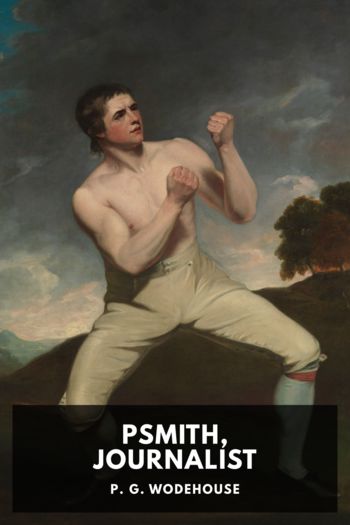
Description
Growing bored while accompanying his Cambridge chum Mike on a cricket tour of the United States, Psmith seeks adventure in New York City. He finds it in the form of the weekly newspaper Cosy Moments, a completely bland and inoffensive publication at which, through charm and sheer force of personality, Psmith appoints himself an unpaid subeditor, fires the entire contributing staff, and embarks on a crusade against the slumlords, gangs, and boxing managers of his holiday destination.
Psmith, Journalist is the second of Wodehouse’s Psmith novels, and is a marked departure from the author’s usual settings and themes. It presents a very strong social justice theme with direct, harsh condemnation of exploitation, corruption, racism, and inequality in early-twentieth century America, and its themes continue to resonate with readers a century later.
The story first appeared in The Captain magazine from October 1909 to February 1910, and was first published as a book, including eight illustrations, by A & C Black in 1915. This Standard Ebook is based on the 1923 edition by the same publisher.
Read free book «Psmith, Journalist by P. G. Wodehouse (romance novel chinese novels txt) 📕» - read online or download for free at americanlibrarybooks.com
- Author: P. G. Wodehouse
Read book online «Psmith, Journalist by P. G. Wodehouse (romance novel chinese novels txt) 📕». Author - P. G. Wodehouse
There was but one thing to be done. Reluctant as they might be to abandon their fallen leader, they must tear themselves away. Already they were suffering grievously from the stick, the blackjack, and the lightning blows of the Kid. For a moment they hung, wavering; then stampeded in half a dozen different directions, melting into the night whence they had come.
Billy, full of zeal, pursued one fugitive some fifty yards down the street, but his quarry, exhibiting a rare turn of speed, easily outstripped him.
He came back, panting, to find Psmith and the Kid examining the fallen leader of the departed ones with the aid of a match, which went out just as Billy arrived.
“It is our friend of the earlier part of the evening, Comrade Windsor,” said Psmith. “The merchant with whom we hobnobbed on our way to the Highfield. In a moment of imprudence I mentioned Cosy Moments. I fancy that this was his first intimation that we were in the offing. His visit to the Highfield was paid, I think, purely from sport-loving motives. He was not on our trail. He came merely to see if Comrade Brady was proficient with his hands. Subsequent events must have justified our fighting editor in his eyes. It seems to be a moot point whether he will ever recover consciousness.”
“Mighty good thing if he doesn’t,” said Billy uncharitably.
“From one point of view, Comrade Windsor, yes. Such an event would undoubtedly be an excellent thing for the public good. But from our point of view, it would be as well if he were to sit up and take notice. We could ascertain from him who he is and which particular collection of horny-handeds he represents. Light another match, Comrade Brady.”
The Kid did so. The head of it fell off and dropped upon the upturned face. The hooligan stirred, shook himself, sat up, and began to mutter something in a foggy voice.
“He’s still woozy,” said the Kid.
“Still—what exactly, Comrade Brady?”
“In the air,” explained the Kid. “Bats in the belfry. Dizzy. See what I mean? It’s often like that when a feller puts one in with a bit of weight behind it just where that one landed. Gum! I remember when I fought Martin Kelly; I was only starting to learn the game then. Martin and me was mixing it good and hard all over the ring, when suddenly he puts over a stiff one right on the point. What do you think I done? Fall down and take the count? Not on your life. I just turns round and walks straight out of the ring to my dressing room. Willie Harvey, who was seconding me, comes tearing in after me, and finds me getting into my clothes. ‘What’s doing, Kid?’ he asks. ‘I’m going fishin’, Willie,’ I says. ‘It’s a lovely day.’ ‘You’ve lost the fight,’ he says. ‘Fight?’ says I. ‘What fight?’ See what I mean? I hadn’t a notion of what had happened. It was a half an hour and more before I could remember a thing.”
During this reminiscence, the man on the ground had contrived to clear his mind of the mistiness induced by the Kid’s uppercut. The first sign he showed of returning intelligence was a sudden dash for safety up the road. But he had not gone five yards when he sat down limply.
The Kid was inspired to further reminiscence. “Guess he’s feeling pretty poor,” he said. “It’s no good him trying to run for a while after he’s put his chin in the way of a real live one. I remember when Joe Peterson put me out, way back when I was new to the game—it was the same year I fought Martin Kelly. He had an awful punch, had old Joe, and he put me down and out in the eighth round. After the fight they found me on the fire escape outside my dressing room. ‘Come in, Kid,’ says they. ‘It’s all right, chaps,’ I says, ‘I’m dying.’ Like that. ‘It’s all right, chaps, I’m dying.’ Same with this guy. See what I mean?”
They formed a group about the fallen blackjack expert.
“Pardon us,” said Psmith courteously, “for breaking in upon your reverie; but, if you could spare us a moment of your valuable time, there are one or two things which we should like to know.”
“Sure thing,” agreed the Kid.
“In the first place,” continued Psmith, “would it be betraying professional secrets if you told us which particular bevy of energetic sandbaggers it is to which you are attached?”
“Gent,” explained the Kid, “wants to know what’s your gang.”
The man on the ground muttered something that to Psmith and Billy was unintelligible.
“It would be a charity,” said the former, “if some philanthropist would give this blighter elocution lessons. Can you interpret, Comrade Brady?”
“Says it’s the Three Points,” said the Kid.
“The Three Points? Let me see, is that Dude Dawson, Comrade Windsor, or the other gentleman?”
“It’s Spider Reilly. Dude Dawson runs the Table Hill crowd.”
“Perhaps this is Spider Reilly?”
“Nope,” said the Kid. “I know the Spider. This ain’t him. This is some other mutt.”
“Which other mutt in particular?” asked Psmith. “Try and find out, Comrade Brady. You seem to be able to understand what he says. To me, personally, his remarks sound like the output of a gramophone with a hot potato in its mouth.”
“Says he’s Jack Repetto,” announced the interpreter.
There was another interruption at this moment. The bashful Mr. Repetto, plainly a man who was not happy in the society of strangers, made another attempt to withdraw. Reaching out a pair of lean hands, he pulled the Kid’s legs from under him with a swift jerk, and, wriggling to his feet, started off again down the road. Once more, however, desire outran performance. He got as far as the nearest street lamp, but no farther. The giddiness seemed to



Comments (0)