Arrowsmith by Sinclair Lewis (learn to read books txt) 📕
Description
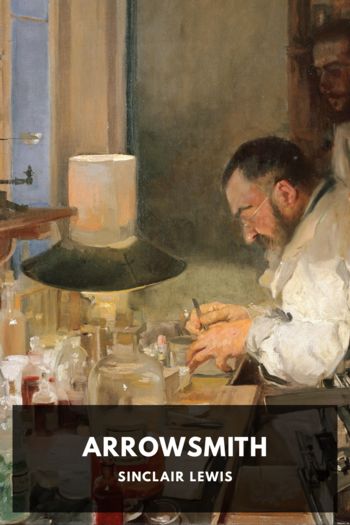
Martin Arrowsmith, the titular protagonist, grows up in a small Midwestern town where he wants to become a doctor. At medical school he meets an abrasive but brilliant professor, Gottlieb, who becomes his mentor. As Arrowsmith completes his training he begins a career practicing medicine. But, echoing Lewis’s Main Street, small-town life becomes too insular and restricting; his interest in research and not people makes him unpopular, and he decides to work in a research laboratory instead.
From there Arrowsmith begins a career that hits all of the ethical quandaries that scientists and those in the medical profession encounter: everything from the ethical problem of research protocol strictness versus saving lives, to doing research for the betterment of mankind versus for turning a profit, to the politics of institutions, to the social problems of wealth and poverty. Arrowsmith struggles with these dilemmas because, like all of us, he isn’t perfect. Despite his interest in helping humanity, he has little interest in people—aside from his serial womanizing—and this makes the path of his career an even harder one to walk. He’s surrounded on all sides by icons of nobility, icons of pride, and icons of rapaciousness, each one distracting him from his calling.
Though the book isn’t strictly a satire, few escape Lewis’s biting pen. He skewers everyone indiscriminately: small-town rubes, big-city blowhards, aspiring politicians, doctors of both the noble and greedy variety, hapless ivory-towered researchers, holier-than-thou neighbors, tedious gilded-age socialites, and even lazy and backwards islanders. In some ways, Arrowsmith rivals Main Street in its often-bleak view of human nature—though unlike Main Street, the good to humanity that science offers is an ultimate light at the end of the tunnel.
The novel’s publication in 1925 made it one of the first serious “science” novels, exploring all aspects of the life and career of a modern scientist. Lewis was aided in the novel’s preparation by Paul de Kruif, a microbiologist and writer, whose medically-accurate contributions greatly enhance the text’s realist flavor.
In 1926 Arrowsmith was awarded the Pulitzer Prize, but Lewis famously declined it. In his refusal letter, he claimed a disinterest in prizes of any kind; but the New York Times reported that those close to him say he was still angered over the Pulitzer’s last-minute snatching of the 1921 prize from Main Street in favor of giving it to The Age of Innocence.
Read free book «Arrowsmith by Sinclair Lewis (learn to read books txt) 📕» - read online or download for free at americanlibrarybooks.com
- Author: Sinclair Lewis
Read book online «Arrowsmith by Sinclair Lewis (learn to read books txt) 📕». Author - Sinclair Lewis
At two o’clock, when the rain had slackened, when the after-lunch crowd had come in and the story of the anti ladies was running strong, the fireman retired behind the Clean Up and Prevent Fires exhibit for his hourly smoke. He was a very sleepy and unhappy little fireman; he was thinking about the pleasant firehouse and the unending games of pinochle. He dropped the match, unextinguished on the back porch of the model Clean House. The Clean House had been so handsomely oiled that it was like kindling soaked in kerosene. It flared up, and instantly the huge and gloomy Tabernacle was hysterical with flames. The crowd rushed toward the exits.
Naturally, most of the original exits of the Tabernacle had been blocked by booths. There was a shrieking panic, and children were being trampled.
Almus Pickerbaugh was neither a coward nor slothful. Suddenly, coming from nowhere, he was marching through the Tabernacle at the head of his eight daughters, singing “Dixie,” his head up, his eyes terrible, his arms wide in pleading. The crowd weakly halted. With the voice of a clipper captain he unsnarled them and ushered them safely out, then charged back into the spouting flames.
The rain-soaked building had not caught. The fireman, with Martin and the head of the Eugenic Family, was beating the flames. Nothing was destroyed save the Clean House, and the crowd which had fled in agony came back in wonder. Their hero was Pickerbaugh.
Within two hours the Nautilus papers vomited specials which explained that not merely had Pickerbaugh organized the greatest lesson in health ever seen, but he had also, by his courage and his power to command, saved hundreds of people from being crushed, which latter was probably the only completely accurate thing that has been said about Dr. Almus Pickerbaugh in ten thousand columns of newspaper publicity.
Whether to see the Fair, Pickerbaugh, the delightful ravages of a disaster, or another fight between the anti ladies, half the city struggled into the Tabernacle that evening, and when Pickerbaugh took the platform for his closing lecture he was greeted with frenzy. Next day, when he galloped into the last week of his campaign, he was overlord of all the district.
IIHis opponent was a snuffy little lawyer whose strength lay in his training. He had been state senator, lieutenant governor, county judge. But the Democratic slogan, “Pickerbaugh the Pickup Candidate,” was drowned in the admiration for the hero of the health fair. He dashed about in motors, proclaiming, “I am not running because I want office, but because I want the chance to take to the whole nation my ideals of health.” Everywhere was plastered:
For Congress
Pickerbaugh
The two-fisted fighting poet doc
Just elect him for a term
And all through the nation he’ll swat the germ.
Enormous meetings were held. Pickerbaugh was ample and vague about his Policies. Yes, he was opposed to our entering the European War, but he assured them, he certainly did assure them, that he was for using every power of our Government to end this terrible calamity. Yes, he was for high tariff, but it must be so adjusted that the farmers in his district could buy everything cheaply. Yes, he was for high wages for each and every workman, but he stood like a rock, like a boulder, like a moraine, for protecting the prosperity of all manufacturers, merchants, and real-estate owners.
While this larger campaign thundered, there was proceeding in Nautilus a smaller and much defter campaign, to reelect as mayor one Mr. Pugh, Pickerbaugh’s loving chief. Mr. Pugh sat nicely at desks, and he was pleasant and promissory to everybody who came to see him; clergymen, gamblers, G.A.R. veterans, circus advance-agents, policemen, and ladies of reasonable virtue—everybody except perhaps socialist agitators, against whom he staunchly protected the embattled city. In his speeches Pickerbaugh commended Pugh for “that firm integrity and ready sympathy with which His Honor had backed up every movement for the public weal,” and when Pickerbaugh (quite honestly) begged, “Mr. Mayor, if I go to Congress you must appoint Arrowsmith in my place; he knows nothing about politics but he’s incorruptible,” then Pugh gave his promise, and amity abode in that land … Nobody said anything at all about Mr. F. X. Jordan.
F. X. Jordan was a contractor with a generous interest in politics. Pickerbaugh called him a grafter, and the last time Pugh had been elected—it had been on a Reform Platform, though since that time the reform had been coaxed to behave itself and be practical—both Pugh and Pickerbaugh had denounced Jordan as a “malign force.” But so kindly was Mayor Pugh that in the present election he said nothing that could hurt Mr. Jordan’s feelings, and in return what could Mr. Jordan do but speak forgivingly about Mr. Pugh to the people in blind-pigs and houses of ill fame?
On the evening of the election, Martin and Leora were among the company awaiting the returns at the Pickerbaughs’. They were confident. Martin had never been roused by politics, but he was stirred now by Pickerbaugh’s twitchy pretense of indifference, by the telephoned report from the newspaper office, “Here’s Willow Grove township—Pickerbaugh leading, two to one!” by the crowds which went past the house howling, “Pickerbaugh, Pickerbaugh, Pickerbaugh!”
At eleven the victory was certain, and Martin, his bowels weak with unconfidence, realized that he was now Director of Public Health, with responsibility for seventy thousand lives.
He looked wistfully toward Leora and in her still smile found assurance.
Orchid had been airy and distant with Martin all evening, and dismayingly chatty and affectionate with Leora. Now she drew him into the back parlor and “So I’m going off to Washington—and you don’t care a bit!” she said, her eyes blurred and languorous and undefended. He held her, muttering, “You darling child, I can’t let you go!” As he walked home




Comments (0)