Short Fiction by Anton Chekhov (libby ebook reader .txt) 📕
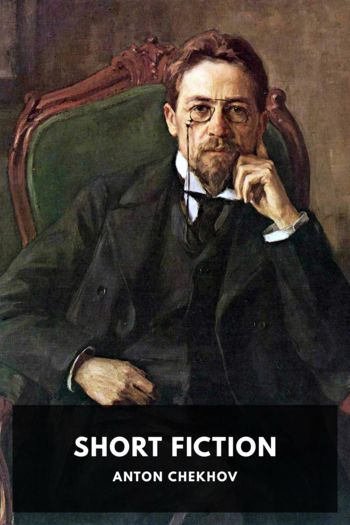
Description
Anton Chekhov is widely considered to be one of the greatest short story writers in history. A physician by day, he’s famously quoted as saying, “Medicine is my lawful wife, and literature is my mistress.” Chekhov wrote nearly 300 short stories in his long writing career; while at first he wrote mainly to make a profit, as his interest in writing—and his skill—grew, he wrote stories that heavily influenced the modern development of the form.
His stories are famous for, among other things, their ambiguous morality and their often inconclusive nature. Chekhov was a firm believer that the role of the artist was to correctly pose a question, but not necessarily to answer it.
This collection contains all of his short stories and two novellas, all translated by Constance Garnett, and arranged by the date they were originally published.
Read free book «Short Fiction by Anton Chekhov (libby ebook reader .txt) 📕» - read online or download for free at americanlibrarybooks.com
- Author: Anton Chekhov
Read book online «Short Fiction by Anton Chekhov (libby ebook reader .txt) 📕». Author - Anton Chekhov
“Just think of it,” says the inspector, addressing the gentleman in the queer overcoat. “I’ll tell you an incident that really is A1! The Z⸺ railway line in the coolest possible way stole three hundred trucks from the N⸺ line. It’s a fact, sir! I swear it! They carried them off, repainted them, put their letters on them, and that’s all about it. The N⸺ line sends its agents everywhere, they hunt and hunt. And then—can you imagine it?—the Company happen to come upon a broken-down carriage of the Z⸺ line. They repair it at their depot, and all at once, bless my soul! see their own mark on the wheels What do you say to that? Eh? If I did it they would send me to Siberia, but the railway companies simply snap their fingers at it!”
It is pleasant to Malahin to talk to educated, cultured people. He strokes his beard and joins in the conversation with dignity.
“Take this case, gentlemen, for instance,” he says. “I am transporting cattle to X⸺. Eight vanloads. Very good. … Now let us say they charge me for each vanload as a weight of ten tons; eight bullocks don’t weigh ten tons, but much less, yet they don’t take any notice of that. …”
At that instant Yasha walks into the room looking for his father. He listens and is about to sit down on a chair, but probably thinking of his weight goes and sits on the windowsill.
“They don’t take any notice of that,” Malahin goes on, “and charge me and my son the third-class fare, too, forty-two roubles, for going in the van with the bullocks. This is my son Yakov. I have two more at home, but they have gone in for study. Well and apart from that it is my opinion that the railways have ruined the cattle trade. In old days when they drove them in herds it was better.”
The old man’s talk is lengthy and drawn out. After every sentence he looks at Yasha as though he would say: “See how I am talking to clever people.”
“Upon my word!” the inspector interrupts him. “No one is indignant, no one criticizes. And why? It is very simple. An abomination strikes the eye and arouses indignation only when it is exceptional, when the established order is broken by it. Here, where, saving your presence, it constitutes the long-established program and forms and enters into the basis of the order itself, where every sleeper on the line bears the trace of it and stinks of it, one too easily grows accustomed to it! Yes, sir!”
The second bell rings, the gentlemen in the queer overcoat gets up. The inspector takes him by the arm and, still talking with heat, goes off with him to the platform. After the third bell the stationmaster runs into his room, and sits down at his table.
“Listen, with what number am I to go?” asks Malahin.
The stationmaster looks at a form and says indignantly:
“Are you Malahin, eight vanloads? You must pay a rouble a van and six roubles and twenty kopecks for stamps. You have no stamps. Total, fourteen roubles, twenty kopecks.”
Receiving the money, he writes something down, dries it with sand, and, hurriedly snatching up a bundle of forms, goes quickly out of the room.
At ten o’clock in the evening Malahin gets an answer from the traffic manager: “Give precedence.”
Reading the telegram through, the old man winks significantly and, very well pleased with himself, puts it in his pocket.
“Here,” he says to Yasha, “look and learn.”
At midnight his train goes on. The night is dark and cold like the previous one; the waits at the stations are long. Yasha sits on the cape and imperturbably strums on the accordion, while the old man is still more eager to exert himself. At one of the stations he is overtaken by a desire to lodge a complaint. At his request a gendarme sits down and writes:
“November 10, 188-.
“—I, noncommissioned officer of the Z⸺ section of the N⸺ police department of railways, Ilya Tchered, in accordance with article II of the statute of May 19, 1871, have drawn up this protocol at the station of X⸺ as herewith follows. …”
“What am I to write next?” asks the gendarme.
Malahin lays out before him forms, postal and telegraph receipts, accounts. … He does not know himself definitely what he wants of the gendarme; he wants to describe in the protocol not any separate episode but his whole journey, with all his losses and conversations with stationmasters—to describe it lengthily and vindictively.
“At the station of Z⸺,” he says, “write that the stationmaster unlinked my vans from the troop train because he did not like my countenance.”
And he wants the gendarme to be sure to mention his countenance. The latter listens wearily, and goes on writing without hearing him to the end. He ends his protocol thus:
“The above deposition I, noncommissioned officer Tchered, have written down in this protocol with a view to present it to the head of the Z⸺ section, and have handed a copy thereof to Gavril Malahin.”
The old man takes the copy, adds it to the papers with which his side pocket is stuffed, and, much pleased, goes back to his van.
In the morning Malahin wakes up again in a bad humor, but his wrath vents itself not on Yasha but the cattle.
“The cattle are done for!” he grumbles. “They are done for! They are at the last gasp! God be my judge! they will all die. Tfoo!”
The bullocks, who have had nothing to drink for many days, tortured by thirst, are licking the hoar frost on the walls, and when Malachin goes up to them they begin licking his cold fur jacket. From their clear, tearful eyes it can be seen that they are



Comments (0)