Short Fiction by Anton Chekhov (libby ebook reader .txt) 📕
Description
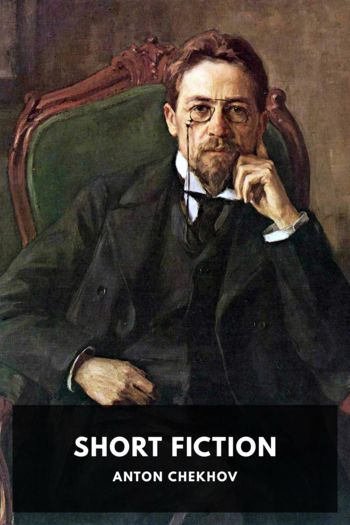
Anton Chekhov is widely considered to be one of the greatest short story writers in history. A physician by day, he’s famously quoted as saying, “Medicine is my lawful wife, and literature is my mistress.” Chekhov wrote nearly 300 short stories in his long writing career; while at first he wrote mainly to make a profit, as his interest in writing—and his skill—grew, he wrote stories that heavily influenced the modern development of the form.
His stories are famous for, among other things, their ambiguous morality and their often inconclusive nature. Chekhov was a firm believer that the role of the artist was to correctly pose a question, but not necessarily to answer it.
This collection contains all of his short stories and two novellas, all translated by Constance Garnett, and arranged by the date they were originally published.
Read free book «Short Fiction by Anton Chekhov (libby ebook reader .txt) 📕» - read online or download for free at americanlibrarybooks.com
- Author: Anton Chekhov
Read book online «Short Fiction by Anton Chekhov (libby ebook reader .txt) 📕». Author - Anton Chekhov
“Professor, I give you my word of honour that if you mark me for a pass I … I’ll …”
As soon as we reach the “word of honour” I wave my hands and sit down to the table. The student ponders a minute longer, and says dejectedly:
“In that case, goodbye … I beg your pardon.”
“Goodbye, my friend. Good luck to you.”
He goes irresolutely into the hall, slowly puts on his outdoor things, and, going out into the street, probably ponders for some time longer; unable to think of anything, except “old devil,” inwardly addressed to me, he goes into a wretched restaurant to dine and drink beer, and then home to bed. “Peace be to thy ashes, honest toiler.”
A third ring at the bell. A young doctor, in a pair of new black trousers, gold spectacles, and of course a white tie, walks in. He introduces himself. I beg him to be seated, and ask what I can do for him. Not without emotion, the young devotee of science begins telling me that he has passed his examination as a doctor of medicine, and that he has now only to write his dissertation. He would like to work with me under my guidance, and he would be greatly obliged to me if I would give him a subject for his dissertation.
“Very glad to be of use to you, colleague,” I say, “but just let us come to an understanding as to the meaning of a dissertation. That word is taken to mean a composition which is a product of independent creative effort. Is that not so? A work written on another man’s subject and under another man’s guidance is called something different. …”
The doctor says nothing. I fly into a rage and jump up from my seat.
“Why is it you all come to me?” I cry angrily. “Do I keep a shop? I don’t deal in subjects. For the thousand and oneth time I ask you all to leave me in peace! Excuse my brutality, but I am quite sick of it!”
The doctor remains silent, but a faint flush is apparent on his cheekbones. His face expresses a profound reverence for my fame and my learning, but from his eyes I can see he feels a contempt for my voice, my pitiful figure, and my nervous gesticulation. I impress him in my anger as a queer fish.
“I don’t keep a shop,” I go on angrily. “And it is a strange thing! Why don’t you want to be independent? Why have you such a distaste for independence?”
I say a great deal, but he still remains silent. By degrees I calm down, and of course give in. The doctor gets a subject from me for his theme not worth a halfpenny, writes under my supervision a dissertation of no use to anyone, with dignity defends it in a dreary discussion, and receives a degree of no use to him.
The rings at the bell may follow one another endlessly, but I will confine my description here to four of them. The bell rings for the fourth time, and I hear familiar footsteps, the rustle of a dress, a dear voice. …
Eighteen years ago a colleague of mine, an oculist, died leaving a little daughter Katya, a child of seven, and sixty thousand roubles. In his will he made me the child’s guardian. Till she was ten years old Katya lived with us as one of the family, then she was sent to a boarding-school, and only spent the summer holidays with us. I never had time to look after her education. I only superintended it at leisure moments, and so I can say very little about her childhood.
The first thing I remember, and like so much in remembrance, is the extraordinary trustfulness with which she came into our house and let herself be treated by the doctors, a trustfulness which was always shining in her little face. She would sit somewhere out of the way, with her face tied up, invariably watching something with attention; whether she watched me writing or turning over the pages of a book, or watched my wife bustling about, or the cook scrubbing a potato in the kitchen, or the dog playing, her eyes invariably expressed the same thought—that is, “Everything that is done in this world is nice and sensible.” She was curious, and very fond of talking to me. Sometimes she would sit at the table opposite me, watching my movements and asking questions. It interested her to know what I was reading, what I did at the University, whether I was not afraid of the dead bodies, what I did with my salary.
“Do the students fight at the University?” she would ask.
“They do, dear.”
“And do you make them go down on their knees?”
“Yes, I do.”
And she thought it funny that the students fought and I made them go down on their knees, and she laughed. She was a gentle, patient, good child. It happened not infrequently that I saw something taken away from her, saw her punished without reason, or her curiosity repressed; at such times a look of sadness was mixed with the invariable expression of trustfulness on her face—that was all. I did not know how to take her part; only when I saw her sad I had an inclination to draw her to me and to commiserate her like some old nurse: “My poor little orphan one!”
I remember, too, that she was fond of fine clothes and of sprinkling herself with scent. In that respect she was like me. I, too, am fond of pretty clothes and nice scent.
I regret that I had not time nor inclination to watch over the rise and development of the passion which took complete possession of Katya when she was fourteen or fifteen. I mean her passionate love for the theatre. When she used to come from boarding-school and stay




Comments (0)