Short Fiction by Anton Chekhov (libby ebook reader .txt) 📕
Description
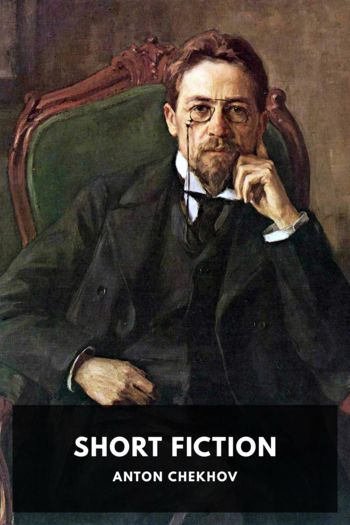
Anton Chekhov is widely considered to be one of the greatest short story writers in history. A physician by day, he’s famously quoted as saying, “Medicine is my lawful wife, and literature is my mistress.” Chekhov wrote nearly 300 short stories in his long writing career; while at first he wrote mainly to make a profit, as his interest in writing—and his skill—grew, he wrote stories that heavily influenced the modern development of the form.
His stories are famous for, among other things, their ambiguous morality and their often inconclusive nature. Chekhov was a firm believer that the role of the artist was to correctly pose a question, but not necessarily to answer it.
This collection contains all of his short stories and two novellas, all translated by Constance Garnett, and arranged by the date they were originally published.
Read free book «Short Fiction by Anton Chekhov (libby ebook reader .txt) 📕» - read online or download for free at americanlibrarybooks.com
- Author: Anton Chekhov
Read book online «Short Fiction by Anton Chekhov (libby ebook reader .txt) 📕». Author - Anton Chekhov
I go on working while Katya sits silent not far from me on the sofa, wrapping herself in her shawl, as though she were cold. Either because I find her sympathetic or because I was used to her frequent visits when she was a little girl, her presence does not prevent me from concentrating my attention. From time to time I mechanically ask her some question; she gives very brief replies; or, to rest for a minute, I turn round and watch her as she looks dreamily at some medical journal or review. And at such moments I notice that her face has lost the old look of confiding trustfulness. Her expression now is cold, apathetic, and absentminded, like that of passengers who had to wait too long for a train. She is dressed, as in old days, simply and beautifully, but carelessly; her dress and her hair show visible traces of the sofas and rocking-chairs in which she spends whole days at a stretch. And she has lost the curiosity she had in old days. She has ceased to ask me questions now, as though she had experienced everything in life and looked for nothing new from it.
Towards four o’clock there begins to be sounds of movement in the hall and in the drawing room. Liza has come back from the Conservatoire, and has brought some girlfriends in with her. We hear them playing on the piano, trying their voices and laughing; in the dining room Yegor is laying the table, with the clatter of crockery.
“Goodbye,” said Katya. “I won’t go in and see your people today. They must excuse me. I haven’t time. Come and see me.”
While I am seeing her to the door, she looks me up and down grimly, and says with vexation:
“You are getting thinner and thinner! Why don’t you consult a doctor? I’ll call at Sergey Fyodorovitch’s and ask him to have a look at you.”
“There’s no need, Katya.”
“I can’t think where your people’s eyes are! They are a nice lot, I must say!”
She puts on her fur coat abruptly, and as she does so two or three hairpins drop unnoticed on the floor from her carelessly arranged hair. She is too lazy and in too great a hurry to do her hair up; she carelessly stuffs the falling curls under her hat, and goes away.
When I go into the dining room my wife asks me:
“Was Katya with you just now? Why didn’t she come in to see us? It’s really strange. …”
“Mamma,” Liza says to her reproachfully, “let her alone, if she doesn’t want to. We are not going down on our knees to her.”
“It’s very neglectful, anyway. To sit for three hours in the study without remembering our existence! But of course she must do as she likes.”
Varya and Liza both hate Katya. This hatred is beyond my comprehension, and probably one would have to be a woman in order to understand it. I am ready to stake my life that of the hundred and fifty young men I see every day in the lecture-theatre, and of the hundred elderly ones I meet every week, hardly one could be found capable of understanding their hatred and aversion for Katya’s past—that is, for her having been a mother without being a wife, and for her having had an illegitimate child; and at the same time I cannot recall one woman or girl of my acquaintance who would not consciously or unconsciously harbour such feelings. And this is not because woman is purer or more virtuous than man: why, virtue and purity are not very different from vice if they are not free from evil feeling. I attribute this simply to the backwardness of woman. The mournful feeling of compassion and the pang of conscience experienced by a modern man at the sight of suffering is, to my mind, far greater proof of culture and moral elevation than hatred and aversion. Woman is as tearful and as coarse in her feelings now as she was in the Middle Ages, and to my thinking those who advise that she should be educated like a man are quite right.
My wife also dislikes Katya for having been an actress, for ingratitude, for pride, for eccentricity, and for the numerous vices which one woman can always find in another.
Besides my wife and daughter and me, there are dining with us two or three of my daughter’s friends and Alexandr Adolfovitch Gnekker, her admirer and suitor. He is a fair-haired young man under thirty, of medium height, very stout and broad-shouldered, with red whiskers near his ears, and little waxed moustaches which make his plump smooth face look like a toy. He is dressed in a very short reefer jacket, a flowered waistcoat, breeches very full at the top and very narrow at the ankle, with a large check pattern on them, and yellow boots without heels. He has prominent eyes like a crab’s, his cravat is like a crab’s neck, and I even fancy there is a smell of crab-soup about the young man’s whole person. He visits us every day, but no one in my family knows anything of his origin nor of the place of his education, nor of his means of livelihood. He neither plays nor sings, but has some connection with music and singing, sells somebody’s pianos somewhere, is frequently at the Conservatoire, is acquainted with all the celebrities, and is a steward at the concerts; he criticizes music with great authority, and I have noticed that people are eager to agree with him.
Rich people always have dependents hanging about them; the arts and sciences have the same. I believe there is not an art nor a science




Comments (0)