Short Fiction by Anton Chekhov (libby ebook reader .txt) 📕
Description
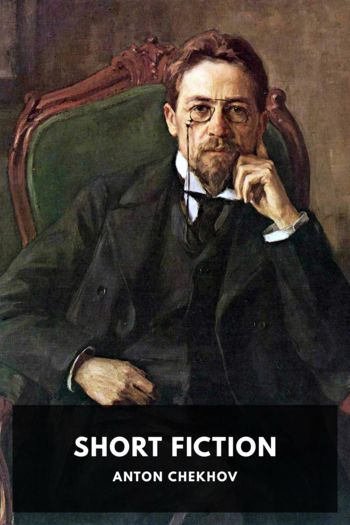
Anton Chekhov is widely considered to be one of the greatest short story writers in history. A physician by day, he’s famously quoted as saying, “Medicine is my lawful wife, and literature is my mistress.” Chekhov wrote nearly 300 short stories in his long writing career; while at first he wrote mainly to make a profit, as his interest in writing—and his skill—grew, he wrote stories that heavily influenced the modern development of the form.
His stories are famous for, among other things, their ambiguous morality and their often inconclusive nature. Chekhov was a firm believer that the role of the artist was to correctly pose a question, but not necessarily to answer it.
This collection contains all of his short stories and two novellas, all translated by Constance Garnett, and arranged by the date they were originally published.
Read free book «Short Fiction by Anton Chekhov (libby ebook reader .txt) 📕» - read online or download for free at americanlibrarybooks.com
- Author: Anton Chekhov
Read book online «Short Fiction by Anton Chekhov (libby ebook reader .txt) 📕». Author - Anton Chekhov
But here there comes a ring at the front-door. Katya and I recognize it, and say:
“It must be Mihail Fyodorovitch.”
And a minute later my colleague, the philologist Mihail Fyodorovitch, a tall, well-built man of fifty, clean-shaven, with thick grey hair and black eyebrows, walks in. He is a good-natured man and an excellent comrade. He comes of a fortunate and talented old noble family which has played a prominent part in the history of literature and enlightenment. He is himself intelligent, talented, and very highly educated, but has his oddities. To a certain extent we are all odd and all queer fish, but in his oddities there is something exceptional, apt to cause anxiety among his acquaintances. I know a good many people for whom his oddities completely obscure his good qualities.
Coming in to us, he slowly takes off his gloves and says in his velvety bass:
“Good evening. Are you having tea? That’s just right. It’s diabolically cold.”
Then he sits down to the table, takes a glass, and at once begins talking. What is most characteristic in his manner of talking is the continually jesting tone, a sort of mixture of philosophy and drollery as in Shakespeare’s gravediggers. He is always talking about serious things, but he never speaks seriously. His judgments are always harsh and railing, but, thanks to his soft, even, jesting tone, the harshness and abuse do not jar upon the ear, and one soon grows used to them. Every evening he brings with him five or six anecdotes from the University, and he usually begins with them when he sits down to table.
“Oh, Lord!” he sighs, twitching his black eyebrows ironically. “What comic people there are in the world!”
“Well?” asks Katya.
“As I was coming from my lecture this morning I met that old idiot N⸺. N⸺ on the stairs. … He was going along as usual, sticking out his chin like a horse, looking for someone to listen to his grumblings at his migraine, at his wife, and his students who won’t attend his lectures. ‘Oh,’ I thought, ‘he has seen me—I am done for now; it is all up. …’ ”
And so on in the same style. Or he will begin like this:
“I was yesterday at our friend Z⸺. Z⸺’s public lecture. I wonder how it is our alma mater—don’t speak of it after dark—dare display in public such noodles and patent dullards as that Z⸺. Z⸺ … Why, he is a European fool! Upon my word, you could not find another like him all over Europe! He lectures—can you imagine?—as though he were sucking a sugar-stick—sue, sue, sue; … he is in a nervous funk; he can hardly decipher his own manuscript; his poor little thoughts crawl along like a bishop on a bicycle, and, what’s worse, you can never make out what he is trying to say. The deadly dullness is awful, the very flies expire. It can only be compared with the boredom in the assembly-hall at the yearly meeting when the traditional address is read—damn it!”
And at once an abrupt transition:
“Three years ago—Nikolay Stepanovitch here will remember it—I had to deliver that address. It was hot, stifling, my uniform cut me under the arms—it was deadly! I read for half an hour, for an hour, for an hour and a half, for two hours. … ‘Come,’ I thought; ‘thank God, there are only ten pages left!’ And at the end there were four pages that there was no need to read, and I reckoned to leave them out. ‘So there are only six really,’ I thought; ‘that is, only six pages left to read.’ But, only fancy, I chanced to glance before me, and, sitting in the front row, side by side, were a general with a ribbon on his breast and a bishop. The poor beggars were numb with boredom; they were staring with their eyes wide open to keep awake, and yet they were trying to put on an expression of attention and to pretend that they understood what I was saying and liked it. ‘Well,’ I thought, ‘since you like it you shall have it! I’ll pay you out;’ so I just gave them those four pages too.”
As is usual with ironical people, when he talks nothing in his face smiles but his eyes and eyebrows. At such times there is no trace of hatred or spite in his eyes, but a great deal of humour, and that peculiar fox-like slyness which is only to be noticed in very observant people. Since I am speaking about his eyes, I notice another peculiarity in them. When he takes a glass from Katya, or listens to her speaking, or looks after her as she goes out of the room for a moment, I notice in his eyes something gentle, beseeching, pure. …
The maidservant takes away the samovar



Comments (0)