Short Fiction by Anton Chekhov (libby ebook reader .txt) 📕
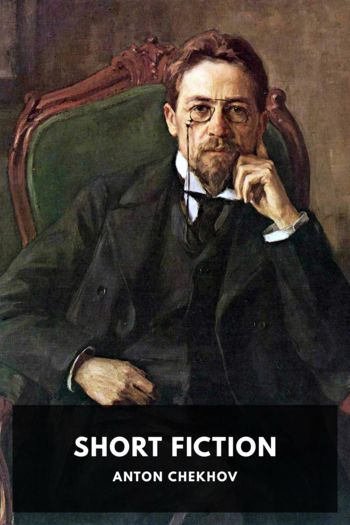
Description
Anton Chekhov is widely considered to be one of the greatest short story writers in history. A physician by day, he’s famously quoted as saying, “Medicine is my lawful wife, and literature is my mistress.” Chekhov wrote nearly 300 short stories in his long writing career; while at first he wrote mainly to make a profit, as his interest in writing—and his skill—grew, he wrote stories that heavily influenced the modern development of the form.
His stories are famous for, among other things, their ambiguous morality and their often inconclusive nature. Chekhov was a firm believer that the role of the artist was to correctly pose a question, but not necessarily to answer it.
This collection contains all of his short stories and two novellas, all translated by Constance Garnett, and arranged by the date they were originally published.
Read free book «Short Fiction by Anton Chekhov (libby ebook reader .txt) 📕» - read online or download for free at americanlibrarybooks.com
- Author: Anton Chekhov
Read book online «Short Fiction by Anton Chekhov (libby ebook reader .txt) 📕». Author - Anton Chekhov
And then—insomnia!
IVSummer comes on and life is changed.
One fine morning Liza comes in to me and says in a jesting tone:
“Come, your Excellency! We are ready.”
My Excellency is conducted into the street, and seated in a cab. As I go along, having nothing to do, I read the signboards from right to left. The word “Traktir” reads “Ritkart”; that would just suit some baron’s family: Baroness Ritkart. Farther on I drive through fields, by the graveyard, which makes absolutely no impression on me, though I shall soon lie in it; then I drive by forests and again by fields. There is nothing of interest. After two hours of driving, my Excellency is conducted into the lower storey of a summer villa and installed in a small, very cheerful little room with light blue hangings.
At night there is sleeplessness as before, but in the morning I do not put a good face upon it and listen to my wife, but lie in bed. I do not sleep, but lie in the drowsy, half-conscious condition in which you know you are not asleep, but dreaming. At midday I get up and from habit sit down at my table, but I do not work now; I amuse myself with French books in yellow covers, sent me by Katya. Of course, it would be more patriotic to read Russian authors, but I must confess I cherish no particular liking for them. With the exception of two or three of the older writers, all our literature of today strikes me as not being literature, but a special sort of home industry, which exists simply in order to be encouraged, though people do not readily make use of its products. The very best of these home products cannot be called remarkable and cannot be sincerely praised without qualification. I must say the same of all the literary novelties I have read during the last ten or fifteen years; not one of them is remarkable, and not one of them can be praised without a “but.” Cleverness, a good tone, but no talent; talent, a good tone, but no cleverness; or talent, cleverness, but not a good tone.
I don’t say the French books have talent, cleverness, and a good tone. They don’t satisfy me, either. But they are not so tedious as the Russian, and it is not unusual to find in them the chief element of artistic creation—the feeling of personal freedom which is lacking in the Russian authors. I don’t remember one new book in which the author does not try from the first page to entangle himself in all sorts of conditions and contracts with his conscience. One is afraid to speak of the naked body; another ties himself up hand and foot in psychological analysis; a third must have a “warm attitude to man”; a fourth purposely scrawls whole descriptions of nature that he may not be suspected of writing with a purpose. … One is bent upon being middle-class in his work, another must be a nobleman, and so on. There is intentionalness, circumspection, and self-will, but they have neither the independence nor the manliness to write as they like, and therefore there is no creativeness.
All this applies to what is called “belles-lettres.”
As for serious treatises in Russian on sociology, for instance, on art, and so on, I do not read them simply from timidity. In my childhood and early youth I had for some reason a terror of doorkeepers and attendants at the theatre, and that terror has remained with me to this day. I am afraid of them even now. It is said that we are only afraid of what we do not understand. And, indeed, it is very difficult to understand why doorkeepers and theatre attendants are so dignified, haughty, and majestically rude. I feel exactly the same terror when I read serious articles. Their extraordinary dignity, their bantering lordly tone, their familiar manner to foreign authors, their ability to split straws with dignity—all that is beyond my understanding; it is intimidating and utterly unlike the quiet, gentlemanly tone to which I am accustomed when I read the works of our medical and scientific writers. It oppresses me to read not only the articles written by serious Russians, but even works translated or edited by them. The pretentious, edifying tone of the preface; the redundancy of remarks made by the translator, which prevent me from concentrating my attention; the question marks and “sic” in parenthesis scattered all over the book or article by the liberal translator, are to my mind an outrage on the author and on my independence as a reader.
Once I was summoned as an expert to a circuit court; in an interval one of my fellow-experts drew my attention to the rudeness of the public prosecutor to the defendants, among whom there were two ladies of good education. I believe I did not exaggerate at all when I told him that the prosecutor’s manner was no ruder than that of the authors of serious articles to one another. Their manners are, indeed, so rude that I cannot speak of them without distaste. They treat one another and the writers they criticize either with superfluous respect, at the sacrifice of their own dignity, or, on the contrary, with far more ruthlessness than I have shown in my notes and my thoughts in regard to my future son-in-law Gnekker. Accusations of irrationality, of evil intentions, and, indeed, of every sort of crime, form an habitual ornament of serious articles. And that, as young





Comments (0)