Short Fiction by Anton Chekhov (libby ebook reader .txt) 📕
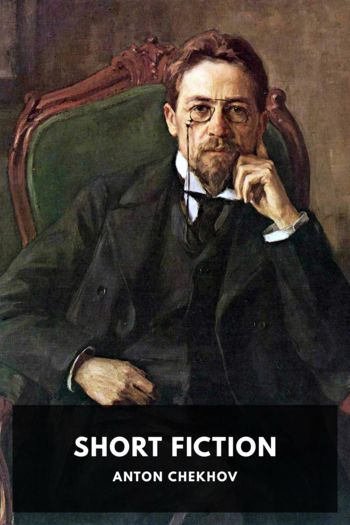
Description
Anton Chekhov is widely considered to be one of the greatest short story writers in history. A physician by day, he’s famously quoted as saying, “Medicine is my lawful wife, and literature is my mistress.” Chekhov wrote nearly 300 short stories in his long writing career; while at first he wrote mainly to make a profit, as his interest in writing—and his skill—grew, he wrote stories that heavily influenced the modern development of the form.
His stories are famous for, among other things, their ambiguous morality and their often inconclusive nature. Chekhov was a firm believer that the role of the artist was to correctly pose a question, but not necessarily to answer it.
This collection contains all of his short stories and two novellas, all translated by Constance Garnett, and arranged by the date they were originally published.
Read free book «Short Fiction by Anton Chekhov (libby ebook reader .txt) 📕» - read online or download for free at americanlibrarybooks.com
- Author: Anton Chekhov
Read book online «Short Fiction by Anton Chekhov (libby ebook reader .txt) 📕». Author - Anton Chekhov
It was getting dark; it would soon be night.
Gusev, a discharged soldier, sat up in his hammock and said in an undertone:
“I say, Pavel Ivanitch. A soldier at Sutchan told me: while they were sailing a big fish came into collision with their ship and stove a hole in it.”
The nondescript individual whom he was addressing, and whom everyone in the ship’s hospital called Pavel Ivanitch, was silent, as though he had not heard.
And again a stillness followed … The wind frolicked with the rigging, the screw throbbed, the waves lashed, the hammocks creaked, but the ear had long ago become accustomed to these sounds, and it seemed that everything around was asleep and silent. It was dreary. The three invalids—two soldiers and a sailor—who had been playing cards all the day were asleep and talking in their dreams.
It seemed as though the ship were beginning to rock. The hammock slowly rose and fell under Gusev, as though it were heaving a sigh, and this was repeated once, twice, three times. … Something crashed on to the floor with a clang: it must have been a jug falling down.
“The wind has broken loose from its chain …” said Gusev, listening.
This time Pavel Ivanitch cleared his throat and answered irritably:
“One minute a vessel’s running into a fish, the next, the wind’s breaking loose from its chain. Is the wind a beast that it can break loose from its chain?”
“That’s how christened folk talk.”
“They are as ignorant as you are then. They say all sorts of things. One must keep a head on one’s shoulders and use one’s reason. You are a senseless creature.”
Pavel Ivanitch was subject to seasickness. When the sea was rough he was usually ill-humoured, and the merest trifle would make him irritable. And in Gusev’s opinion there was absolutely nothing to be vexed about. What was there strange or wonderful, for instance, in the fish or in the wind’s breaking loose from its chain? Suppose the fish were as big as a mountain and its back were as hard as a sturgeon: and in the same way, supposing that away yonder at the end of the world there stood great stone walls and the fierce winds were chained up to the walls … if they had not broken loose, why did they tear about all over the sea like maniacs, and struggle to escape like dogs? If they were not chained up, what did become of them when it was calm?
Gusev pondered for a long time about fishes as big as a mountain and stout, rusty chains, then he began to feel dull and thought of his native place to which he was returning after five years’ service in the East. He pictured an immense pond covered with snow. … On one side of the pond the redbrick building of the potteries with a tall chimney and clouds of black smoke; on the other side—a village. … His brother Alexey comes out in a sledge from the fifth yard from the end; behind him sits his little son Vanka in big felt overboots, and his little girl Akulka, also in big felt boots. Alexey has been drinking, Vanka is laughing, Akulka’s face he could not see, she had muffled herself up.
“You never know, he’ll get the children frozen …” thought Gusev. “Lord send them sense and judgment that they may honour their father and mother and not be wiser than their parents.”
“They want re-soleing,” a delirious sailor says in a bass voice. “Yes, yes!”
Gusev’s thoughts break off, and instead of a pond there suddenly appears apropos of nothing a huge bull’s head without eyes, and the horse and sledge are not driving along, but are whirling round and round in a cloud of smoke. But still he was glad he had seen his own folks. He held his breath from delight, shudders ran all over him, and his fingers twitched.
“The Lord let us meet again,” he muttered feverishly, but he at once opened his eyes and sought in the darkness for water.
He drank and lay back, and again the sledge was moving, then again the bull’s head without eyes, smoke, clouds. … And so on till daybreak.
IIThe first outline visible in the darkness was a blue circle—the little round window; then little by little Gusev could distinguish his neighbour in the next hammock, Pavel Ivanitch. The man slept sitting up, as he could not breathe lying down. His face was grey, his nose was long and sharp, his eyes looked huge from the terrible thinness of his face, his temples were sunken, his beard was skimpy, his hair was long. … Looking at him you could not make out of what class he was, whether he were a gentleman, a merchant, or a peasant. Judging from his expression and his long hair he might have been a hermit or a lay brother in a monastery—but if one listened to what he said it seemed that he could not be a monk. He was worn out by his cough and his illness and by the stifling heat, and breathed with difficulty, moving his parched lips. Noticing that Gusev was looking at him he turned his face towards him and said:
“I begin to guess. … Yes. … I understand it all perfectly now.”
“What do you understand, Pavel Ivanitch?”
“I’ll tell you. … It has always seemed to me strange that terribly ill as you are you should be here in a steamer where it is so hot and stifling and we are always being tossed up and down, where, in fact, everything threatens you with death; now it is all clear to me. … Yes. … Your doctors put you on the steamer to get rid of you. They get sick of looking after poor brutes like you. … You don’t pay them anything, they have a bother with you, and you damage their records with your deaths—so, of course, you are brutes! It’s not difficult





Comments (0)