Short Fiction by Anton Chekhov (libby ebook reader .txt) 📕
Description
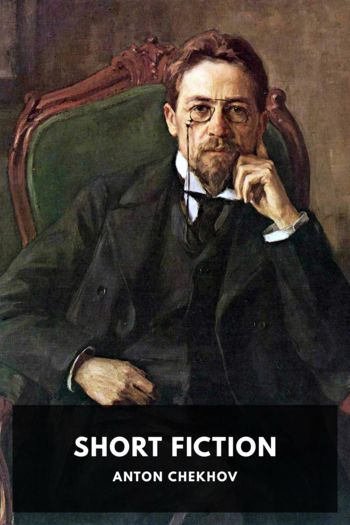
Anton Chekhov is widely considered to be one of the greatest short story writers in history. A physician by day, he’s famously quoted as saying, “Medicine is my lawful wife, and literature is my mistress.” Chekhov wrote nearly 300 short stories in his long writing career; while at first he wrote mainly to make a profit, as his interest in writing—and his skill—grew, he wrote stories that heavily influenced the modern development of the form.
His stories are famous for, among other things, their ambiguous morality and their often inconclusive nature. Chekhov was a firm believer that the role of the artist was to correctly pose a question, but not necessarily to answer it.
This collection contains all of his short stories and two novellas, all translated by Constance Garnett, and arranged by the date they were originally published.
Read free book «Short Fiction by Anton Chekhov (libby ebook reader .txt) 📕» - read online or download for free at americanlibrarybooks.com
- Author: Anton Chekhov
Read book online «Short Fiction by Anton Chekhov (libby ebook reader .txt) 📕». Author - Anton Chekhov
“How naive she is!” I thought with surprise. “What a child!”
I felt both vexed and amused.
VMy wife had already collected eight thousand; with my five it would be thirteen thousand. For a start that was very good. The business which had so worried and interested me was at last in my hands; I was doing what the others would not and could not do; I was doing my duty, organizing the relief fund in a practical and businesslike way.
Everything seemed to be going in accordance with my desires and intentions; but why did my feeling of uneasiness persist? I spent four hours over my wife’s papers, making out their meaning and correcting her mistakes, but instead of feeling soothed, I felt as though someone were standing behind me and rubbing my back with a rough hand. What was it I wanted? The organization of the relief fund had come into trustworthy hands, the hungry would be fed—what more was wanted?
The four hours of this light work for some reason exhausted me, so that I could not sit bending over the table nor write. From below I heard from time to time a smothered moan; it was my wife sobbing. Alexey, invariably meek, sleepy, and sanctimonious, kept coming up to the table to see to the candles, and looked at me somewhat strangely.
“Yes, I must go away,” I decided at last, feeling utterly exhausted. “As far as possible from these agreeable impressions! I will set off tomorrow.”
I gathered together the papers and exercise books, and went down to my wife. As, feeling quite worn out and shattered, I held the papers and the exercise books to my breast with both hands, and passing through my bedroom saw my trunks, the sound of weeping reached me through the floor.
“Are you a kammer-junker?” a voice whispered in my ear. “That’s a very pleasant thing. But yet you are a reptile.”
“It’s all nonsense, nonsense, nonsense,” I muttered as I went downstairs. “Nonsense … and it’s nonsense, too, that I am actuated by vanity or a love of display. … What rubbish! Am I going to get a decoration for working for the peasants or be made the director of a department? Nonsense, nonsense! And who is there to show off to here in the country?”
I was tired, frightfully tired, and something kept whispering in my ear: “Very pleasant. But, still, you are a reptile.” For some reason I remembered a line out of an old poem I knew as a child: “How pleasant it is to be good!”
My wife was lying on the couch in the same attitude, on her face and with her hands clutching her head. She was crying. A maid was standing beside her with a perplexed and frightened face. I sent the maid away, laid the papers on the table, thought a moment and said:
“Here are all your papers, Natalie. It’s all in order, it’s all capital, and I am very much pleased. I am going away tomorrow.”
She went on crying. I went into the drawing room and sat there in the dark. My wife’s sobs, her sighs, accused me of something, and to justify myself I remembered the whole of our quarrel, starting from my unhappy idea of inviting my wife to our consultation and ending with the exercise books and these tears. It was an ordinary attack of our conjugal hatred, senseless and unseemly, such as had been frequent during our married life, but what had the starving peasants to do with it? How could it have happened that they had become a bone of contention between us? It was just as though pursuing one another we had accidentally run up to the altar and had carried on a quarrel there.
“Natalie,” I said softly from the drawing room, “hush, hush!”
To cut short her weeping and make an end of this agonizing state of affairs, I ought to have gone up to my wife and comforted her, caressed her, or apologized; but how could I do it so that she would believe me? How could I persuade the wild duck, living in captivity and hating me, that it was dear to me, and that I felt for its sufferings? I had never known my wife, so I had never known how to talk to her or what to talk about. Her appearance I knew very well and appreciated it as it deserved, but her spiritual, moral world, her mind, her outlook on life, her frequent changes of mood, her eyes full of hatred, her disdain, the scope and variety of her reading which sometimes struck me, or, for instance, the nun-like expression I had seen on her face the day before—all that was unknown and incomprehensible to me. When in my collisions with her I tried to define what sort of a person she was, my psychology went no farther than deciding that she was giddy, impractical, ill-tempered, guided by feminine logic; and it seemed to me that that was quite sufficient. But now that she was crying I had a passionate desire to know more.
The weeping ceased. I went up to my wife. She sat up on the couch, and, with her head propped in both hands, looked fixedly and dreamily at the fire.
“I am going away tomorrow morning,” I said.
She said nothing. I walked across the room, sighed, and said:
“Natalie, when you begged me to go away, you said: ‘I will forgive you everything, everything.’ … So you think I have wronged you. I beg you calmly and in brief terms to formulate the wrong I’ve done you.”
“I am worn out. Afterwards, some time …” said my wife.
“How am I to blame?” I went on. “What have I done? Tell me: you are young and beautiful, you want to live, and I am nearly twice your age and hated by you, but is that my fault? I didn’t marry you by force. But if you want to live in freedom,



Comments (0)