Short Fiction by Anton Chekhov (libby ebook reader .txt) 📕
Description
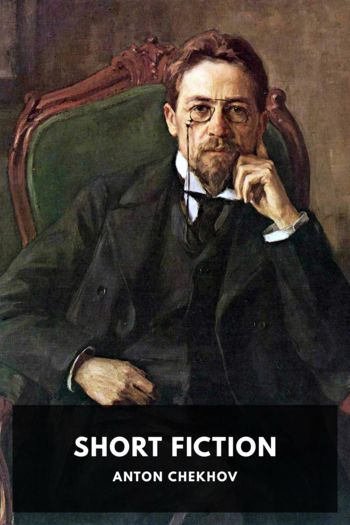
Anton Chekhov is widely considered to be one of the greatest short story writers in history. A physician by day, he’s famously quoted as saying, “Medicine is my lawful wife, and literature is my mistress.” Chekhov wrote nearly 300 short stories in his long writing career; while at first he wrote mainly to make a profit, as his interest in writing—and his skill—grew, he wrote stories that heavily influenced the modern development of the form.
His stories are famous for, among other things, their ambiguous morality and their often inconclusive nature. Chekhov was a firm believer that the role of the artist was to correctly pose a question, but not necessarily to answer it.
This collection contains all of his short stories and two novellas, all translated by Constance Garnett, and arranged by the date they were originally published.
Read free book «Short Fiction by Anton Chekhov (libby ebook reader .txt) 📕» - read online or download for free at americanlibrarybooks.com
- Author: Anton Chekhov
Read book online «Short Fiction by Anton Chekhov (libby ebook reader .txt) 📕». Author - Anton Chekhov
My wife, looking intently and with curiosity into my face, suddenly uttered a faint cry, burst into tears, and ran into the next room. I went upstairs to my own storey.
An hour later I was sitting at my table, writing my History of Railways, and the starving peasants did not now hinder me from doing so. Now I feel no uneasiness. Neither the scenes of disorder which I saw when I went the round of the huts at Pestrovo with my wife and Sobol the other day, nor malignant rumours, nor the mistakes of the people around me, nor old age close upon me—nothing disturbs me. Just as the flying bullets do not hinder soldiers from talking of their own affairs, eating and cleaning their boots, so the starving peasants do not hinder me from sleeping quietly and looking after my personal affairs. In my house and far around it there is in full swing the work which Dr. Sobol calls “an orgy of philanthropy.” My wife often comes up to me and looks about my rooms uneasily, as though looking for what more she can give to the starving peasants “to justify her existence,” and I see that, thanks to her, there will soon be nothing of our property left and we shall be poor; but that does not trouble me, and I smile at her gaily. What will happen in the future I don’t know.
The Grasshopper IAll Olga Ivanovna’s friends and acquaintances were at her wedding.
“Look at him; isn’t it true that there is something in him?” she said to her friends, with a nod towards her husband, as though she wanted to explain why she was marrying a simple, very ordinary, and in no way remarkable man.
Her husband, Osip Stepanitch Dymov, was a doctor, and only of the rank of a titular councillor. He was on the staff of two hospitals: in one a ward-surgeon and in the other a dissecting demonstrator. Every day from nine to twelve he saw patients and was busy in his ward, and after twelve o’clock he went by tram to the other hospital, where he dissected. His private practice was a small one, not worth more than five hundred roubles a year. That was all. What more could one say about him? Meanwhile, Olga Ivanovna and her friends and acquaintances were not quite ordinary people. Every one of them was remarkable in some way, and more or less famous; already had made a reputation and was looked upon as a celebrity; or if not yet a celebrity, gave brilliant promise of becoming one. There was an actor from the Dramatic Theatre, who was a great talent of established reputation, as well as an elegant, intelligent, and modest man, and a capital elocutionist, and who taught Olga Ivanovna to recite; there was a singer from the opera, a good-natured, fat man who assured Olga Ivanovna, with a sigh, that she was ruining herself, that if she would take herself in hand and not be lazy she might make a remarkable singer; then there were several artists, and chief among them Ryabovsky, a very handsome, fair young man of five-and-twenty who painted genre pieces, animal studies, and landscapes, was successful at exhibitions, and had sold his last picture for five hundred roubles. He touched up Olga Ivanovna’s sketches, and used to say she might do something. Then a violoncellist, whose instrument used to sob, and who openly declared that of all the ladies of his acquaintance the only one who could accompany him was Olga Ivanovna; then there was a literary man, young but already well known, who had written stories, novels, and plays. Who else? Why, Vassily Vassilyitch, a landowner and amateur illustrator and vignettist, with a great feeling for the old Russian style, the old ballad and epic. On paper, on china, and on smoked plates, he produced literally marvels. In the midst of this free artistic company, spoiled by fortune, though refined and modest, who recalled the existence of doctors only in times of illness, and to whom the name of Dymov sounded in no way different from Sidorov or Tarasov—in the midst of this company Dymov seemed strange, not wanted, and small, though he was tall and broad-shouldered. He looked as though he had on somebody else’s coat, and his beard was like a shopman’s. Though if he had been a writer or an artist, they would have said that his beard reminded them of Zola.
An artist said to Olga Ivanovna that with her flaxen hair and in her wedding dress she was very much like a graceful cherry tree when it is covered all over with delicate white blossoms in spring.
“Oh, let me tell you,” said Olga Ivanovna, taking his arm, “how it was it all came to pass so suddenly. Listen, listen! … I must tell you that my father was on the same staff at the hospital as Dymov. When my poor father was taken ill, Dymov watched for days and nights together at his bedside. Such self-sacrifice! Listen, Ryabovsky! You, my writer, listen; it is very interesting! Come nearer. Such self-sacrifice, such genuine sympathy! I sat up with my father, and did not sleep for nights, either. And all at once—the princess had won the hero’s heart—my Dymov fell head over ears in love. Really, fate is so strange at times! Well, after my father’s death he came to see me sometimes, met me in the street, and one fine evening, all at once he made me an offer … like snow upon my head. … I lay awake all night, crying, and fell hellishly in love myself. And here, as you see, I am his wife. There really is something strong, powerful, bearlike



Comments (0)