Short Fiction by Anton Chekhov (libby ebook reader .txt) 📕
Description
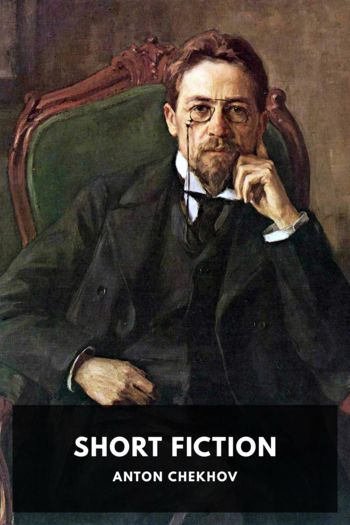
Anton Chekhov is widely considered to be one of the greatest short story writers in history. A physician by day, he’s famously quoted as saying, “Medicine is my lawful wife, and literature is my mistress.” Chekhov wrote nearly 300 short stories in his long writing career; while at first he wrote mainly to make a profit, as his interest in writing—and his skill—grew, he wrote stories that heavily influenced the modern development of the form.
His stories are famous for, among other things, their ambiguous morality and their often inconclusive nature. Chekhov was a firm believer that the role of the artist was to correctly pose a question, but not necessarily to answer it.
This collection contains all of his short stories and two novellas, all translated by Constance Garnett, and arranged by the date they were originally published.
Read free book «Short Fiction by Anton Chekhov (libby ebook reader .txt) 📕» - read online or download for free at americanlibrarybooks.com
- Author: Anton Chekhov
Read book online «Short Fiction by Anton Chekhov (libby ebook reader .txt) 📕». Author - Anton Chekhov
“But you will send for Shrek?” said Olga Ivanovna.
“He has been already. It was he noticed that the diphtheria had passed into the nose. What’s the use of Shrek! Shrek’s no use at all, really. He is Shrek, I am Korostelev, and nothing more.”
The time dragged on fearfully slowly. Olga Ivanovna lay down in her clothes on her bed, that had not been made all day, and sank into a doze. She dreamed that the whole flat was filled up from floor to ceiling with a huge piece of iron, and that if they could only get the iron out they would all be lighthearted and happy. Waking, she realized that it was not the iron but Dymov’s illness that was weighing on her.
“Nature morte, port …” she thought, sinking into forgetfulness again. “Sport … Kurort … and what of Shrek? Shrek … trek … wreck. … And where are my friends now? Do they know that we are in trouble? Lord, save … spare! Shrek … trek …”
And again the iron was there. … The time dragged on slowly, though the clock on the lower storey struck frequently. And bells were continually ringing as the doctors arrived. … The housemaid came in with an empty glass on a tray, and asked, “Shall I make the bed, madam?” and getting no answer, went away.
The clock below struck the hour. She dreamed of the rain on the Volga; and again someone came into her bedroom, she thought a stranger. Olga Ivanovna jumped up, and recognized Korostelev.
“What time is it?” she asked.
“About three.”
“Well, what is it?”
“What, indeed! … I’ve come to tell you he is passing. …”
He gave a sob, sat down on the bed beside her, and wiped away the tears with his sleeve. She could not grasp it at once, but turned cold all over and began slowly crossing herself.
“He is passing,” he repeated in a shrill voice, and again he gave a sob. “He is dying because he sacrificed himself. What a loss for science!” he said bitterly. “Compare him with all of us. He was a great man, an extraordinary man! What gifts! What hopes we all had of him!” Korostelev went on, wringing his hands: “Merciful God, he was a man of science; we shall never look on his like again. Osip Dymov, what have you done—aie, aie, my God!”
Korostelev covered his face with both hands in despair, and shook his head.
“And his moral force,” he went on, seeming to grow more and more exasperated against someone. “Not a man, but a pure, good, loving soul, and clean as crystal. He served science and died for science. And he worked like an ox night and day—no one spared him—and with his youth and his learning he had to take a private practice and work at translations at night to pay for these … vile rags!”
Korostelev looked with hatred at Olga Ivanovna, snatched at the sheet with both hands and angrily tore it, as though it were to blame.
“He did not spare himself, and others did not spare him. Oh, what’s the use of talking!”
“Yes, he was a rare man,” said a bass voice in the drawing room.
Olga Ivanovna remembered her whole life with him from the beginning to the end, with all its details, and suddenly she understood that he really was an extraordinary, rare, and, compared with everyone else she knew, a great man. And remembering how her father, now dead, and all the other doctors had behaved to him, she realized that they really had seen in him a future celebrity. The walls, the ceiling, the lamp, and the carpet on the floor, seemed to be winking at her sarcastically, as though they would say, “You were blind! you were blind!” With a wail she flung herself out of the bedroom, dashed by some unknown man in the drawing room, and ran into her husband’s study. He was lying motionless on the sofa, covered to the waist with a quilt. His face was fearfully thin and sunken, and was of a greyish-yellow colour such as is never seen in the living; only from the forehead, from the black eyebrows and from the familiar smile, could he be recognized as Dymov. Olga Ivanovna hurriedly felt his chest, his forehead, and his hands. The chest was still warm, but the forehead and hands were unpleasantly cold, and the half-open eyes looked, not at Olga Ivanovna, but at the quilt.
“Dymov!” she called aloud, “Dymov!” She wanted to explain to him that it had been a mistake, that all was not lost, that life might still be beautiful and happy, that he was an extraordinary, rare, great man, and that she would all her life worship him and bow down in homage and holy awe before him. …
“Dymov!” she called him, patting him on the shoulder, unable to believe that he would never wake again. “Dymov! Dymov!”
In the drawing room Korostelev was saying to the housemaid:
“Why keep asking? Go to the church beadle and enquire where they live. They’ll wash the body and lay it out, and do everything that is necessary.”
After the TheatreNadya Zelenin had just come back with her mamma from the theatre where she had seen a performance of Yevgeny Onyegin. As soon as she reached her own room she threw off her dress, let down her hair, and in her petticoat and white dressing-jacket hastily sat down to the table to write a letter like Tatyana’s.
“I love you,” she wrote, “but you do not love me, do not love me!”
She wrote it and laughed.
She was only sixteen and did not yet love anyone. She knew that an officer called Gorny and a student called Gruzdev loved her, but now after the opera she wanted to be doubtful of their love. To be unloved and unhappy—how interesting that was. There is something beautiful, touching, and poetical about it when one loves and



Comments (0)