Short Fiction by Anton Chekhov (libby ebook reader .txt) 📕
Description
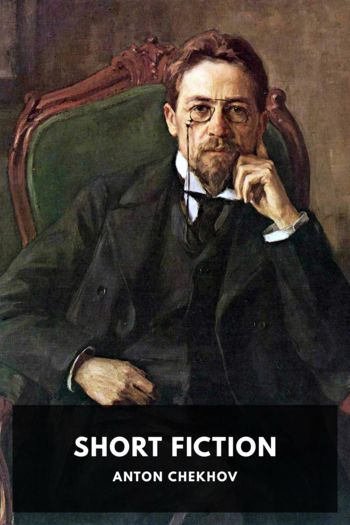
Anton Chekhov is widely considered to be one of the greatest short story writers in history. A physician by day, he’s famously quoted as saying, “Medicine is my lawful wife, and literature is my mistress.” Chekhov wrote nearly 300 short stories in his long writing career; while at first he wrote mainly to make a profit, as his interest in writing—and his skill—grew, he wrote stories that heavily influenced the modern development of the form.
His stories are famous for, among other things, their ambiguous morality and their often inconclusive nature. Chekhov was a firm believer that the role of the artist was to correctly pose a question, but not necessarily to answer it.
This collection contains all of his short stories and two novellas, all translated by Constance Garnett, and arranged by the date they were originally published.
Read free book «Short Fiction by Anton Chekhov (libby ebook reader .txt) 📕» - read online or download for free at americanlibrarybooks.com
- Author: Anton Chekhov
Read book online «Short Fiction by Anton Chekhov (libby ebook reader .txt) 📕». Author - Anton Chekhov
“Good! good!” said the Tatar, shivering with cold.
“What is good?” asked Canny.
“His wife, his daughter. … What of prison and what of sorrow!—anyway, he did see his wife and his daughter. … You say, want nothing. But ‘nothing’ is bad! His wife lived with him three years—that was a gift from God. ‘Nothing’ is bad, but three years is good. How not understand?”
Shivering and hesitating, with effort picking out the Russian words of which he knew but few, the Tatar said that God forbid one should fall sick and die in a strange land, and be buried in the cold and dark earth; that if his wife came to him for one day, even for one hour, that for such happiness he would be ready to bear any suffering and to thank God. Better one day of happiness than nothing.
Then he described again what a beautiful and clever wife he had left at home. Then, clutching his head in both hands, he began crying and assuring Semyon that he was not guilty, and was suffering for nothing. His two brothers and an uncle had carried off a peasant’s horses, and had beaten the old man till he was half dead, and the commune had not judged fairly, but had contrived a sentence by which all the three brothers were sent to Siberia, while the uncle, a rich man, was left at home.
“You will get used to it!” said Semyon.
The Tatar was silent, and stared with tear-stained eyes at the fire; his face expressed bewilderment and fear, as though he still did not understand why he was here in the darkness and the wet, beside strangers, and not in the Simbirsk province.
Canny lay near the fire, chuckled at something, and began humming a song in an undertone.
“What joy has she with her father?” he said a little later. “He loves her and he rejoices in her, that’s true; but, mate, you must mind your p’s and q’s with him, he is a strict old man, a harsh old man. And young wenches don’t want strictness. They want petting and ha-ha-ha! and ho-ho-ho! and scent and pomade. Yes. … Ech! life, life,” sighed Semyon, and he got up heavily. “The vodka is all gone, so it is time to sleep. Eh? I am going, my lad. …”
Left alone, the Tatar put on more twigs, lay down and stared at the fire; he began thinking of his own village and of his wife. If his wife could only come for a month, for a day; and then if she liked she might go back again. Better a month or even a day than nothing. But if his wife kept her promise and came, what would he have to feed her on? Where could she live here?
“If there were not something to eat, how could she live?” the Tatar asked aloud.
He was paid only ten kopecks for working all day and all night at the oar; it is true that travelers gave him tips for tea and for vodkas but the men shared all they received among themselves, and gave nothing to the Tatar, but only laughed at him. And from poverty he was hungry, cold, and frightened. … Now, when his whole body was aching and shivering, he ought to go into the hut and lie down to sleep; but he had nothing to cover him there, and it was colder than on the riverbank; here he had nothing to cover him either, but at least he could make up the fire. …
In another week, when the floods were quite over and they set the ferry going, none of the ferrymen but Semyon would be wanted, and the Tatar would begin going from village to village begging for alms and for work. His wife was only seventeen; she was beautiful, spoilt, and shy; could she possibly go from village to village begging alms with her face unveiled? No, it was terrible even to think of that. …
It was already getting light; the barge, the bushes of willow on the water, and the waves could be clearly discerned, and if one looked round there was the steep clay slope; at the bottom of it the hut thatched with dingy brown straw, and the huts of the village lay clustered higher up. The cocks were already crowing in the village.
The rusty red clay slope, the barge, the river, the strange, unkind people, hunger, cold, illness, perhaps all that was not real. Most likely it was all a dream, thought the Tatar. He felt that he was asleep and heard his own snoring. … Of course he was at home in the Simbirsk province, and he had only to call his wife by name for her to answer; and in the next room was his mother. … What terrible dreams there are, though! What are they for? The Tatar smiled and opened his eyes. What river was this, the Volga?
Snow was falling.
“Boat!” was shouted on the further side. “Boat!”
The Tatar woke up, and went to wake his mates and row over to the other side. The ferrymen came on to the riverbank, putting on their torn sheepskins as they walked, swearing with voices husky from sleepiness and shivering from the cold. On waking from their sleep, the river, from which came a breath of piercing cold, seemed to strike them as revolting and horrible. They jumped into the barge without hurrying themselves. … The Tatar and the three ferrymen took the long, broad-bladed oars, which in the darkness looked like the claws of crabs; Semyon leaned his stomach against the tiller. The shout on the other side still continued, and two shots were fired from a revolver, probably with the idea that the ferrymen were asleep or had gone to the pothouse in the village.
“All right, you have plenty of time,” said Semyon in




Comments (0)