Short Fiction by Anton Chekhov (libby ebook reader .txt) 📕
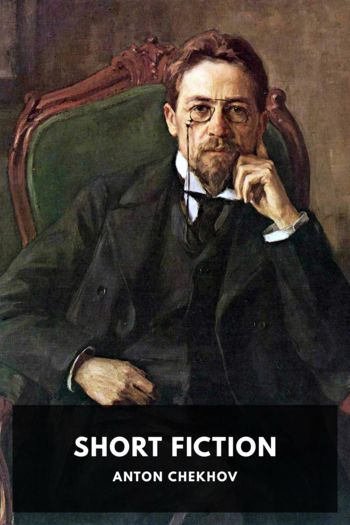
Description
Anton Chekhov is widely considered to be one of the greatest short story writers in history. A physician by day, he’s famously quoted as saying, “Medicine is my lawful wife, and literature is my mistress.” Chekhov wrote nearly 300 short stories in his long writing career; while at first he wrote mainly to make a profit, as his interest in writing—and his skill—grew, he wrote stories that heavily influenced the modern development of the form.
His stories are famous for, among other things, their ambiguous morality and their often inconclusive nature. Chekhov was a firm believer that the role of the artist was to correctly pose a question, but not necessarily to answer it.
This collection contains all of his short stories and two novellas, all translated by Constance Garnett, and arranged by the date they were originally published.
Read free book «Short Fiction by Anton Chekhov (libby ebook reader .txt) 📕» - read online or download for free at americanlibrarybooks.com
- Author: Anton Chekhov
Read book online «Short Fiction by Anton Chekhov (libby ebook reader .txt) 📕». Author - Anton Chekhov
Rashevitch stood still, combing his beard with both hands; his shadow, too, stood still on the wall, looking like a pair of scissors.
“Take Mother-Russia now,” he went on, thrusting his hands in his pockets and standing first on his heels and then on his toes. “Who are her best people? Take our first-rate painters, writers, composers. … Who are they? They were all of aristocratic origin. Pushkin, Lermontov, Turgenev, Gontcharov, Tolstoy, they were not sexton’s children.”
“Gontcharov was a merchant,” said Meier.
“Well, the exception only proves the rule. Besides, Gontcharov’s genius is quite open to dispute. But let us drop names and turn to facts. What would you say, my good sir, for instance, to this eloquent fact: when one of the mob forces his way where he has not been permitted before, into society, into the world of learning, of literature, into the Zemstvo or the law courts, observe, Nature herself, first of all, champions the higher rights of humanity, and is the first to wage war on the rabble. As soon as the plebeian forces himself into a place he is not fit for he begins to ail, to go into consumption, to go out of his mind, and to degenerate, and nowhere do we find so many puny, neurotic wrecks, consumptives, and starvelings of all sorts as among these darlings. They die like flies in autumn. If it were not for this providential degeneration there would not have been a stone left standing of our civilization, the rabble would have demolished everything. Tell me, if you please, what has the inroad of the barbarians given us so far? What has the rabble brought with it?” Rashevitch assumed a mysterious, frightened expression, and went on: “Never has literature and learning been at such low ebb among us as now. The men of today, my good sir, have neither ideas nor ideals, and all their sayings and doings are permeated by one spirit—to get all they can and to strip someone to his last thread. All these men of today who give themselves out as honest and progressive people can be bought at a rouble a piece, and the distinguishing mark of the ‘intellectual’ of today is that you have to keep strict watch over your pocket when you talk to him, or else he will run off with your purse.” Rashevitch winked and burst out laughing. “Upon my soul, he will!” he said, in a thin, gleeful voice. “And morals! What of their morals?” Rashevitch looked round towards the door. “No one is surprised nowadays when a wife robs and leaves her husband. What’s that, a trifle! Nowadays, my dear boy, a chit of a girl of twelve is scheming to get a lover, and all these amateur theatricals and literary evenings are only invented to make it easier to get a rich merchant to take a girl on as his mistress. … Mothers sell their daughters, and people make no bones about asking a husband at what price he sells his wife, and one can haggle over the bargain, you know, my dear. …”
Meier, who had been sitting motionless and silent all the time, suddenly got up from the sofa and looked at his watch.
“I beg your pardon, Pavel Ilyitch,” he said, “it is time for me to be going.”
But Pavel Ilyitch, who had not finished his remarks, put his arm round him and, forcibly reseating him on the sofa, vowed that he would not let him go without supper. And again Meier sat and listened, but he looked at Rashevitch with perplexity and uneasiness, as though he were only now beginning to understand him. Patches of red came into his face. And when at last a maidservant came in to tell them that the young ladies asked them to go to supper, he gave a sigh of relief and was the first to walk out of the study.
At the table in the next room were Rashevitch’s daughters, Genya and Iraida, girls of four-and-twenty and two-and-twenty respectively, both very pale, with black eyes, and exactly the same height. Genya had her hair down, and Iraida had hers done up high on her head. Before eating anything they each drank a wineglassful of bitter liqueur, with an air as though they had drunk it by accident for the first time in their lives and both were overcome with confusion and burst out laughing.
“Don’t be naughty, girls,” said Rashevitch.
Genya and Iraida talked French with each other, and Russian with their father and their visitor. Interrupting one another, and mixing up French words with Russian, they began rapidly describing how just at this time in August, in previous years, they had set off to the boarding school and what fun it had been. Now there was nowhere to go, and they had to stay at their home in the country, summer and winter without change. Such dreariness!
“Don’t be naughty, girls,” Rashevitch said again.
He wanted to be talking himself. If other people talked in his presence, he suffered from a feeling like jealousy.
“So that’s how it is, my dear boy,” he began, looking affectionately at Meier. “In the simplicity and goodness of our hearts, and from fear of being suspected of





Comments (0)