Short Fiction by Anton Chekhov (libby ebook reader .txt) 📕
Description
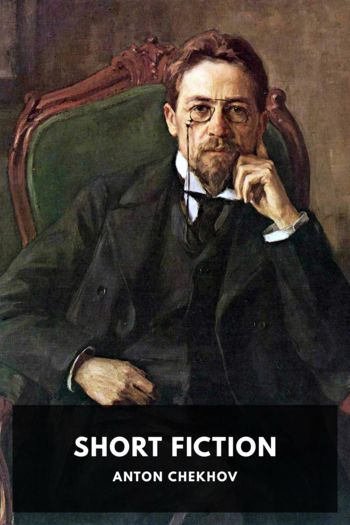
Anton Chekhov is widely considered to be one of the greatest short story writers in history. A physician by day, he’s famously quoted as saying, “Medicine is my lawful wife, and literature is my mistress.” Chekhov wrote nearly 300 short stories in his long writing career; while at first he wrote mainly to make a profit, as his interest in writing—and his skill—grew, he wrote stories that heavily influenced the modern development of the form.
His stories are famous for, among other things, their ambiguous morality and their often inconclusive nature. Chekhov was a firm believer that the role of the artist was to correctly pose a question, but not necessarily to answer it.
This collection contains all of his short stories and two novellas, all translated by Constance Garnett, and arranged by the date they were originally published.
Read free book «Short Fiction by Anton Chekhov (libby ebook reader .txt) 📕» - read online or download for free at americanlibrarybooks.com
- Author: Anton Chekhov
Read book online «Short Fiction by Anton Chekhov (libby ebook reader .txt) 📕». Author - Anton Chekhov
The lawyer Lysevitch, a tall, handsome fair man, with a slight sprinkling of grey on his temples and beard, was distinguished by exceptionally elegant manners; he walked with a swaying step, bowed as it were reluctantly, and shrugged his shoulders as he talked, and all this with an indolent grace, like a spoiled horse fresh from the stable. He was well fed, extremely healthy, and very well off; on one occasion he had won forty thousand roubles, but concealed the fact from his friends. He was fond of good fare, especially cheese, truffles, and grated radish with hemp oil; while in Paris he had eaten, so he said, baked but unwashed guts. He spoke smoothly, fluently, without hesitation, and only occasionally, for the sake of effect, permitted himself to hesitate and snap his fingers as if picking up a word. He had long ceased to believe in anything he had to say in the law courts, or perhaps he did believe in it, but attached no kind of significance to it; it had all so long been familiar, stale, ordinary. … He believed in nothing but what was original and unusual. A copybook moral in an original form would move him to tears. Both his notebooks were filled with extraordinary expressions which he had read in various authors; and when he needed to look up any expression, he would search nervously in both books, and usually failed to find it. Anna Akimovna’s father had in a good-humoured moment ostentatiously appointed him legal adviser in matters concerning the factory, and had assigned him a salary of twelve thousand roubles. The legal business of the factory had been confined to two or three trivial actions for recovering debts, which Lysevitch handed to his assistants.
Anna Akimovna knew that he had nothing to do at the factory, but she could not dismiss him—she had not the moral courage; and besides, she was used to him. He used to call himself her legal adviser, and his salary, which he invariably sent for on the first of the month punctually, he used to call “stern prose.” Anna Akimovna knew that when, after her father’s death, the timber of her forest was sold for railway sleepers, Lysevitch had made more than fifteen thousand out of the transaction, and had shared it with Nazaritch. When first she found out they had cheated her she had wept bitterly, but afterwards she had grown used to it.
Wishing her a happy Christmas, and kissing both her hands, he looked her up and down, and frowned.
“You mustn’t,” he said with genuine disappointment. “I have told you, my dear, you mustn’t!”
“What do you mean, Viktor Nikolaitch?”
“I have told you you mustn’t get fat. All your family have an unfortunate tendency to grow fat. You mustn’t,” he repeated in an imploring voice, and kissed her hand. “You are so handsome! You are so splendid! Here, your Excellency, let me introduce the one woman in the world whom I have ever seriously loved.”
“There is nothing surprising in that. To know Anna Akimovna at your age and not to be in love with her, that would be impossible.”
“I adore her,” the lawyer continued with perfect sincerity, but with his usual indolent grace. “I love her, but not because I am a man and she is a woman. When I am with her I always feel as though she belongs to some third sex, and I to a fourth, and we float away together into the domain of the subtlest shades, and there we blend into the spectrum. Leconte de Lisle defines such relations better than anyone. He has a superb passage, a marvellous passage. …”
Lysevitch rummaged in one notebook, then in the other, and, not finding the quotation, subsided. They began talking of the weather, of the opera, of the arrival, expected shortly, of Duse. Anna Akimovna remembered that the year before Lysevitch and, she fancied, Krylin had dined with her, and now when they were getting ready to go away, she began with perfect sincerity pointing out to them in an imploring voice that as they had no more visits to pay, they ought to remain to dinner with her. After some hesitation the visitors agreed.
In addition to the family dinner, consisting of cabbage soup, sucking pig, goose with apples, and so on, a so-called “French” or “chef’s” dinner used to be prepared in the kitchen on great holidays, in case any visitor in the upper story wanted a meal. When they heard the clatter of crockery in the dining room, Lysevitch began to betray a noticeable excitement; he rubbed his hands, shrugged his shoulders, screwed up his eyes, and described with feeling what dinners her father and uncle used to give at one time, and a marvellous matelote of turbots the cook here could make: it was not a matelote, but a veritable revelation! He was already gloating over the dinner, already eating it in imagination and enjoying it. When Anna Akimovna took his arm and led him to the dining room, he tossed off a glass of vodka and put a piece of salmon in his mouth; he positively purred with pleasure. He munched loudly, disgustingly, emitting sounds from his nose, while his eyes grew oily and rapacious.
The hors d’oeuvres were superb; among other things, there were fresh white mushrooms stewed in cream, and sauce provençale made of fried oysters and crayfish, strongly flavoured with some bitter pickles. The dinner, consisting of elaborate holiday dishes, was excellent, and so were the wines. Mishenka waited at table with enthusiasm. When he laid some new dish on the table and lifted the shining cover, or poured out the wine, he did it with the solemnity of a professor of black magic, and, looking at his face and his movements suggesting the first figure of a quadrille, the lawyer




Comments (0)