Arrowsmith by Sinclair Lewis (learn to read books txt) 📕
Description
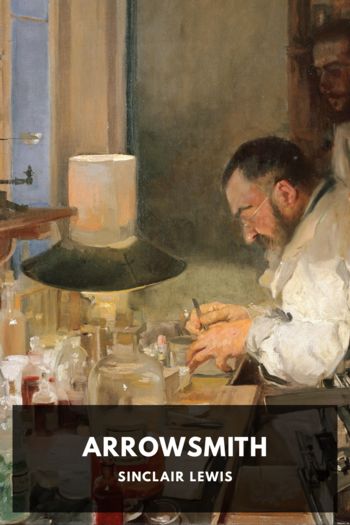
Martin Arrowsmith, the titular protagonist, grows up in a small Midwestern town where he wants to become a doctor. At medical school he meets an abrasive but brilliant professor, Gottlieb, who becomes his mentor. As Arrowsmith completes his training he begins a career practicing medicine. But, echoing Lewis’s Main Street, small-town life becomes too insular and restricting; his interest in research and not people makes him unpopular, and he decides to work in a research laboratory instead.
From there Arrowsmith begins a career that hits all of the ethical quandaries that scientists and those in the medical profession encounter: everything from the ethical problem of research protocol strictness versus saving lives, to doing research for the betterment of mankind versus for turning a profit, to the politics of institutions, to the social problems of wealth and poverty. Arrowsmith struggles with these dilemmas because, like all of us, he isn’t perfect. Despite his interest in helping humanity, he has little interest in people—aside from his serial womanizing—and this makes the path of his career an even harder one to walk. He’s surrounded on all sides by icons of nobility, icons of pride, and icons of rapaciousness, each one distracting him from his calling.
Though the book isn’t strictly a satire, few escape Lewis’s biting pen. He skewers everyone indiscriminately: small-town rubes, big-city blowhards, aspiring politicians, doctors of both the noble and greedy variety, hapless ivory-towered researchers, holier-than-thou neighbors, tedious gilded-age socialites, and even lazy and backwards islanders. In some ways, Arrowsmith rivals Main Street in its often-bleak view of human nature—though unlike Main Street, the good to humanity that science offers is an ultimate light at the end of the tunnel.
The novel’s publication in 1925 made it one of the first serious “science” novels, exploring all aspects of the life and career of a modern scientist. Lewis was aided in the novel’s preparation by Paul de Kruif, a microbiologist and writer, whose medically-accurate contributions greatly enhance the text’s realist flavor.
In 1926 Arrowsmith was awarded the Pulitzer Prize, but Lewis famously declined it. In his refusal letter, he claimed a disinterest in prizes of any kind; but the New York Times reported that those close to him say he was still angered over the Pulitzer’s last-minute snatching of the 1921 prize from Main Street in favor of giving it to The Age of Innocence.
Read free book «Arrowsmith by Sinclair Lewis (learn to read books txt) 📕» - read online or download for free at americanlibrarybooks.com
- Author: Sinclair Lewis
Read book online «Arrowsmith by Sinclair Lewis (learn to read books txt) 📕». Author - Sinclair Lewis
With his spoon held inside the cup by a brawny thumb, the policeman gulped his coffee and proclaimed, while the greasy friendly cook of the lunch-wagon nodded in agreement:
“Well, if you want the straight dope, he hollers a good deal, but he’s one awful brainy man. He certainly can sling the Queen’s English, and jever hear one of his poems? They’re darn bright. I’ll tell you: There’s some people say Pickerbaugh pulls the song and dance too much, but way I figure it, course maybe for you and me, Doctor, it’d be all right if he just looked after the milk and the garbage and the kids’ teeth. But there’s a lot of careless, ignorant, foreign slobs that need to be jollied into using their konks about these health biznai, so’s they won’t go getting sick with a lot of these infectious diseases and pass ’em on to the rest of us, and believe me, old Doc Pickerbaugh is the boy that gets the idea into their noodles!
“Yes, sir, he’s a great old coot—he ain’t a clam like some of these docs. Why, say, one day he showed up at the St. Patrick picnic, even if he is a dirty Protestant, and him and Father Costello chummed up like two old cronies, and darn if he didn’t wrestle a fellow half his age, and awful near throw him, yes, you bet he did, he certainly give that young fellow a run for his money all right! We fellows on the Force all like him, and we have to grin, the way he comes around and soft-soaps us into doing a lot of health work that by law we ain’t hardly supposed to do, you might say, instead of issuing a lot of fool orders. You bet. He’s a real guy.”
“I see,” said Martin, and as he returned to the hotel he meditated:
“But think of what Gottlieb would say about him.
“Damn Gottlieb! Damn everybody except Leora!
“I’m not going to fail here, way I did in Wheatsylvania.
“Some day Pickerbaugh will get a bigger job—Huh! He’s just the kind of jollying fourflusher that would climb! But anyway, I’ll have my training then, and maybe I’ll make a real health department here.
“Orchid said we’d go skating this winter—
“Damn Orchid!”
XX IMartin found in Dr. Pickerbaugh a generous chief. He was eager to have Martin invent and clamor about his own Causes and Movements. His scientific knowledge was rather thinner than that of the visiting nurses, but he had little jealousy, and he demanded of Martin only the belief that a rapid and noisy moving from place to place is the means (and possibly the end) of Progress.
In a two-family house on Social Hill, which is not a hill but a slight swelling in the plain, Martin and Leora found an upper floor. There was a simple pleasantness in these continuous lawns, these wide maple-shaded streets, and a joy in freedom from the peering whispers of Wheatsylvania.
Suddenly they were being courted by the Nice Society of Nautilus.
A few days after their arrival Martin was summoned to the telephone to hear a masculine voice rasping:
“Hello. Martin? I bet you can’t guess who this is!”
Martin, very busy, restrained his desire to observe, “You win—g’ by!” and he buzzed, with the cordiality suitable to a new Assistant Director:
“No, I’m afraid I can’t.”
“Well, make a guess.”
“Oh—Clif Clawson?”
“Nope. Say, I see you’re looking fine. Oh, I guess I’ve got you guessing this time! Go on! Have another try!”
The stenographer was waiting to take letters, and Martin had not yet learned to become impersonal and indifferent in her presence. He said with a perceptible tartness:
“Oh, I suppose it’s President Wilson. Look here—”
“Well, Mart, it’s Irve Watters! What do you know about that!”
Apparently the jester expected large gratification, but it took ten seconds for Martin to remember who Irving Watters might be. Then he had it: Watters, the appalling normal medical student whose faith in the good, the true, the profitable, had annoyed him at Digamma Pi. He made his response as hearty as he could:
“Well, well, what you doing here, Irve?”
“Why, I’m settled here. Been here ever since internship. And got a nice little practice, too. Look, Mart, Mrs. Watters and I want you and your wife—I believe you are married, aren’t you?—to come up to the house for dinner, tomorrow evening, and I’ll put you onto all the local slants.”
The dread of Watters’s patronage enabled Martin to lie vigorously:
“Awfully sorry—awfully sorry—got a date for tomorrow evening and the next evening.”
“Then come have lunch with me tomorrow at the Elks’ Club, and you and your wife take dinner with us Sunday noon.”
Hopelessly, “I don’t think I can make it for lunch but—Well, we’ll dine with you Sunday.”
It is one of the major tragedies that nothing is more discomforting than the hearty affection of the Old Friends who never were friends. Martin’s imaginative dismay at being caught here by Watters was not lessened when Leora and he reluctantly appeared on Sunday at one-thirty and were by a fury of Old Friendship dragged back into the days of Digamma Pi.
Watters’s house was new, and furnished in a highly built-in and leaded-glass manner. He had in three years of practice already become didactic and incredibly married; he had put on weight and infallibility; and he had learned many new things about which to be dull. Having been graduated a year earlier than Martin and having married an almost rich wife, he was kind and hospitable with an emphasis which aroused a desire to do homicide. His conversation was a series of maxims and admonitions:
“If you stay with the Department of Public Health for a couple of years and take care to meet the right people, you’ll be able to go into very lucrative practice here. It’s a fine town—prosperous—so few dead beats.
“You want to join the country club and take




Comments (0)