Arrowsmith by Sinclair Lewis (learn to read books txt) 📕
Description
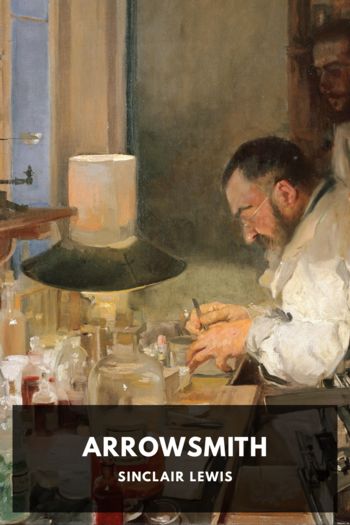
Martin Arrowsmith, the titular protagonist, grows up in a small Midwestern town where he wants to become a doctor. At medical school he meets an abrasive but brilliant professor, Gottlieb, who becomes his mentor. As Arrowsmith completes his training he begins a career practicing medicine. But, echoing Lewis’s Main Street, small-town life becomes too insular and restricting; his interest in research and not people makes him unpopular, and he decides to work in a research laboratory instead.
From there Arrowsmith begins a career that hits all of the ethical quandaries that scientists and those in the medical profession encounter: everything from the ethical problem of research protocol strictness versus saving lives, to doing research for the betterment of mankind versus for turning a profit, to the politics of institutions, to the social problems of wealth and poverty. Arrowsmith struggles with these dilemmas because, like all of us, he isn’t perfect. Despite his interest in helping humanity, he has little interest in people—aside from his serial womanizing—and this makes the path of his career an even harder one to walk. He’s surrounded on all sides by icons of nobility, icons of pride, and icons of rapaciousness, each one distracting him from his calling.
Though the book isn’t strictly a satire, few escape Lewis’s biting pen. He skewers everyone indiscriminately: small-town rubes, big-city blowhards, aspiring politicians, doctors of both the noble and greedy variety, hapless ivory-towered researchers, holier-than-thou neighbors, tedious gilded-age socialites, and even lazy and backwards islanders. In some ways, Arrowsmith rivals Main Street in its often-bleak view of human nature—though unlike Main Street, the good to humanity that science offers is an ultimate light at the end of the tunnel.
The novel’s publication in 1925 made it one of the first serious “science” novels, exploring all aspects of the life and career of a modern scientist. Lewis was aided in the novel’s preparation by Paul de Kruif, a microbiologist and writer, whose medically-accurate contributions greatly enhance the text’s realist flavor.
In 1926 Arrowsmith was awarded the Pulitzer Prize, but Lewis famously declined it. In his refusal letter, he claimed a disinterest in prizes of any kind; but the New York Times reported that those close to him say he was still angered over the Pulitzer’s last-minute snatching of the 1921 prize from Main Street in favor of giving it to The Age of Innocence.
Read free book «Arrowsmith by Sinclair Lewis (learn to read books txt) 📕» - read online or download for free at americanlibrarybooks.com
- Author: Sinclair Lewis
Read book online «Arrowsmith by Sinclair Lewis (learn to read books txt) 📕». Author - Sinclair Lewis
Oh, are you out for happiness or are you out for pelf?
You owe it to the grand old flag to cultivate yourself,
To train the mind, keep clean the streets, and ever guard your health.
Then we’ll all go marching on.
A healthy mind in A clean body,
A healthy mind in A clean body,
A healthy mind in A clean body,
The slogan for one and all.
As a bedtime farewell, the twins then recited, as they had recently at the Congregational Festival, one of their father’s minor lyrics:
What does little birdie say
On the sill at break o’ day?
“Hurrah for health in Nautilus
For Pa and Ma and all of us,
Hurray, hurray, hurray!”
“There, my popsywopsies, up to bed we go!” said Mrs. Pickerbaugh. “Don’t you think, Mrs. Arrowsmith, they’re natural-born actresses? They’re not afraid of any audience, and the way they throw themselves into it—perhaps not Broadway, but the more refined theaters in New York would just love them, and maybe they’ve been sent to us to elevate the drama. Upsy go.”
During her absence the others gave a brief musical program.
Verbena, the second oldest, played Chaminade. (“Of course we all love music, and popularize it among the neighbors, but Verby is perhaps the only real musical genius in the family.”) But the unexpected feature was Orchid’s cornet solo.
Martin dared not look at Leora. It was not that he was sniffily superior to cornet solos, for in Elk Mills, Wheatsylvania, and surprisingly large portions of Zenith, cornet solos were done by the most virtuous females. But he felt that he had been in a madhouse for dozens of years.
“I’ve never been so drunk in my life. I wish I could get at a drink and sober up,” he agonized. He made hysterical and completely impractical plans for escape. Then Mrs. Pickerbaugh, returning from the still audible twins, sat down at the harp.
While she played, a faded woman and thickish, she fell into a great dreaming, and suddenly Martin had a picture of her as a gay, good, dove-like maiden who had admired the energetic young medical student, Almus Pickerbaugh. She must have been a veritable girl of the late eighties and the early nineties, the naive and idyllic age of Howells, when young men were pure, when they played croquet and sang “Swanee River”; a girl who sat on a front porch enchanted by the sweetness of lilacs, and hoped that when Almus and she were married they would have a nickel-plated baseburner stove and a son who would become a missionary or a millionaire.
For the first time that evening, Martin managed to put a respectable heartiness into his “Enjoyed that s’ much.” He felt victorious, and somewhat recovered from his weakness. But the evening’s orgy was only begun.
They played word-games, which Martin hated and Leora did very badly indeed. They acted charades, at which Pickerbaugh was tremendous. The sight of him on the floor in his wife’s fur coat, being a seal on an ice-floe, was incomparable. Then Martin, Orchid, and Hibisca (aged twelve) had to present a charade, and there were complications.
Orchid was as full of simple affections, of smilings and pattings and bouncings, as her younger sisters, but she was nineteen and not altogether a child. Doubtless she was as pure-minded and as devoted to Clean and Wholesome Novels as Dr. Pickerbaugh stated, and he stated it with frequency, but she was not unconscious of young men, even though they were married.
She planned to enact the word “doleful,” with a beggar asking a dole, and a corncrib full. As they skipped upstairs to dress, she hugged Martin’s arm, frisked beside him, and murmured, “Oh, Doctor, I’m so glad Daddy has you for assistant—somebody that’s young and good-looking. Oh, was that dreadful of me? But I mean: you look so athletic and everything, and the other assistant director—don’t tell Daddy I said so, but he was an old crank!”
He was conscious of brown eyes and unshadowed virginal lips. As Orchid put on her agreeably loose costume as a beggar, he was also conscious of ankles and young bosom. She smiled at him, as one who had long known him, and said loyally, “We’ll show ’em! I know you’re a dan-dy actor!”
When they bustled downstairs, as she did not take his arm, he took hers, and he pressed it slightly and felt alarmed and relinquished it with emphasis.
Since his marriage he had been so absorbed in Leora, as lover, as companion, as helper, that till this hour his most devastating adventure had been a glance at a pretty girl in a train. But the flushed young gaiety of Orchid disturbed him. He wanted to be rid of her, he hoped that he would not be altogether rid of her, and for the first time in years he was afraid of Leora’s eyes.
There were acrobatic feats later, and a considerable prominence of Orchid, who did not wear stays, who loved dancing, and who praised Martin’s feats in the game of “Follow the Leader.”
All the daughters save Orchid were sent to bed, and the rest of the fête consisted of what Pickerbaugh called “a little quiet scientific conversation by the fireside,” made up of his observations on good roads, rural sanitation, Ideals in politics, and methods of letter filing in health departments. Through this placid hour, or it may have been an hour and a half, Martin saw that Orchid was observing his hair, his jaw, his hands, and he had, and dismissed, and had again a thought about the innocent agreeableness of holding her small friendly paw.
He also saw that Leora was observing both of them, and he suffered a good deal, and had practically no benefit whatever from Pickerbaugh’s notes on




Comments (0)