Short Fiction by Anton Chekhov (libby ebook reader .txt) 📕
Description
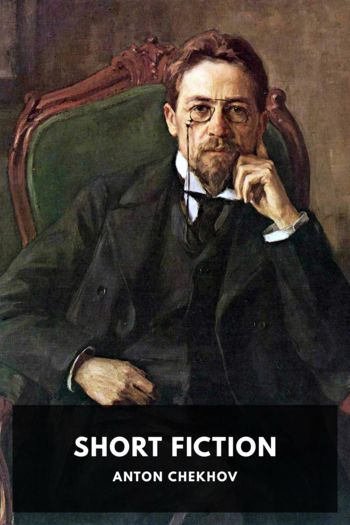
Anton Chekhov is widely considered to be one of the greatest short story writers in history. A physician by day, he’s famously quoted as saying, “Medicine is my lawful wife, and literature is my mistress.” Chekhov wrote nearly 300 short stories in his long writing career; while at first he wrote mainly to make a profit, as his interest in writing—and his skill—grew, he wrote stories that heavily influenced the modern development of the form.
His stories are famous for, among other things, their ambiguous morality and their often inconclusive nature. Chekhov was a firm believer that the role of the artist was to correctly pose a question, but not necessarily to answer it.
This collection contains all of his short stories and two novellas, all translated by Constance Garnett, and arranged by the date they were originally published.
Read free book «Short Fiction by Anton Chekhov (libby ebook reader .txt) 📕» - read online or download for free at americanlibrarybooks.com
- Author: Anton Chekhov
Read book online «Short Fiction by Anton Chekhov (libby ebook reader .txt) 📕». Author - Anton Chekhov
“Goodbye, old fellow!” said Ognev.
Kuznetsov put the lamp on a little table and went out to the verandah. Two long narrow shadows moved down the steps towards the flowerbeds, swayed to and fro, and leaned their heads on the trunks of the lime trees.
“Goodbye and once more thank you, my dear fellow!” said Ivan Alexeyitch. “Thank you for your welcome, for your kindness, for your affection. … I shall never forget your hospitality as long as I live. You are so good, and your daughter is so good, and everyone here is so kind, so good-humoured and friendly … Such a splendid set of people that I don’t know how to say what I feel!”
From excess of feeling and under the influence of the homemade wine he had just drunk, Ognev talked in a singing voice like a divinity student, and was so touched that he expressed his feelings not so much by words as by the blinking of his eyes and the twitching of his shoulders. Kuznetsov, who had also drunk a good deal and was touched, craned forward to the young man and kissed him.
“I’ve grown as fond of you as if I were your dog,” Ognev went on. “I’ve been turning up here almost every day; I’ve stayed the night a dozen times. It’s dreadful to think of all the homemade wine I’ve drunk. And thank you most of all for your cooperation and help. Without you I should have been busy here over my statistics till October. I shall put in my preface: ‘I think it my duty to express my gratitude to the President of the District Zemstvo of N⸺, Kuznetsov, for his kind cooperation.’ There is a brilliant future before statistics! My humble respects to Vera Gavrilovna, and tell the doctors, both the lawyers and your secretary, that I shall never forget their help! And now, old fellow, let us embrace one another and kiss for the last time!”
Ognev, limp with emotion, kissed the old man once more and began going down the steps. On the last step he looked round and asked: “Shall we meet again some day?”
“God knows!” said the old man. “Most likely not!”
“Yes, that’s true! Nothing will tempt you to Petersburg and I am never likely to turn up in this district again. Well, goodbye!”
“You had better leave the books behind!” Kuznetsov called after him. “You don’t want to drag such a weight with you. I would send them by a servant tomorrow!”
But Ognev was rapidly walking away from the house and was not listening. His heart, warmed by the wine, was brimming over with good-humour, friendliness, and sadness. He walked along thinking how frequently one met with good people, and what a pity it was that nothing was left of those meetings but memories. At times one catches a glimpse of cranes on the horizon, and a faint gust of wind brings their plaintive, ecstatic cry, and a minute later, however greedily one scans the blue distance, one cannot see a speck nor catch a sound; and like that, people with their faces and their words flit through our lives and are drowned in the past, leaving nothing except faint traces in the memory. Having been in the N⸺ District from the early spring, and having been almost every day at the friendly Kuznetsovs’, Ivan Alexeyitch had become as much at home with the old man, his daughter, and the servants as though they were his own people; he had grown familiar with the whole house to the smallest detail, with the cosy verandah, the windings of the avenues, the silhouettes of the trees over the kitchen and the bathhouse; but as soon as he was out of the gate all this would be changed to memory and would lose its meaning as reality forever, and in a year or two all these dear images would grow as dim in his consciousness as stories he had read or things he had imagined.
“Nothing in life is so precious as people!” Ognev thought in his emotion, as he strode along the avenue to the gate. “Nothing!”
It was warm and still in the garden. There was a scent of the mignonette, of the tobacco-plants, and of the heliotrope, which were not yet over in the flowerbeds. The spaces between the bushes and the tree-trunks were filled with a fine soft mist soaked through and through with moonlight, and, as Ognev long remembered, coils of mist that looked like phantoms slowly but perceptibly followed one another across the avenue. The moon stood high above the garden, and below it transparent patches of mist were floating eastward. The whole world seemed to consist of nothing but black silhouettes and wandering white shadows. Ognev, seeing the mist on a moonlight August evening almost for the first time in his life, imagined he was seeing, not nature, but a stage effect in which unskilful workmen, trying to light up the garden with white Bengal fire, hid behind the bushes and let off clouds of white smoke together with the light.
When Ognev reached the garden gate a dark shadow moved away from the low fence and came towards him.
“Vera Gavrilovna!” he said, delighted. “You here? And I have been looking everywhere for you; wanted to say goodbye. … Goodbye; I am going away!”
“So early? Why, it’s only eleven o’clock.”
“Yes, it’s time I was off. I have a four-mile walk and then my packing. I must be up early tomorrow.”
Before Ognev stood Kuznetsov’s daughter Vera, a girl of one-and-twenty, as usual melancholy, carelessly dressed, and attractive. Girls who are dreamy and spend whole days lying down, lazily reading whatever they come across, who are bored and melancholy, are usually careless in their dress. To those of them who have been endowed by nature with taste and an instinct of beauty, the slight




Comments (0)