Short Fiction by Anton Chekhov (libby ebook reader .txt) 📕
Description
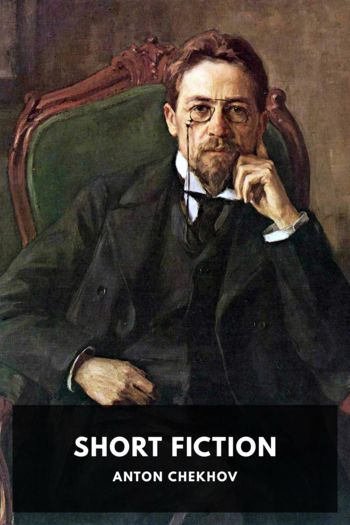
Anton Chekhov is widely considered to be one of the greatest short story writers in history. A physician by day, he’s famously quoted as saying, “Medicine is my lawful wife, and literature is my mistress.” Chekhov wrote nearly 300 short stories in his long writing career; while at first he wrote mainly to make a profit, as his interest in writing—and his skill—grew, he wrote stories that heavily influenced the modern development of the form.
His stories are famous for, among other things, their ambiguous morality and their often inconclusive nature. Chekhov was a firm believer that the role of the artist was to correctly pose a question, but not necessarily to answer it.
This collection contains all of his short stories and two novellas, all translated by Constance Garnett, and arranged by the date they were originally published.
Read free book «Short Fiction by Anton Chekhov (libby ebook reader .txt) 📕» - read online or download for free at americanlibrarybooks.com
- Author: Anton Chekhov
Read book online «Short Fiction by Anton Chekhov (libby ebook reader .txt) 📕». Author - Anton Chekhov
What has happened to him since I don’t know.
And in this room here a street musician lived for ten years. When he died they found twenty thousand roubles in his feather bed.
The Cattle-DealersThe long goods train has been standing for hours in the little station. The engine is as silent as though its fire had gone out; there is not a soul near the train or in the station yard.
A pale streak of light comes from one of the vans and glides over the rails of a siding. In that van two men are sitting on an outspread cape: one is an old man with a big gray beard, wearing a sheepskin coat and a high lambskin hat, somewhat like a busby; the other a beardless youth in a threadbare cloth reefer jacket and muddy high boots. They are the owners of the goods. The old man sits, his legs stretched out before him, musing in silence; the young man half reclines and softly strums on a cheap accordion. A lantern with a tallow candle in it is hanging on the wall near them.
The van is quite full. If one glances in through the dim light of the lantern, for the first moment the eyes receive an impression of something shapeless, monstrous, and unmistakably alive, something very much like gigantic crabs which move their claws and feelers, crowd together, and noiselessly climb up the walls to the ceiling; but if one looks more closely, horns and their shadows, long lean backs, dirty hides, tails, eyes begin to stand out in the dusk. They are cattle and their shadows. There are eight of them in the van. Some turn round and stare at the men and swing their tails. Others try to stand or lie down more comfortably. They are crowded. If one lies down the others must stand and huddle closer. No manger, no halter, no litter, not a wisp of hay. …1
At last the old man pulls out of his pocket a silver watch and looks at the time: a quarter past two.
“We have been here nearly two hours,” he says, yawning. “Better go and stir them up, or we may be here till morning. They have gone to sleep, or goodness knows what they are up to.”
The old man gets up and, followed by his long shadow, cautiously gets down from the van into the darkness. He makes his way along beside the train to the engine, and after passing some two dozen vans sees a red open furnace; a human figure sits motionless facing it; its peaked cap, nose, and knees are lighted up by the crimson glow, all the rest is black and can scarcely be distinguished in the darkness.
“Are we going to stay here much longer?” asks the old man.
No answer. The motionless figure is evidently asleep. The old man clears his throat impatiently and, shrinking from the penetrating damp, walks round the engine, and as he does so the brilliant light of the two engine lamps dazzles his eyes for an instant and makes the night even blacker to him; he goes to the station.
The platform and steps of the station are wet. Here and there are white patches of freshly fallen melting snow. In the station itself it is light and as hot as a steam-bath. There is a smell of paraffin. Except for the weighing-machine and a yellow seat on which a man wearing a guard’s uniform is asleep, there is no furniture in the place at all. On the left are two wide-open doors. Through one of them the telegraphic apparatus and a lamp with a green shade on it can be seen; through the other, a small room, half of it taken up by a dark cupboard. In this room the head guard and the engine-driver are sitting on the windowsill. They are both feeling a cap with their fingers and disputing.
“That’s not real beaver, it’s imitation,” says the engine-driver. “Real beaver is not like that. Five roubles would be a high price for the whole cap, if you care to know!”
“You know a great deal about it, …” the head guard says, offended. “Five roubles, indeed! Here, we will ask the merchant. Mr. Malahin,” he says, addressing the old man, “what do you say: is this imitation beaver or real?”
Old Malahin takes the cap into his hand, and with the air of a connoisseur pinches the fur, blows on it, sniffs at it, and a contemptuous smile lights up his angry face.
“It must be imitation!” he says gleefully. “Imitation it is.”
A dispute follows. The guard maintains that the cap is real beaver, and the engine-driver and Malahin try to persuade him that it is not. In the middle of the argument the old man suddenly remembers the object of his coming.
“Beaver and cap is all very well, but the train’s standing still, gentlemen!” he says. “Who is it we are waiting for? Let us start!”
“Let us,” the guard agrees. “We will smoke another cigarette and go on. But there is no need to be in a hurry. … We shall be delayed at the next station anyway!”
“Why should we?”
“Oh, well. … We are too much behind time. … If you are late at one station you can’t help being delayed at the other stations to let the trains going the opposite way pass. Whether we set off now or in the morning we shan’t be number fourteen. We shall have to be number twenty-three.”
“And how do you make that out?”
“Well, there it is.”
Malahin looks



Comments (0)