Short Fiction by Anton Chekhov (libby ebook reader .txt) 📕
Description
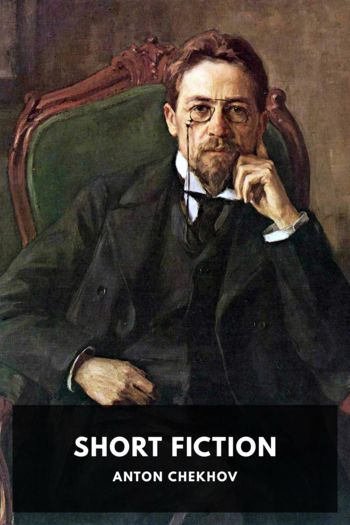
Anton Chekhov is widely considered to be one of the greatest short story writers in history. A physician by day, he’s famously quoted as saying, “Medicine is my lawful wife, and literature is my mistress.” Chekhov wrote nearly 300 short stories in his long writing career; while at first he wrote mainly to make a profit, as his interest in writing—and his skill—grew, he wrote stories that heavily influenced the modern development of the form.
His stories are famous for, among other things, their ambiguous morality and their often inconclusive nature. Chekhov was a firm believer that the role of the artist was to correctly pose a question, but not necessarily to answer it.
This collection contains all of his short stories and two novellas, all translated by Constance Garnett, and arranged by the date they were originally published.
Read free book «Short Fiction by Anton Chekhov (libby ebook reader .txt) 📕» - read online or download for free at americanlibrarybooks.com
- Author: Anton Chekhov
Read book online «Short Fiction by Anton Chekhov (libby ebook reader .txt) 📕». Author - Anton Chekhov
But now the wheat, too, had flashed by; again the parched plain, the sunburnt hills, the sultry sky stretched before them; again a hawk hovered over the earth. In the distance, as before, a windmill whirled its sails, and still it looked like a little man waving his arms. It was wearisome to watch, and it seemed as though one would never reach it, as though it were running away from the chaise.
Father Christopher and Kuzmitchov were silent. Deniska lashed the horses and kept shouting to them, while Yegorushka had left off crying, and gazed about him listlessly. The heat and the tedium of the steppes overpowered him. He felt as though he had been travelling and jolting up and down for a very long time, that the sun had been baking his back a long time. Before they had gone eight miles he began to feel “It must be time to rest.” The geniality gradually faded out of his uncle’s face and nothing else was left but the air of business reserve; and to a gaunt shaven face, especially when it is adorned with spectacles and the nose and temples are covered with dust, this reserve gives a relentless, inquisitorial appearance. Father Christopher never left off gazing with wonder at God’s world, and smiling. Without speaking, he brooded over something pleasant and nice, and a kindly, genial smile remained imprinted on his face. It seemed as though some nice and pleasant thought were imprinted on his brain by the heat.
“Well, Deniska, shall we overtake the wagons today?” asked Kuzmitchov.
Deniska looked at the sky, rose in his seat, lashed at his horses and then answered:
“By nightfall, please God, we shall overtake them.”
There was a sound of dogs barking. Half a dozen steppe sheepdogs, suddenly leaping out as though from ambush, with ferocious howling barks, flew to meet the chaise. All of them, extraordinarily furious, surrounded the chaise, with their shaggy spider-like muzzles and their eyes red with anger, and jostling against one another in their anger, raised a hoarse howl. They were filled with passionate hatred of the horses, of the chaise, and of the human beings, and seemed ready to tear them into pieces. Deniska, who was fond of teasing and beating, was delighted at the chance of it, and with a malignant expression bent over and lashed at the sheepdogs with his whip. The brutes growled more than ever, the horses flew on; and Yegorushka, who had difficulty in keeping his seat on the box, realized, looking at the dogs’ eyes and teeth, that if he fell down they would instantly tear him to bits; but he felt no fear and looked at them as malignantly as Deniska, and regretted that he had no whip in his hand.
The chaise came upon a flock of sheep.
“Stop!” cried Kuzmitchov. “Pull up! Woa!”
Deniska threw his whole body backwards and pulled up the horses.
“Come here!” Kuzmitchov shouted to the shepherd. “Call off the dogs, curse them!”
The old shepherd, tattered and barefoot, wearing a fur cap, with a dirty sack round his loins and a long crook in his hand—a regular figure from the Old Testament—called off the dogs, and taking off his cap, went up to the chaise. Another similar Old Testament figure was standing motionless at the other end of the flock, staring without interest at the travellers.
“Whose sheep are these?” asked Kuzmitchov.
“Varlamov’s,” the old man answered in a loud voice.
“Varlamov’s,” repeated the shepherd standing at the other end of the flock.
“Did Varlamov come this way yesterday or not?”
“He did not; his clerk came. …”
“Drive on!”
The chaise rolled on and the shepherds, with their angry dogs, were left behind. Yegorushka gazed listlessly at the lilac distance in front, and it began to seem as though the windmill, waving its sails, were getting nearer. It became bigger and bigger, grew quite large, and now he could distinguish clearly its two sails. One sail was old and patched, the other had only lately been made of new wood and glistened in the sun. The chaise drove straight on, while the windmill, for some reason, began retreating to the left. They drove on and on, and the windmill kept moving away to the left, and still did not disappear.
“A fine windmill Boltva has put up for his son,” observed Deniska.
“And how is it we don’t see his farm?”
“It is that way, beyond the creek.”
Boltva’s farm, too, soon came into sight, but yet the windmill did not retreat, did not drop behind; it still watched Yegorushka with its shining sail and waved. What a sorcerer!
IITowards midday the chaise turned off the road to the right; it went on a little way at walking pace and then stopped. Yegorushka heard a soft, very caressing gurgle, and felt a different air breathe on his face with a cool velvety touch. Through a little pipe of hemlock stuck there by some unknown benefactor, water was running in a thin trickle from a low hill, put together by nature of huge monstrous stones. It fell to the ground, and limpid, sparkling gaily in the sun, and softly



Comments (0)