Short Fiction by Anton Chekhov (libby ebook reader .txt) 📕
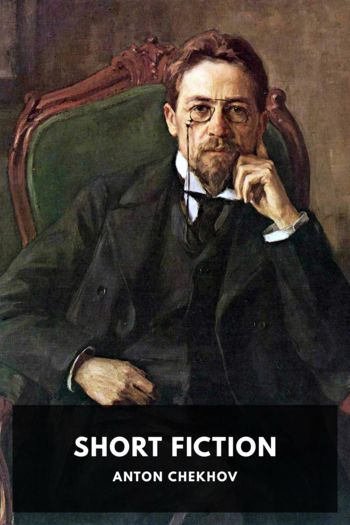
Description
Anton Chekhov is widely considered to be one of the greatest short story writers in history. A physician by day, he’s famously quoted as saying, “Medicine is my lawful wife, and literature is my mistress.” Chekhov wrote nearly 300 short stories in his long writing career; while at first he wrote mainly to make a profit, as his interest in writing—and his skill—grew, he wrote stories that heavily influenced the modern development of the form.
His stories are famous for, among other things, their ambiguous morality and their often inconclusive nature. Chekhov was a firm believer that the role of the artist was to correctly pose a question, but not necessarily to answer it.
This collection contains all of his short stories and two novellas, all translated by Constance Garnett, and arranged by the date they were originally published.
Read free book «Short Fiction by Anton Chekhov (libby ebook reader .txt) 📕» - read online or download for free at americanlibrarybooks.com
- Author: Anton Chekhov
Read book online «Short Fiction by Anton Chekhov (libby ebook reader .txt) 📕». Author - Anton Chekhov
The travellers got out to rest by the stream and feed the horses. Kuzmitchov, Father Christopher and Yegorushka sat down on a mat in the narrow strip of shade cast by the chaise and the unharnessed horses. The nice pleasant thought that the heat had imprinted in Father Christopher’s brain craved expression after he had had a drink of water and eaten a hard-boiled egg. He bent a friendly look upon Yegorushka, munched, and began:
“I studied too, my boy; from the earliest age God instilled into me good sense and understanding, so that while I was just such a lad as you I was beyond others, a comfort to my parents and preceptors by my good sense. Before I was fifteen I could speak and make verses in Latin, just as in Russian. I was the crosier-bearer to his Holiness Bishop Christopher. After mass one day, as I remember it was the patron saint’s day of His Majesty Tsar Alexandr Pavlovitch of blessed memory, he unrobed at the altar, looked kindly at me and asked, ‘Puer bone, quam appelaris?’ And I answered, ‘Christopherus sum;’ and he said, ‘Ergo connominati sumus’—that is, that we were namesakes … Then he asked in Latin, ‘Whose son are you?’ To which I answered, also in Latin, that I was the son of deacon Sireysky of the village of Lebedinskoe. Seeing my readiness and the clearness of my answers, his Holiness blessed me and said, ‘Write to your father that I will not forget him, and that I will keep you in view.’ The holy priests and fathers who were standing round the altar, hearing our discussion in Latin, were not a little surprised, and everyone expressed his pleasure in praise of me. Before I had moustaches, my boy, I could read Latin, Greek, and French; I knew philosophy, mathematics, secular history, and all the sciences. The Lord gave me a marvellous memory. Sometimes, if I read a thing once or twice, I knew it by heart. My preceptors and patrons were amazed, and so they expected I should make a learned man, a luminary of the Church. I did think of going to Kiev to continue my studies, but my parents did not approve. ‘You’ll be studying all your life,’ said my father; ‘when shall we see you finished?’ Hearing such words, I gave up study and took a post. … Of course, I did not become a learned man, but then I did not disobey my parents; I was a comfort to them in their old age and gave them a creditable funeral. Obedience is more than fasting and prayer.
“I suppose you have forgotten all your learning?” observed Kuzmitchov.
“I should think so! Thank God, I have reached my eightieth year! Something of philosophy and rhetoric I do remember, but languages and mathematics I have quite forgotten.”
Father Christopher screwed up his eyes, thought a minute and said in an undertone:
“What is a substance? A creature is a self-existing object, not requiring anything else for its completion.”
He shook his head and laughed with feeling.
“Spiritual nourishment!” he said. “Of a truth matter nourishes the flesh and spiritual nourishment the soul!”
“Learning is all very well,” sighed Kuzmitchov, “but if we don’t overtake Varlamov, learning won’t do much for us.”
“A man isn’t a needle—we shall find him. He must be going his rounds in these parts.”
Among the sedge were flying the three snipe they had seen before, and in their plaintive cries there was a note of alarm and vexation at having been driven away from the stream. The horses were steadily munching and snorting. Deniska walked about by them and, trying to appear indifferent to the cucumbers, pies, and eggs that the gentry were eating, he concentrated himself on the gadflies and horseflies that were fastening upon the horses’ backs and bellies; he squashed his victims apathetically, emitting a peculiar, fiendishly triumphant, guttural sound, and when he missed them cleared his throat with an air of vexation and looked after every lucky one that escaped death.
“Deniska, where are you? Come and eat,” said Kuzmitchov, heaving a deep sigh, a sign that he had had enough.
Deniska diffidently approached the mat and picked out five thick and yellow cucumbers (he did not venture to take the smaller and fresher ones), took two hard-boiled eggs that looked dark and were cracked, then irresolutely, as though afraid he might get a blow on his outstretched hand, touched a pie with his finger.
“Take them, take them,” Kuzmitchov urged him on.
Deniska took the pies resolutely, and, moving some distance away, sat down on the grass with his back to the chaise. At once there was such a sound of loud munching that even the horses turned round to look suspiciously at Deniska.
After his meal Kuzmitchov took a sack containing something out of the chaise and said to Yegorushka:
“I am going to sleep, and you mind that no one takes the sack from under my head.”
Father Christopher took off his cassock, his girdle, and his full coat, and Yegorushka, looking at him, was dumb with astonishment. He had never imagined that priests wore trousers, and Father Christopher had on real canvas trousers thrust into high boots, and a short striped jacket. Looking at him, Yegorushka thought that in this costume, so unsuitable to his dignified position, he looked with his long hair and beard very much like Robinson Crusoe. After taking off their outer garments Kuzmitchov and Father Christopher lay down in the shade



Comments (0)