Short Fiction by Anton Chekhov (libby ebook reader .txt) 📕
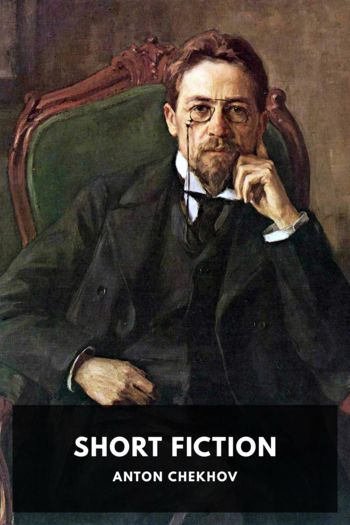
Description
Anton Chekhov is widely considered to be one of the greatest short story writers in history. A physician by day, he’s famously quoted as saying, “Medicine is my lawful wife, and literature is my mistress.” Chekhov wrote nearly 300 short stories in his long writing career; while at first he wrote mainly to make a profit, as his interest in writing—and his skill—grew, he wrote stories that heavily influenced the modern development of the form.
His stories are famous for, among other things, their ambiguous morality and their often inconclusive nature. Chekhov was a firm believer that the role of the artist was to correctly pose a question, but not necessarily to answer it.
This collection contains all of his short stories and two novellas, all translated by Constance Garnett, and arranged by the date they were originally published.
Read free book «Short Fiction by Anton Chekhov (libby ebook reader .txt) 📕» - read online or download for free at americanlibrarybooks.com
- Author: Anton Chekhov
Read book online «Short Fiction by Anton Chekhov (libby ebook reader .txt) 📕». Author - Anton Chekhov
“Oh excuse me, what a queer fellow you are really!”
The doctor sat down on the stool near the bed and shook his head reproachfully.
“But let us suppose you are right,” he said, “let us suppose that I am treacherously trying to trap you into saying something so as to betray you to the police. You would be arrested and then tried. But would you be any worse off being tried and in prison than you are here? If you are banished to a settlement, or even sent to penal servitude, would it be worse than being shut up in this ward? I imagine it would be no worse. … What, then, are you afraid of?”
These words evidently had an effect on Ivan Dmitritch. He sat down quietly.
It was between four and five in the afternoon—the time when Andrey Yefimitch usually walked up and down his rooms, and Daryushka asked whether it was not time for his beer. It was a still, bright day.
“I came out for a walk after dinner, and here I have come, as you see,” said the doctor. “It is quite spring.”
“What month is it? March?” asked Ivan Dmitritch.
“Yes, the end of March.”
“Is it very muddy?”
“No, not very. There are already paths in the garden.”
“It would be nice now to drive in an open carriage somewhere into the country,” said Ivan Dmitritch, rubbing his red eyes as though he were just awake, “then to come home to a warm, snug study, and … and to have a decent doctor to cure one’s headache. … It’s so long since I have lived like a human being. It’s disgusting here! Insufferably disgusting!”
After his excitement of the previous day he was exhausted and listless, and spoke unwillingly. His fingers twitched, and from his face it could be seen that he had a splitting headache.
“There is no real difference between a warm, snug study and this ward,” said Andrey Yefimitch. “A man’s peace and contentment do not lie outside a man, but in himself.”
“What do you mean?”
“The ordinary man looks for good and evil in external things—that is, in carriages, in studies—but a thinking man looks for it in himself.”
“You should go and preach that philosophy in Greece, where it’s warm and fragrant with the scent of pomegranates, but here it is not suited to the climate. With whom was it I was talking of Diogenes? Was it with you?”
“Yes, with me yesterday.”
“Diogenes did not need a study or a warm habitation; it’s hot there without. You can lie in your tub and eat oranges and olives. But bring him to Russia to live: he’d be begging to be let indoors in May, let alone December. He’d be doubled up with the cold.”
“No. One can be insensible to cold as to every other pain. Marcus Aurelius says: ‘A pain is a vivid idea of pain; make an effort of will to change that idea, dismiss it, cease to complain, and the pain will disappear.’ That is true. The wise man, or simply the reflecting, thoughtful man, is distinguished precisely by his contempt for suffering; he is always contented and surprised at nothing.”
“Then I am an idiot, since I suffer and am discontented and surprised at the baseness of mankind.”
“You are wrong in that; if you will reflect more on the subject you will understand how insignificant is all that external world that agitates us. One must strive for the comprehension of life, and in that is true happiness.”
“Comprehension …” repeated Ivan Dmitritch frowning. “External, internal. … Excuse me, but I don’t understand it. I only know,” he said, getting up and looking angrily at the doctor—“I only know that God has created me of warm blood and nerves, yes, indeed! If organic tissue is capable of life it must react to every stimulus. And I do! To pain I respond with tears and outcries, to baseness with indignation, to filth with loathing. To my mind, that is just what is called life. The lower the organism, the less sensitive it is, and the more feebly it reacts to stimulus; and the higher it is, the more responsively and vigorously it reacts to reality. How is it you don’t know that? A doctor, and not know such trifles! To despise suffering, to be always contented, and to be surprised at nothing, one must reach this condition”—and Ivan Dmitritch pointed to the peasant who was a mass of fat—“or to harden oneself by suffering to such a point that one loses all sensibility to it—that is, in other words, to cease to live. You must excuse me, I am not a sage or a philosopher,” Ivan Dmitritch continued with irritation, “and I don’t understand anything about it. I am not capable of reasoning.”
“On the contrary, your reasoning is excellent.”
“The Stoics, whom you are parodying, were remarkable people, but their doctrine crystallized two thousand years ago and has not advanced, and will not advance, an inch forward, since it is not practical or living. It had a success only with the minority which spends its life in savouring all sorts of theories and ruminating over them; the majority did not understand it. A doctrine which advocates indifference to wealth and to the comforts of life, and a contempt for suffering and death, is quite unintelligible to the vast majority of men, since that majority has never known wealth or the comforts of life; and to despise suffering would mean to it despising life itself, since the whole existence of man is made up of the sensations of hunger, cold, injury, and a Hamlet-like dread of death. The whole of life lies in these sensations; one may be oppressed by it, one may hate it, but one cannot despise it. Yes, so, I repeat, the doctrine of the Stoics can never have a future; from the beginning of time up to today you see continually increasing the struggle, the sensibility to pain, the capacity of responding to stimulus.”
Ivan Dmitritch suddenly lost the thread of his thoughts,



Comments (0)