Short Fiction by Anton Chekhov (libby ebook reader .txt) 📕
Description
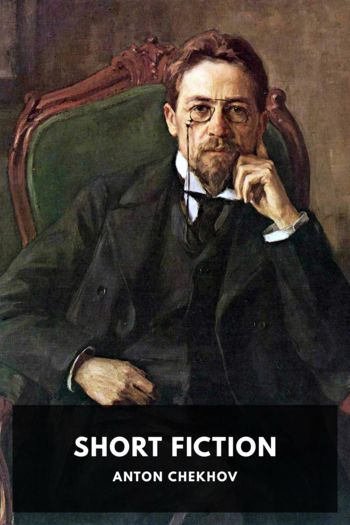
Anton Chekhov is widely considered to be one of the greatest short story writers in history. A physician by day, he’s famously quoted as saying, “Medicine is my lawful wife, and literature is my mistress.” Chekhov wrote nearly 300 short stories in his long writing career; while at first he wrote mainly to make a profit, as his interest in writing—and his skill—grew, he wrote stories that heavily influenced the modern development of the form.
His stories are famous for, among other things, their ambiguous morality and their often inconclusive nature. Chekhov was a firm believer that the role of the artist was to correctly pose a question, but not necessarily to answer it.
This collection contains all of his short stories and two novellas, all translated by Constance Garnett, and arranged by the date they were originally published.
Read free book «Short Fiction by Anton Chekhov (libby ebook reader .txt) 📕» - read online or download for free at americanlibrarybooks.com
- Author: Anton Chekhov
Read book online «Short Fiction by Anton Chekhov (libby ebook reader .txt) 📕». Author - Anton Chekhov
“I agree with you, Konstantin Ivanovitch,” said Yulia Sergeyevna. “One describes a love scene; another, a betrayal; and the third, meeting again after separation. Are there no other subjects? Why, there are many people sick, unhappy, harassed by poverty, to whom reading all that must be distasteful.”
It was disagreeable to Laptev to hear his wife, not yet twenty-two, speaking so seriously and coldly about love. He understood why this was so.
“If poetry does not solve questions that seem so important,” said Yartsev, “you should turn to works on technical subjects, criminal law, or finance, read scientific pamphlets. What need is there to discuss in Romeo and Juliet, liberty of speech, or the disinfecting of prisons, instead of love, when you can find all that in special articles and textbooks?”
“That’s pushing it to the extreme,” Kostya interrupted. “We are not talking of giants like Shakespeare or Goethe; we are talking of the hundreds of talented mediocre writers, who would be infinitely more valuable if they would let love alone, and would employ themselves in spreading knowledge and humane ideas among the masses.”
Kish, lisping and speaking a little through his nose, began telling the story of a novel he had lately been reading. He spoke circumstantially and without haste. Three minutes passed, then five, then ten, and no one could make out what he was talking about, and his face grew more and more indifferent, and his eyes more and more blank.
“Kish, do be quick over it,” Yulia Sergeyevna could not resist saying; “it’s really agonizing!”
“Shut up, Kish!” Kostya shouted to him.
They all laughed, and Kish with them.
Fyodor came in. Flushing red in patches, he greeted them all in a nervous flurry, and led his brother away into the study. Of late he had taken to avoiding the company of more than one person at once.
“Let the young people laugh, while we speak from the heart in here,” he said, settling himself in a deep armchair at a distance from the lamp. “It’s a long time, my dear brother, since we’ve seen each other. How long is it since you were at the warehouse? I think it must be a week.”
“Yes, there’s nothing for me to do there. And I must confess that the old man wearies me.”
“Of course, they could get on at the warehouse without you and me, but one must have some occupation. ‘In the sweat of thy brow thou shalt eat bread,’ as it is written. God loves work.”
Pyotr brought in a glass of tea on a tray. Fyodor drank it without sugar, and asked for more. He drank a great deal of tea, and could get through as many as ten glasses in the evening.
“I tell you what, brother,” he said, getting up and going to his brother. “Laying aside philosophic subtleties, you must get elected on to the town council, and little by little we will get you on to the local Board, and then to be an alderman. And as time goes on—you are a clever man and well-educated—you will be noticed in Petersburg and asked to go there—active men on the provincial assemblies and town councils are all the fashion there now—and before you are fifty you’ll be a privy councillor, and have a ribbon across your shoulders.”
Laptev made no answer; he knew that all this—being a privy councillor and having a ribbon over his shoulder—was what Fyodor desired for himself, and he did not know what to say.
The brothers sat still and said nothing. Fyodor opened his watch and for a long, long time gazed into it with strained attention, as though he wanted to detect the motion of the hand, and the expression of his face struck Laptev as strange.
They were summoned to supper. Laptev went into the dining room, while Fyodor remained in the study. The argument was over and Yartsev was speaking in the tones of a professor giving a lecture:
“Owing to differences of climate, of energy, of tastes, of age, equality among men is physically impossible. But civilised man can make this inequality innocuous, as he has already done with bogs and bears. A learned man succeeded in making a cat, a mouse, a falcon, a sparrow, all eat out of one plate; and education, one must hope, will do the same thing with men. Life continually progresses, civilisation makes enormous advances before our eyes, and obviously a time will come when we shall think, for instance, the present condition of the factory population as absurd as we now do the state of serfdom, in which girls were exchanged for dogs.”
“That won’t be for a long while, a very long while,” said Kostya, with a laugh, “not till Rothschild thinks his cellars full of gold absurd, and till then the workers may bend their backs and die of hunger. No; that’s not it. We mustn’t wait for it; we must struggle for it. Do you suppose because the cat eats out of the same saucer as the mouse—do you suppose that she is influenced by a sense of conscious intelligence? Not a bit of it! She’s made to do it by force.”
“Fyodor and I are rich; our father’s a capitalist, a millionaire. You will have to struggle with us,” said Laptev, rubbing his forehead with his hand. “Struggle with me is an idea I cannot grasp. I am rich, but what has money given me so far? What has this power given me? In what way am I happier than you? My childhood was slavery, and money did not save me from the birch. When Nina was ill and died, my money did not help her. If people don’t care for me, I can’t make them like me if I spend a hundred million.”
“But you can do a great deal of good,” said Kish.
“Good, indeed! You spoke to me yesterday of a mathematical man who



Comments (0)