Short Fiction by Anton Chekhov (libby ebook reader .txt) 📕
Description
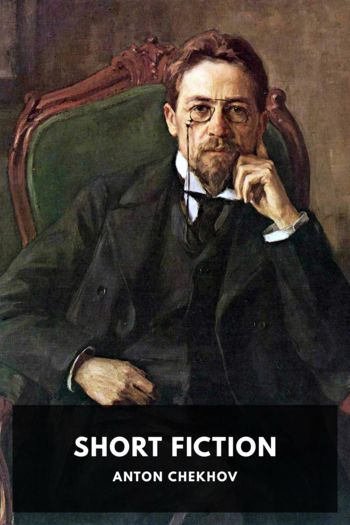
Anton Chekhov is widely considered to be one of the greatest short story writers in history. A physician by day, he’s famously quoted as saying, “Medicine is my lawful wife, and literature is my mistress.” Chekhov wrote nearly 300 short stories in his long writing career; while at first he wrote mainly to make a profit, as his interest in writing—and his skill—grew, he wrote stories that heavily influenced the modern development of the form.
His stories are famous for, among other things, their ambiguous morality and their often inconclusive nature. Chekhov was a firm believer that the role of the artist was to correctly pose a question, but not necessarily to answer it.
This collection contains all of his short stories and two novellas, all translated by Constance Garnett, and arranged by the date they were originally published.
Read free book «Short Fiction by Anton Chekhov (libby ebook reader .txt) 📕» - read online or download for free at americanlibrarybooks.com
- Author: Anton Chekhov
Read book online «Short Fiction by Anton Chekhov (libby ebook reader .txt) 📕». Author - Anton Chekhov
“What did you see through the field-glasses today?” Yulia Sergeyevna asked Kostya.
“Nothing today, but yesterday I saw the old Frenchman having his bath.”
At seven o’clock Yulia and Kostya went to the Little Theatre. Laptev was left with the little girls.
“It’s time your father was here,” he said, looking at his watch. “The train must be late.”
The children sat in their armchair dumb and huddling together like animals when they are cold, while he walked about the room looking impatiently at his watch. It was quiet in the house. But just before nine o’clock someone rang at the bell. Pyotr went to open the door.
Hearing a familiar voice, the children shrieked, burst into sobs, and ran into the hall. Panaurov was wearing a sumptuous coat of antelope skin, and his head and moustaches were white with hoar frost. “In a minute, in a minute,” he muttered, while Sasha and Lida, sobbing and laughing, kissed his cold hands, his hat, his antelope coat. With the languor of a handsome man spoilt by too much love, he fondled the children without haste, then went into the study and said, rubbing his hands:
“I’ve not come to stay long, my friends. I’m going to Petersburg tomorrow. They’ve promised to transfer me to another town.”
He was staying at the Dresden Hotel.
XA friend who was often at the Laptevs’ was Ivan Gavrilitch Yartsev. He was a strong, healthy man with black hair and a clever, pleasant face. He was considered to be handsome, but of late he had begun to grow stout, and that rather spoilt his face and figure; another thing that spoilt him was that he wore his hair cut so close that the skin showed through.
At the University his tall figure and physical strength had won him the nickname of “the pounder” among the students. He had taken his degree with the Laptev brothers in the faculty of philology—then he went in for science and now had the degree of magister in chemistry. But he had never given a lecture or even been a demonstrator. He taught physics and natural history in the modern school, and in two girls’ high schools. He was enthusiastic over his pupils, especially the girls, and used to maintain that a remarkable generation was growing up. At home he spent his time studying sociology and Russian history, as well as chemistry, and he sometimes published brief notes in the newspapers and magazines, signing them “Y.” When he talked of some botanical or zoological subject, he spoke like an historian; when he was discussing some historical question, he approached it as a man of science.
Kish, nicknamed “the eternal student,” was also like one of the family at the Laptevs’. He had been for three years studying medicine. Then he took up mathematics, and spent two years over each year’s course. His father, a provincial druggist, used to send him forty roubles a month, to which his mother, without his father’s knowledge, added another ten. And this sum was not only sufficient for his board and lodging, but even for such luxuries as an overcoat lined with Polish beaver, gloves, scent, and photographs (he often had photographs taken of himself and used to distribute them among his friends). He was neat and demure, slightly bald, with golden side-whiskers, and he had the air of a man nearly always ready to oblige. He was always busy looking after other people’s affairs. At one time he would be rushing about with a subscription list; at another time he would be freezing in the early morning at a ticket office to buy tickets for ladies of his acquaintance, or at somebody’s request would be ordering a wreath or a bouquet. People simply said of him: “Kish will go, Kish will do it, Kish will buy it.” He was usually unsuccessful in carrying out his commissions. Reproaches were showered upon him, people frequently forgot to pay him for the things he bought, but he simply sighed in hard cases and never protested. He was never particularly delighted nor disappointed; his stories were always long and boring; and his jokes invariably provoked laughter just because they were not funny. Thus, one day, for instance, intending to make a joke, he said to Pyotr: “Pyotr, you’re not a sturgeon;” and this aroused a general laugh, and he, too, laughed for a long time, much pleased at having made such a successful jest. Whenever one of the professors was buried, he walked in front with the mutes.
Yartsev and Kish usually came in the evening to tea. If the Laptevs were not going to the theatre or a concert, the evening tea lingered on till supper. One evening in February the following conversation took place:
“A work of art is only significant and valuable when there are some serious social problems contained in its central idea,” said Kostya, looking wrathfully at Yartsev. “If there is in the work a protest against serfdom, or the author takes up arms against the vulgarity of aristocratic society, the work is significant and valuable. The novels that are taken up with



Comments (0)