Short Fiction by Anton Chekhov (libby ebook reader .txt) 📕
Description
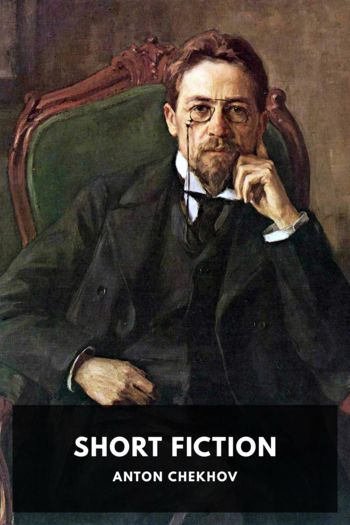
Anton Chekhov is widely considered to be one of the greatest short story writers in history. A physician by day, he’s famously quoted as saying, “Medicine is my lawful wife, and literature is my mistress.” Chekhov wrote nearly 300 short stories in his long writing career; while at first he wrote mainly to make a profit, as his interest in writing—and his skill—grew, he wrote stories that heavily influenced the modern development of the form.
His stories are famous for, among other things, their ambiguous morality and their often inconclusive nature. Chekhov was a firm believer that the role of the artist was to correctly pose a question, but not necessarily to answer it.
This collection contains all of his short stories and two novellas, all translated by Constance Garnett, and arranged by the date they were originally published.
Read free book «Short Fiction by Anton Chekhov (libby ebook reader .txt) 📕» - read online or download for free at americanlibrarybooks.com
- Author: Anton Chekhov
Read book online «Short Fiction by Anton Chekhov (libby ebook reader .txt) 📕». Author - Anton Chekhov
“We can’t go back!” I said. “We have come over ten miles!”
“What’s to be done?” sighed Grontovsky. “If you had come not ten but a hundred thousand miles, if the king even had come from America or from some other distant land, even then I should think it my duty … sacred, so to say, obligation …”
“Does the forest belong to Nadyezhda Lvovna?” asked the prince.
“Yes, Nadyezhda Lvovna …”
“Is she at home now?”
“Yes … I tell you what, you go to her, it is not more than half a mile from here; if she gives you a note, then I. … I needn’t say! Ha—ha … he—he—!”
“By all means,” I agreed. “It’s much nearer than to go back. … You go to her, Sergey Ivanitch,” I said, addressing the prince. “You know her.”
The prince, who had been gazing the whole time at the crushed agaric, raised his eyes to me, thought a minute, and said:
“I used to know her at one time, but … it’s rather awkward for me to go to her. Besides, I am in shabby clothes. … You go, you don’t know her. … It’s more suitable for you to go.”
I agreed. We got into our chaise and, followed by Grontovsky’s smiles, drove along the edge of the forest to the manor house. I was not acquainted with Nadyezhda Lvovna Kandurin, née Shabelsky. I had never seen her at close quarters, and knew her only by hearsay. I knew that she was incredibly wealthy, richer than anyone else in the province. After the death of her father, Shabelsky, who was a landowner with no other children, she was left with several estates, a stud farm, and a lot of money. I had heard that, though she was only twenty-five or twenty-six, she was ugly, uninteresting, and as insignificant as anybody, and was only distinguished from the ordinary ladies of the district by her immense wealth.
It has always seemed to me that wealth is felt, and that the rich must have special feelings unknown to the poor. Often as I passed by Nadyezhda Lvovna’s big fruit garden, in which stood the large, heavy house with its windows always curtained, I thought: “What is she thinking at this moment? Is there happiness behind those blinds?” and so on. Once I saw her from a distance in a fine light cabriolet, driving a handsome white horse, and, sinful man that I am, I not only envied her, but even thought that in her poses, in her movements, there was something special, not to be found in people who are not rich, just as persons of a servile nature succeed in discovering “good family” at the first glance in people of the most ordinary exterior, if they are a little more distinguished than themselves. Nadyezhda Lvovna’s inner life was only known to me by scandal. It was said in the district that five or six years ago, before she was married, during her father’s lifetime, she had been passionately in love with Prince Sergey Ivanitch, who was now beside me in the chaise. The prince had been fond of visiting her father, and used to spend whole days in his billiard room, where he played pyramids indefatigably till his arms and legs ached. Six months before the old man’s death he had suddenly given up visiting the Shabelskys. The gossip of the district having no positive facts to go upon explained this abrupt change in their relations in various ways. Some said that the prince, having observed the plain daughter’s feeling for him and being unable to reciprocate it, considered it the duty of a gentleman to cut short his visits. Others maintained that old Shabelsky had discovered why his daughter was pining away, and had proposed to the poverty-stricken prince that he should marry her; the prince, imagining in his narrow-minded way that they were trying to buy him together with his title, was indignant, said foolish things, and quarrelled with them. What was true and what was false in this nonsense was difficult to say. But that there was a portion of truth in it was evident, from the fact that the prince always avoided conversation about Nadyezhda Lvovna.
I knew that soon after her father’s death Nadyezhda Lvovna had married one Kandurin, a bachelor of law, not wealthy, but adroit, who had come on a visit to the neighbourhood. She married him not from love, but because she was touched by the love of the legal gentleman who, so it was said, had cleverly played the lovesick swain. At the time I am describing, Kandurin was for some reason living in Cairo, and writing thence to his friend, the marshal of the district, “Notes of Travel,” while she sat languishing behind lowered blinds, surrounded by idle parasites, and whiled away her dreary days in petty philanthropy.
On the way to the house the prince fell to talking.
“It’s three days since I have been at home,” he said in a half whisper, with a sidelong glance at the driver. “I am not a child, nor a silly woman, and I have no prejudices, but I can’t stand the bailiffs. When I see a bailiff in my house I turn pale and tremble, and even have a twitching in the calves of my legs. Do you know Rogozhin refused to honour my note?”
The prince did not, as a rule, like to complain of his straitened circumstances; where poverty was concerned he was




Comments (0)