Short Fiction by Anton Chekhov (libby ebook reader .txt) 📕
Description
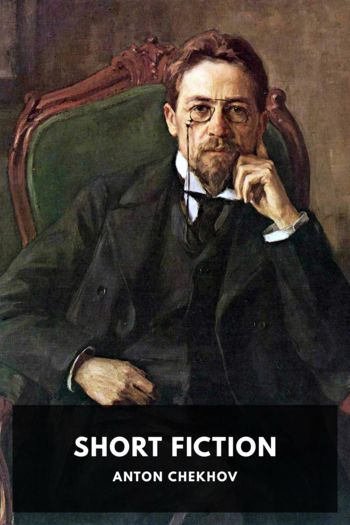
Anton Chekhov is widely considered to be one of the greatest short story writers in history. A physician by day, he’s famously quoted as saying, “Medicine is my lawful wife, and literature is my mistress.” Chekhov wrote nearly 300 short stories in his long writing career; while at first he wrote mainly to make a profit, as his interest in writing—and his skill—grew, he wrote stories that heavily influenced the modern development of the form.
His stories are famous for, among other things, their ambiguous morality and their often inconclusive nature. Chekhov was a firm believer that the role of the artist was to correctly pose a question, but not necessarily to answer it.
This collection contains all of his short stories and two novellas, all translated by Constance Garnett, and arranged by the date they were originally published.
Read free book «Short Fiction by Anton Chekhov (libby ebook reader .txt) 📕» - read online or download for free at americanlibrarybooks.com
- Author: Anton Chekhov
Read book online «Short Fiction by Anton Chekhov (libby ebook reader .txt) 📕». Author - Anton Chekhov
“Have you any questions to ask?”
The assistant prosecutor shook his head negatively, without lifting his eyes from Cain; the counsel for the defence unexpectedly stirred and, clearing his throat, asked:
“Tell me, doctor, can you from the dimensions of the wound form any theory as to … as to the mental condition of the criminal? That is, I mean, does the extent of the injury justify the supposition that the accused was suffering from temporary aberration?”
The president raised his drowsy indifferent eyes to the counsel for the defence. The assistant prosecutor tore himself from Cain, and looked at the president. They merely looked, but there was no smile, no surprise, no perplexity-their faces expressed nothing.
“Perhaps,” the doctor hesitated, “if one considers the force with which … er—er—er … the criminal strikes the blow. … However, excuse me, I don’t quite understand your question. …”
The counsel for the defence did not get an answer to his question, and indeed he did not feel the necessity of one. It was clear even to himself that that question had strayed into his mind and found utterance simply through the effect of the stillness, the boredom, the whirring ventilator wheels.
When they had got rid of the doctor the court rose to examine the “material evidences.” The first thing examined was the full-skirted coat, upon the sleeve of which there was a dark brownish stain of blood. Harlamov on being questioned as to the origin of the stain stated:
“Three days before my old woman’s death Penkov bled his horse. I was there; I was helping to be sure, and … and got smeared with it. …”
“But Penkov has just given evidence that he does not remember that you were present at the bleeding. …”
“I can’t tell about that.”
“Sit down.”
They proceeded to examine the axe with which the old woman had been murdered.
“That’s not my axe,” the prisoner declared.
“Whose is it, then?”
“I can’t tell … I hadn’t an axe. …”
“A peasant can’t get on for a day without an axe. And your neighbour Ivan Timofeyitch, with whom you mended a sledge, has given evidence that it is your axe. …”
“I can’t say about that, but I swear before God (Harlamov held out his hand before him and spread out the fingers), before the living God. And I don’t remember how long it is since I did have an axe of my own. I did have one like that only a bit smaller, but my son Prohor lost it. Two years before he went into the army, he drove off to fetch wood, got drinking with the fellows, and lost it. …”
“Good, sit down.”
This systematic distrust and disinclination to hear him probably irritated and offended Harlamov. He blinked and red patches came out on his cheekbones.
“I swear in the sight of God,” he went on, craning his neck forward. “If you don’t believe me, be pleased to ask my son Prohor. Proshka, what did you do with the axe?” he suddenly asked in a rough voice, turning abruptly to the soldier escorting him. “Where is it?”
It was a painful moment! Everyone seemed to wince and as it were shrink together. The same fearful, incredible thought flashed like lightning through every head in the court, the thought of possibly fatal coincidence, and not one person in the court dared to look at the soldier’s face. Everyone refused to trust his thought and believed that he had heard wrong.
“Prisoner, conversation with the guards is forbidden …” the president made haste to say.
No one saw the escort’s face, and horror passed over the hall unseen as in a mask. The usher of the court got up quietly from his place and tiptoeing with his hand held out to balance himself went out of the court. Half a minute later there came the muffled sounds and footsteps that accompany the change of guard.
All raised their heads and, trying to look as though nothing had happened, went on with their work. …
A Peculiar ManBetween twelve and one at night a tall gentleman, wearing a top-hat and a coat with a hood, stops before the door of Marya Petrovna Koshkin, a midwife and an old maid. Neither face nor hand can be distinguished in the autumn darkness, but in the very manner of his coughing and the ringing of the bell a certain solidity, positiveness, and even impressiveness can be discerned. After the third ring the door opens and Marya Petrovna herself appears. She has a man’s overcoat flung on over her white petticoat. The little lamp with the green shade which she holds in her hand throws a greenish light over her sleepy, freckled face, her scraggy neck, and the lank, reddish hair that strays from under her cap.
“Can I see the midwife?” asks the gentleman.
“I am the midwife. What do you want?”
The gentleman walks into the entry and Marya Petrovna sees facing her a tall, well-made man, no longer young, but with a handsome, severe face and bushy whiskers.
“I am a collegiate assessor, my name is Kiryakov,” he says. “I came to fetch you to my wife. Only please make haste.”
“Very good …” the midwife assents. “I’ll dress at once, and I must trouble you to wait for me in the parlour.”
Kiryakov takes off his overcoat and goes into the parlour. The greenish light of the lamp lies sparsely on the cheap furniture in patched white covers, on the pitiful flowers and the posts on which ivy is trained. … There is a smell of geranium and carbolic. The little clock on the wall ticks timidly, as though abashed at the presence of a strange man.
“I am ready,” says Marya Petrovna, coming into the room five minutes later, dressed, washed, and ready for action. “Let us go.”
“Yes, you must make haste,” says Kiryakov. “And, by the way, it is not out of place to enquire—what do you ask for your services?”
“I really don’t know …” says Marya Petrovna with an embarrassed smile. “As much as you will give.”
“No, I don’t like that,” says



Comments (0)