Short Fiction by Anton Chekhov (libby ebook reader .txt) 📕
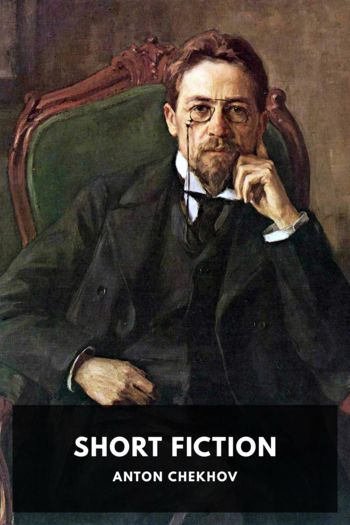
Description
Anton Chekhov is widely considered to be one of the greatest short story writers in history. A physician by day, he’s famously quoted as saying, “Medicine is my lawful wife, and literature is my mistress.” Chekhov wrote nearly 300 short stories in his long writing career; while at first he wrote mainly to make a profit, as his interest in writing—and his skill—grew, he wrote stories that heavily influenced the modern development of the form.
His stories are famous for, among other things, their ambiguous morality and their often inconclusive nature. Chekhov was a firm believer that the role of the artist was to correctly pose a question, but not necessarily to answer it.
This collection contains all of his short stories and two novellas, all translated by Constance Garnett, and arranged by the date they were originally published.
Read free book «Short Fiction by Anton Chekhov (libby ebook reader .txt) 📕» - read online or download for free at americanlibrarybooks.com
- Author: Anton Chekhov
Read book online «Short Fiction by Anton Chekhov (libby ebook reader .txt) 📕». Author - Anton Chekhov
The man shook his head, and with a gesture of despair sat down.
“Of course you mustn’t cry,” said the young lady. “It’s only little babies cry. If you are ill, dear, you must undress and go to sleep. … Let us take off your things!”
When the child had been undressed and pacified a silence reigned again. The young lady seated herself at the window, and looked round wonderingly at the room of the inn, at the icon, at the stove. … Apparently the room and the little girl with the thick nose, in her short boy’s nightgown, and the child’s father, all seemed strange to her. This strange man was sitting in a corner; he kept looking about him helplessly, as though he were drunk, and rubbing his face with the palm of his hand. He sat silent, blinking, and judging from his guilty-looking figure it was difficult to imagine that he would soon begin to speak. Yet he was the first to begin. Stroking his knees, he gave a cough, laughed, and said:
“It’s a comedy, it really is. … I look and I cannot believe my eyes: for what devilry has destiny driven us to this accursed inn? What did she want to show by it? Life sometimes performs such ‘salto mortale,’ one can only stare and blink in amazement. Have you come from far, Madam?”
“No, not from far,” answered the young lady. “I am going from our estate, fifteen miles from here, to our farm, to my father and brother. My name is Ilovaisky, and the farm is called Ilovaiskoe. It’s nine miles away. What unpleasant weather!”
“It couldn’t be worse.”
The lame boy came in and stuck a new candle in the pomatum pot.
“You might bring us the samovar, boy,” said the man, addressing him.
“Who drinks tea now?” laughed the boy. “It is a sin to drink tea before mass. …”
“Never mind boy, you won’t burn in hell if we do. …”
Over the tea the new acquaintances got into conversation.
Mlle. Ilovaisky learned that her companion was called Grigory Petrovitch Liharev, that he was the brother of the Liharev who was Marshal of Nobility in one of the neighbouring districts, and he himself had once been a landowner, but had “run through everything in his time.” Liharev learned that her name was Marya Mihailovna, that her father had a huge estate, but that she was the only one to look after it as her father and brother looked at life through their fingers, were irresponsible, and were too fond of harriers.
“My father and brother are all alone at the farm,” she told him, brandishing her fingers (she had the habit of moving her fingers before her pointed face as she talked, and after every sentence moistened her lips with her sharp little tongue). “They, I mean men, are an irresponsible lot, and don’t stir a finger for themselves. I can fancy there will be no one to give them a meal after the fast! We have no mother, and we have such servants that they can’t lay the tablecloth properly when I am away. You can imagine their condition now! They will be left with nothing to break their fast, while I have to stay here all night. How strange it all is.”
She shrugged her shoulders, took a sip from her cup, and said:
“There are festivals that have a special fragrance: at Easter, Trinity and Christmas there is a peculiar scent in the air. Even unbelievers are fond of those festivals. My brother, for instance, argues that there is no God, but he is the first to hurry to Matins at Easter.”
Liharev raised his eyes to Mlle. Ilovaisky and laughed.
“They argue that there is no God,” she went on, laughing too, “but why is it, tell me, all the celebrated writers, the learned men, clever people generally, in fact, believe towards the end of their life?”
“If a man does not know how to believe when he is young, Madam, he won’t believe in his old age if he is ever so much of a writer.”
Judging from Liharev’s cough he had a bass voice, but, probably from being afraid to speak aloud, or from exaggerated shyness, he spoke in a tenor. After a brief pause he heaved a sign and said:
“The way I look at it is that faith is a faculty of the spirit. It is just the same as a talent, one must be born with it. So far as I can judge by myself, by the people I have seen in my time, and by all that is done around us, this faculty is present in Russians in its highest degree. Russian life presents us with an uninterrupted succession of convictions and aspirations, and if you care to know, it has not yet the faintest notion of lack of faith or scepticism. If a Russian does not believe in God, it means he believes in something else.”
Liharev took a cup of tea from Mlle. Ilovaisky, drank off half in one gulp, and went on:
“I will tell you about myself. Nature has implanted in my breast an extraordinary faculty for belief. Whisper it not to the night, but half my life I was in the ranks of the Atheists and Nihilists, but there was not one hour in my life in which I ceased to believe. All talents, as a rule, show themselves in early childhood, and so my faculty showed itself when I could still walk upright under the table. My mother liked her children to eat a great deal, and when she gave me food she used to say: ‘Eat! Soup is the great thing in life!’ I believed, and ate the soup ten



Comments (0)