Short Fiction by Anton Chekhov (libby ebook reader .txt) 📕
Description
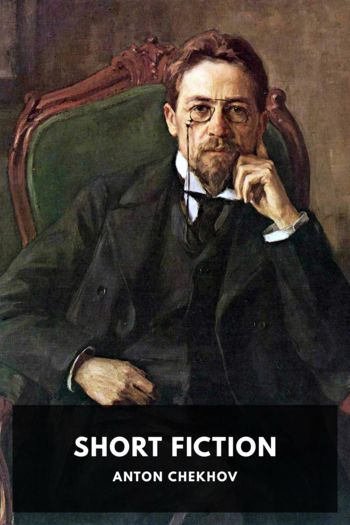
Anton Chekhov is widely considered to be one of the greatest short story writers in history. A physician by day, he’s famously quoted as saying, “Medicine is my lawful wife, and literature is my mistress.” Chekhov wrote nearly 300 short stories in his long writing career; while at first he wrote mainly to make a profit, as his interest in writing—and his skill—grew, he wrote stories that heavily influenced the modern development of the form.
His stories are famous for, among other things, their ambiguous morality and their often inconclusive nature. Chekhov was a firm believer that the role of the artist was to correctly pose a question, but not necessarily to answer it.
This collection contains all of his short stories and two novellas, all translated by Constance Garnett, and arranged by the date they were originally published.
Read free book «Short Fiction by Anton Chekhov (libby ebook reader .txt) 📕» - read online or download for free at americanlibrarybooks.com
- Author: Anton Chekhov
Read book online «Short Fiction by Anton Chekhov (libby ebook reader .txt) 📕». Author - Anton Chekhov
“Yes. But what of that?”
“It’s unlucky,” she said, putting down her glass and turning paler still. “It’s a bad omen. It means that some misfortune will happen to us this year.”
“What a silly thing you are,” I sighed. “You are a clever woman, and yet you talk as much nonsense as an old nurse. Drink.”
“God grant it is nonsense, but … something is sure to happen! You’ll see.”
She did not even sip her glass, she moved away and sank into thought. I uttered a few stale commonplaces about superstition, drank half a bottle, paced up and down, and then went out of the room.
Outside there was the still frosty night in all its cold, inhospitable beauty. The moon and two white fluffy clouds beside it hung just over the station, motionless as though glued to the spot, and looked as though waiting for something. A faint transparent light came from them and touched the white earth softly, as though afraid of wounding her modesty, and lighted up everything—the snowdrifts, the embankment. … It was still.
I walked along the railway embankment.
“Silly woman,” I thought, looking at the sky spangled with brilliant stars. “Even if one admits that omens sometimes tell the truth, what evil can happen to us? The misfortunes we have endured already, and which are facing us now, are so great that it is difficult to imagine anything worse. What further harm can you do a fish which has been caught and fried and served up with sauce?”
A poplar covered with hoar frost looked in the bluish darkness like a giant wrapt in a shroud. It looked at me sullenly and dejectedly, as though like me it realized its loneliness. I stood a long while looking at it.
“My youth is thrown away for nothing, like a useless cigarette end,” I went on musing. “My parents died when I was a little child; I was expelled from the high school, I was born of a noble family, but I have received neither education nor breeding, and I have no more knowledge than the humblest mechanic. I have no refuge, no relations, no friends, no work I like. I am not fitted for anything, and in the prime of my powers I am good for nothing but to be stuffed into this little station; I have known nothing but trouble and failure all my life. What can happen worse?”
Red lights came into sight in the distance. A train was moving towards me. The slumbering steppe listened to the sound of it. My thoughts were so bitter that it seemed to me that I was thinking aloud and that the moan of the telegraph wire and the rumble of the train were expressing my thoughts.
“What can happen worse? The loss of my wife?” I wondered. “Even that is not terrible. It’s no good hiding it from my conscience: I don’t love my wife. I married her when I was only a wretched boy; now I am young and vigorous, and she has gone off and grown older and sillier, stuffed from her head to her heels with conventional ideas. What charm is there in her maudlin love, in her hollow chest, in her lusterless eyes? I put up with her, but I don’t love her. What can happen? My youth is being wasted, as the saying is, for a pinch of snuff. Women flit before my eyes only in the carriage windows, like falling stars. Love I never had and have not. My manhood, my courage, my power of feeling are going to ruin. … Everything is being thrown away like dirt, and all my wealth here in the steppe is not worth a farthing.”
The train rushed past me with a roar and indifferently cast the glow of its red lights upon me. I saw it stop by the green lights of the station, stop for a minute and rumble off again. After walking a mile and a half I went back. Melancholy thoughts haunted me still. Painful as it was to me, yet I remember I tried as it were to make my thoughts still gloomier and more melancholy. You know people who are vain and not very clever have moments when the consciousness that they are miserable affords them positive satisfaction, and they even coquet with their misery for their own entertainment. There was a great deal of truth in what I thought, but there was also a great deal that was absurd and conceited, and there was something boyishly defiant in my question: “What could happen worse?”
“And what is there to happen?” I asked myself. “I think I have endured everything. I’ve been ill, I’ve lost money, I get reprimanded by my superiors every day, and I go hungry, and a mad wolf has run into the station yard. What more is there? I have been insulted, humiliated, … and I have insulted others in my time. I have not been a criminal, it is true, but I don’t think I am capable of crime—I am not afraid of being hauled up for it.”
The two little clouds had moved away from the moon and stood at a little distance, looking as though they were whispering about something which the moon must not know. A light breeze was racing across the steppe, bringing the faint rumble of the retreating train.
My wife met me at the doorway. Her eyes were laughing gaily and her whole face was beaming with good-humor.
“There is news for you!” she whispered. “Make haste, go to your room and put on your new coat; we have a visitor.”
“What visitor?”
“Aunt Natalya Petrovna has just come by the train.”
“What Natalya Petrovna?”
“The wife of my uncle Semyon Fyodoritch. You don’t know her. She is a very nice, good woman.”
Probably I frowned, for my wife looked grave and whispered rapidly:
“Of course it is queer her having come, but don’t be cross, Nikolay, and don’t be hard on her. She is unhappy, you know; Uncle Semyon Fyodoritch really is ill-natured and tyrannical, it



Comments (0)