Short Fiction by Anton Chekhov (libby ebook reader .txt) 📕
Description
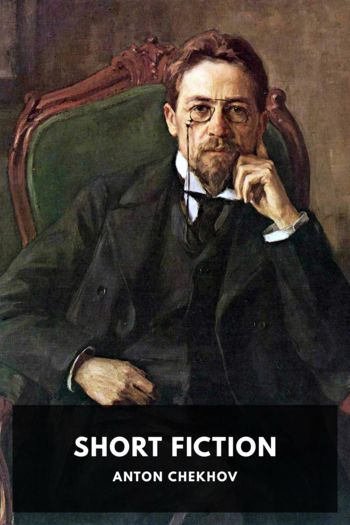
Anton Chekhov is widely considered to be one of the greatest short story writers in history. A physician by day, he’s famously quoted as saying, “Medicine is my lawful wife, and literature is my mistress.” Chekhov wrote nearly 300 short stories in his long writing career; while at first he wrote mainly to make a profit, as his interest in writing—and his skill—grew, he wrote stories that heavily influenced the modern development of the form.
His stories are famous for, among other things, their ambiguous morality and their often inconclusive nature. Chekhov was a firm believer that the role of the artist was to correctly pose a question, but not necessarily to answer it.
This collection contains all of his short stories and two novellas, all translated by Constance Garnett, and arranged by the date they were originally published.
Read free book «Short Fiction by Anton Chekhov (libby ebook reader .txt) 📕» - read online or download for free at americanlibrarybooks.com
- Author: Anton Chekhov
Read book online «Short Fiction by Anton Chekhov (libby ebook reader .txt) 📕». Author - Anton Chekhov
“No, your Excellency.”
“Upon my word, but he has signed his name! So he must have been in the hall. Has he been?”
“No, he hasn’t, your Excellency.”
“How could he have signed his name without being there?”
“I can’t tell.”
“Who is to tell, then? You sit gaping there in the hall. Try and remember, perhaps someone you didn’t know came in? Think a minute!”
“No, your Excellency, there has been no one I didn’t know. Our clerks have been, the baroness came to see her Excellency, the priests have been with the Cross, and there has been no one else. …”
“Why, he was invisible when he signed his name, then, was he?”
“I can’t say: but there has been no Fedyukov here. That I will swear before the holy image. …”
“It’s queer! It’s incomprehensible! It’s extraordinary!” mused Navagin. “It’s positively ludicrous. A man has been signing his name here for thirteen years and you can’t find out who he is. Perhaps it’s a joke? Perhaps some clerk writes that name as well as his own for fun.”
And Navagin began examining Fedyukov’s signature.
The bold, florid signature in the old-fashioned style with twirls and flourishes was utterly unlike the handwriting of the other signatures. It was next below the signature of Shtutchkin, the provincial secretary, a scared, timorous little man who would certainly have died of fright if he had ventured upon such an impudent joke.
“The mysterious Fedyukov has signed his name again!” said Navagin, going in to see his wife. “Again I fail to find out who he is.”
Madame Navagin was a spiritualist, and so for all phenomena in nature, comprehensible or incomprehensible, she had a very simple explanation.
“There’s nothing extraordinary about it,” she said. “You don’t believe it, of course, but I have said it already and I say it again: there is a great deal in the world that is supernatural, which our feeble intellect can never grasp. I am convinced that this Fedyukov is a spirit who has a sympathy for you … If I were you, I would call him up and ask him what he wants.”
“Nonsense, nonsense!”
Navagin was free from superstitions, but the phenomenon which interested him was so mysterious that all sorts of uncanny devilry intruded into his mind against his will. All the evening he was imagining that the incognito Fedyukov was the spirit of some long-dead clerk, who had been discharged from the service by Navagin’s ancestors and was now revenging himself on their descendant; or perhaps it was the kinsman of some petty official dismissed by Navagin himself, or of a girl seduced by him. …
All night Navagin dreamed of a gaunt old clerk in a shabby uniform, with a face as yellow as a lemon, hair that stood up like a brush, and pewtery eyes; the clerk said something in a sepulchral voice and shook a bony finger at him. And Navagin almost had an attack of inflammation of the brain.
For a fortnight he was silent and gloomy and kept walking up and down and thinking. In the end he overcame his sceptical vanity, and going into his wife’s room he said in a hollow voice:
“Zina, call up Fedyukov!”
The spiritualistic lady was delighted; she sent for a sheet of cardboard and a saucer, made her husband sit down beside her, and began upon the magic rites.
Fedyukov did not keep them waiting long. …
“What do you want?” asked Navagin.
“Repent,” answered the saucer.
“What were you on earth?”
“A sinner. …”
“There, you see!” whispered his wife, “and you did not believe!”
Navagin conversed for a long time with Fedyukov, and then called up Napoleon, Hannibal, Askotchensky, his aunt Klavdya Zaharovna, and they all gave him brief but correct answers full of deep significance. He was busy with the saucer for four hours, and fell asleep soothed and happy that he had become acquainted with a mysterious world that was new to him. After that he studied spiritualism every day, and at the office, informed the clerks that there was a great deal in nature that was supernatural and marvellous to which our men of science ought to have turned their attention long ago.
Hypnotism, mediumism, bishopism, spiritualism, the fourth dimension, and other misty notions took complete possession of him, so that for whole days at a time, to the great delight of his wife, he read books on spiritualism or devoted himself to the saucer, table-turning, and discussions of supernatural phenomena. At his instigation all his clerks took up spiritualism, too, and with such ardour that the old managing clerk went out of his mind and one day sent a telegram: “Hell. Government House. I feel that I am turning into an evil spirit. What’s to be done? Reply paid. Vassily Krinolinsky.”
After reading several hundreds of treatises on spiritualism Navagin had a strong desire to write something himself. For five months he sat composing, and in the end had written a huge monograph, entitled: My Opinion. When he had finished this essay he determined to send it to a spiritualist journal.
The day on which it was intended to despatch it to the journal was a very memorable one for him. Navagin remembers that on that never-to-be-forgotten day the secretary who had made a fair copy of his article and the sacristan of the parish who had been sent for on business were in his study. Nayagin’s face was beaming. He looked lovingly at his creation, felt between his fingers how thick it was, and with a happy smile said to the secretary:
“I propose, Filipp Sergeyitch, to send it registered. It will be safer. …” And raising his eyes to the sacristan, he said: “I have sent for you on business, my good man. I am putting my youngest son to the high school and I must have a certificate of baptism; only could you let me have it quickly?”
“Very good, your Excellency!” said the sacristan, bowing. “Very good, I understand. …”
“Can you let me have it by tomorrow?”
“Very well, your Excellency, set your mind at rest! Tomorrow it shall be ready!




Comments (0)