Short Fiction by Anton Chekhov (libby ebook reader .txt) 📕
Description
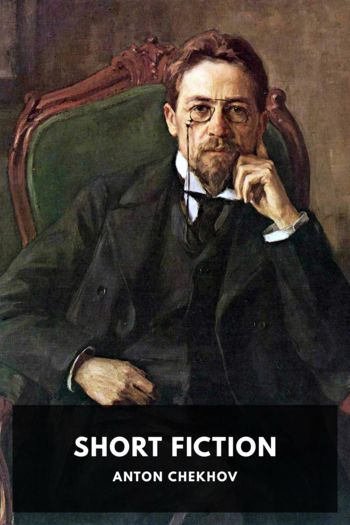
Anton Chekhov is widely considered to be one of the greatest short story writers in history. A physician by day, he’s famously quoted as saying, “Medicine is my lawful wife, and literature is my mistress.” Chekhov wrote nearly 300 short stories in his long writing career; while at first he wrote mainly to make a profit, as his interest in writing—and his skill—grew, he wrote stories that heavily influenced the modern development of the form.
His stories are famous for, among other things, their ambiguous morality and their often inconclusive nature. Chekhov was a firm believer that the role of the artist was to correctly pose a question, but not necessarily to answer it.
This collection contains all of his short stories and two novellas, all translated by Constance Garnett, and arranged by the date they were originally published.
Read free book «Short Fiction by Anton Chekhov (libby ebook reader .txt) 📕» - read online or download for free at americanlibrarybooks.com
- Author: Anton Chekhov
Read book online «Short Fiction by Anton Chekhov (libby ebook reader .txt) 📕». Author - Anton Chekhov
My room was small and poky, with neither table nor chairs in it, but quite filled up with a chest of drawers by the window, the stove and two little wooden sofas which stood against the walls, facing one another, leaving a narrow space to walk between them. Thin rusty-looking little mattresses lay on the little sofas, as well as my belongings. There were two sofas, so this room was evidently intended for two, and I pointed out the fact to my companion.
“They will soon be ringing for mass, though,” he said, “and I shan’t have to be in your way very long.”
Still under the impression that he was in my way and feeling awkward, he moved with a guilty step to his little sofa, sighed guiltily and sat down. When the tallow candle with its dim, dilatory flame had left off flickering and burned up sufficiently to make us both visible, I could make out what he was like. He was a young man of two-and-twenty, with a round and pleasing face, dark childlike eyes, dressed like a townsman in grey cheap clothes, and as one could judge from his complexion and narrow shoulders, not used to manual labour. He was of a very indefinite type; one could take him neither for a student nor for a man in trade, still less for a workman. But looking at his attractive face and childlike friendly eyes, I was unwilling to believe he was one of those vagabond impostors with whom every conventual establishment where they give food and lodging is flooded, and who give themselves out as divinity students, expelled for standing up for justice, or for church singers who have lost their voice. … There was something characteristic, typical, very familiar in his face, but what exactly, I could not remember nor make out.
For a long time he sat silent, pondering. Probably because I had not shown appreciation of his remarks about bones and the mortuary, he thought that I was ill-humoured and displeased at his presence. Pulling a sausage out of his pocket, he turned it about before his eyes and said irresolutely:
“Excuse my troubling you, … have you a knife?”
I gave him a knife.
“The sausage is disgusting,” he said, frowning and cutting himself off a little bit. “In the shop here they sell you rubbish and fleece you horribly. … I would offer you a piece, but you would scarcely care to consume it. Will you have some?”
In his language, too, there was something typical that had a very great deal in common with what was characteristic in his face, but what it was exactly I still could not decide. To inspire confidence and to show that I was not ill-humoured, I took some of the proffered sausage. It certainly was horrible; one needed the teeth of a good house-dog to deal with it. As we worked our jaws we got into conversation; we began complaining to each other of the lengthiness of the service.
“The rule here approaches that of Mount Athos,” I said; “but at Athos the night services last ten hours, and on great feast-days—fourteen! You should go there for prayers!”
“Yes,” answered my companion, and he wagged his head, “I have been here for three weeks. And you know, every day services, every day services. On ordinary days at midnight they ring for matins, at five o’clock for early mass, at nine o’clock for late mass. Sleep is utterly out of the question. In the daytime there are hymns of praise, special prayers, vespers. … And when I was preparing for the sacrament I was simply dropping from exhaustion.” He sighed and went on: “And it’s awkward not to go to church. … The monks give one a room, feed one, and, you know, one is ashamed not to go. One wouldn’t mind standing it for a day or two, perhaps, but three weeks is too much—much too much! Are you here for long?”
“I am going tomorrow evening.”
“But I am staying another fortnight.”
“But I thought it was not the rule to stay for so long here?” I said.
“Yes, that’s true: if anyone stays too long, sponging on the monks, he is asked to go. Judge for yourself, if the proletariat were allowed to stay on here as long as they liked there would never be a room vacant, and they would eat up the whole monastery. That’s true. But the monks make an exception for me, and I hope they won’t turn me out for some time. You know I am a convert.”
“You mean?”
“I am a Jew baptized. … Only lately I have embraced orthodoxy.”
Now I understood what I had before been utterly unable to understand from his face: his thick lips, and his way of twitching up the right corner of his mouth and his right eyebrow, when he was talking, and that peculiar oily brilliance of his eyes which is only found in Jews. I understood, too, his phraseology. … From further conversation I learned that his name was Alexandr Ivanitch, and had in the past been Isaac, that he was a native of the Mogilev province, and that he had come to the Holy Mountains from Novotcherkassk, where he had adopted the orthodox faith.
Having finished his sausage, Alexandr Ivanitch got up, and, raising his right eyebrow, said his prayer before the icon. The eyebrow remained up when he sat down again on the little sofa and began giving me a brief account of his long biography.
“From early childhood I cherished a love for learning,” he began in a tone which suggested he was not speaking of himself, but of some great man of the past. “My parents were poor Hebrews; they exist by buying and selling in a small way; they live like beggars, you know, in filth. In fact, all the people there are poor and superstitious; they don’t like education, because education, very naturally, turns a man away from religion. … They are fearful fanatics. … Nothing would induce my parents to let



Comments (0)