Short Fiction by Anton Chekhov (libby ebook reader .txt) 📕
Description
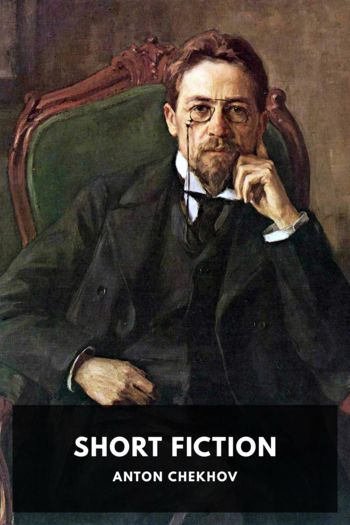
Anton Chekhov is widely considered to be one of the greatest short story writers in history. A physician by day, he’s famously quoted as saying, “Medicine is my lawful wife, and literature is my mistress.” Chekhov wrote nearly 300 short stories in his long writing career; while at first he wrote mainly to make a profit, as his interest in writing—and his skill—grew, he wrote stories that heavily influenced the modern development of the form.
His stories are famous for, among other things, their ambiguous morality and their often inconclusive nature. Chekhov was a firm believer that the role of the artist was to correctly pose a question, but not necessarily to answer it.
This collection contains all of his short stories and two novellas, all translated by Constance Garnett, and arranged by the date they were originally published.
Read free book «Short Fiction by Anton Chekhov (libby ebook reader .txt) 📕» - read online or download for free at americanlibrarybooks.com
- Author: Anton Chekhov
Read book online «Short Fiction by Anton Chekhov (libby ebook reader .txt) 📕». Author - Anton Chekhov
Having made such an intellectual observation, Isaac, as he had been, raised his right eyebrow higher than ever in his satisfaction and looked at me, as it were, sideways, like a cock at a grain of corn, with an air as though he would say: “Now at last you see for certain that I am an intellectual man, don’t you?” After saying something more about fanaticism and his irresistible yearning for enlightenment, he went on:
“What could I do? I ran away to Smolensk. And there I had a cousin who relined saucepans and made tins. Of course, I was glad to work under him, as I had nothing to live upon; I was barefoot and in rags. … I thought I could work by day and study at night and on Saturdays. And so I did, but the police found out I had no passport and sent me back by stages to my father. …”
Alexandr Ivanitch shrugged one shoulder and sighed.
“What was one to do?” he went on, and the more vividly the past rose up before his mind, the more marked his Jewish accent became. “My parents punished me and handed me over to my grandfather, a fanatical old Jew, to be reformed. But I went off at night to Shklov. And when my uncle tried to catch me in Shklov, I went off to Mogilev; there I stayed two days and then I went off to Starodub with a comrade.”
Later on he mentioned in his story Gonel, Kiev, Byelaya, Tserkov, Uman, Balt, Bendery and at last reached Odessa.
“In Odessa I wandered about for a whole week, out of work and hungry, till I was taken in by some Jews who went about the town buying secondhand clothes. I knew how to read and write by then, and had done arithmetic up to fractions, and I wanted to go to study somewhere, but I had not the means. What was I to do? For six months I went about Odessa buying old clothes, but the Jews paid me no wages, the rascals. I resented it and left them. Then I went by steamer to Perekop.”
“What for?”
“Oh, nothing. A Greek promised me a job there. In short, till I was sixteen I wandered about like that with no definite work and no roots till I got to Poltava. There a student, a Jew, found out that I wanted to study, and gave me a letter to the Harkov students. Of course, I went to Harkov. The students consulted together and began to prepare me for the technical school. And, you know, I must say the students that I met there were such that I shall never forget them to the day of my death. To say nothing of their giving me food and lodging, they set me on the right path, they made me think, showed me the object of life. Among them were intellectual remarkable people who by now are celebrated. For instance, you have heard of Grumaher, haven’t you?”
“No, I haven’t.”
“You haven’t! He wrote very clever articles in the Harkov Gazette, and was preparing to be a professor. Well, I read a great deal and attended the student’s societies, where you hear nothing that is commonplace. I was working up for six months, but as one has to have been through the whole high school course of mathematics to enter the technical school, Grumaher advised me to try for the veterinary institute, where they admit high school boys from the sixth form. Of course, I began working for it. I did not want to be a veterinary surgeon but they told me that after finishing the course at the veterinary institute I should be admitted to the faculty of medicine without examination. I learnt all Kühner; I could read Cornelius Nepos, à livre ouvert; and in Greek I read through almost all Curtius. But, you know, one thing and another, … the students leaving and the uncertainty of my position, and then I heard that my mamma had come and was looking for me all over Harkov. Then I went away. What was I to do? But luckily I learned that there was a school of mines here on the Donets line. Why should I not enter that? You know the school of mines qualifies one as a mining foreman—a splendid berth. I know of mines where the foremen get a salary of fifteen hundred a year. Capital. … I entered it. …”
With an expression of reverent awe on his face Alexandr Ivanitch enumerated some two dozen abstruse sciences in which instruction was given at the school of mines; he described the school itself, the construction of the shafts, and the condition of the miners. … Then he told me a terrible story which sounded like an invention, though I could not help believing it, for his tone in telling it was too genuine and the expression of horror on his Semitic face was too evidently sincere.
“While I was doing the practical work, I had such an accident one



Comments (0)