War and Peace by Leo Tolstoy (ebook reader for pc TXT) 📕
Description
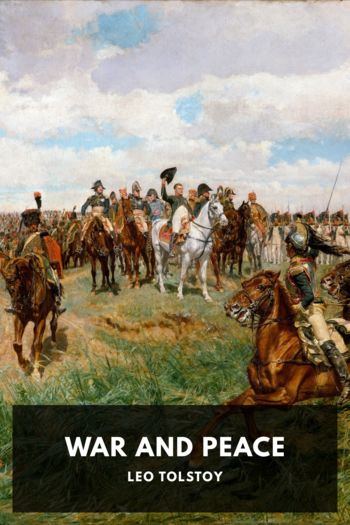
Against the backdrop of the Napoleonic Wars, five aristocratic families in Russia are transformed by the vagaries of life, by war, and by the intersection of their lives with each other. Hundreds of characters populate War and Peace, many of them historical persons, including Napoleon and Tsar Alexander I, and all of them come to life under Tolstoy’s deft hand.
War and Peace is generally considered to be Tolstoy’s masterpiece, a pinnacle of Russian literature, and one of history’s great novels. Tolstoy himself refused to call it that, saying it was “not a novel, even less is it a poem, and still less a historical chronicle.” It contains elements of history, narrative, and philosophy, the latter increasing in quantity as the book moves towards its climax. Whatever it is called, it is a triumph whose breadth and depth is perhaps unmatched in literature.
This production restores the Russian given names that were anglicized by the Maudes in their translation, the use of Russian patronymics and diminutives that they eliminated, and Tolstoy’s original four-book structure.
Read free book «War and Peace by Leo Tolstoy (ebook reader for pc TXT) 📕» - read online or download for free at americanlibrarybooks.com
- Author: Leo Tolstoy
Read book online «War and Peace by Leo Tolstoy (ebook reader for pc TXT) 📕». Author - Leo Tolstoy
The discussions continued a long time, and the longer they lasted the more heated became the disputes, culminating in shouts and personalities, and the less was it possible to arrive at any general conclusion from all that had been said. Prince Andréy, listening to this polyglot talk and to these surmises, plans, refutations, and shouts, felt nothing but amazement at what they were saying. A thought that had long since and often occurred to him during his military activities—the idea that there is not and cannot be any science of war, and that therefore there can be no such thing as a military genius—now appeared to him an obvious truth. “What theory and science is possible about a matter the conditions and circumstances of which are unknown and cannot be defined, especially when the strength of the acting forces cannot be ascertained? No one was or is able to foresee in what condition our or the enemy’s armies will be in a day’s time, and no one can gauge the force of this or that detachment. Sometimes—when there is not a coward at the front to shout, ‘We are cut off!’ and start running, but a brave and jolly lad who shouts, ‘Hurrah!’—a detachment of five thousand is worth thirty thousand, as at Schön Grabern, while at times fifty thousand run from eight thousand, as at Austerlitz. What science can there be in a matter in which, as in all practical matters, nothing can be defined and everything depends on innumerable conditions, the significance of which is determined at a particular moment which arrives no one knows when? Armfeldt says our army is cut in half, and Paulucci says we have got the French army between two fires; Michaud says that the worthlessness of the Drissa camp lies in having the river behind it, and Pfuel says that is what constitutes its strength; Toll proposes one plan, Armfeldt another, and they are all good and all bad, and the advantages of any suggestions can be seen only at the moment of trial. And why do they all speak of a ‘military genius’? Is a man a genius who can order bread to be brought up at the right time and say who is to go to the right and who to the left? It is only because military men are invested with pomp and power and crowds of sychophants flatter power, attributing to it qualities of genius it does not possess. The best generals I have known were, on the contrary, stupid or absentminded men. Bagratión was the best, Napoleon himself admitted that. And of Bonaparte himself! I remember his limited, self-satisfied face on the field of Austerlitz. Not only does a good army commander not need any special qualities, on the contrary he needs the absence of the highest and best human attributes—love, poetry, tenderness, and philosophic inquiring doubt. He should be limited, firmly convinced that what he is doing is very important (otherwise he will not have sufficient patience), and only then will he be a brave leader. God forbid that he should be humane, should love, or pity, or think of what is just and unjust. It is understandable that a theory of their ‘genius’ was invented for them long ago because they have power! The success of a military action depends not on them, but on the man in the ranks who shouts, ‘We are lost!’ or who shouts, ‘Hurrah!’ And only in the ranks can one serve with assurance of being useful.”
So thought Prince Andréy as he listened to the talking, and he roused himself only when Paulucci called him and everyone was leaving.
At the review next day the Emperor asked Prince Andréy where he would like to serve, and Prince Andréy lost his standing in court circles forever by not asking to remain attached to the sovereign’s person, but for permission to serve in the army.
XIIBefore the beginning of the campaign, Rostóv had received a letter from his parents in which they told him briefly of Natásha’s illness and the breaking off of her engagement to Prince Andréy (which they explained by Natásha’s having rejected him) and again asked Nikoláy to retire from the army and return home. On receiving this letter, Nikoláy did not even make any attempt to get leave of absence or to retire from the army, but wrote to his parents that he was sorry Natásha was ill and her engagement broken off, and that he would do all he


Comments (0)