War and Peace by Leo Tolstoy (ebook reader for pc TXT) 📕
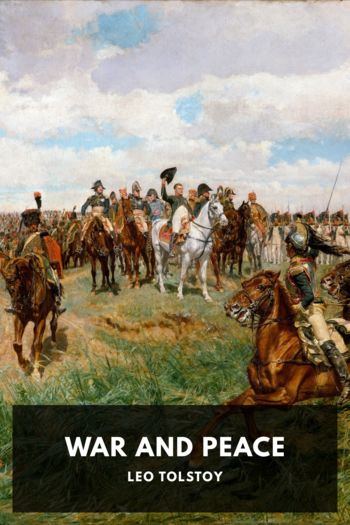
Description
Against the backdrop of the Napoleonic Wars, five aristocratic families in Russia are transformed by the vagaries of life, by war, and by the intersection of their lives with each other. Hundreds of characters populate War and Peace, many of them historical persons, including Napoleon and Tsar Alexander I, and all of them come to life under Tolstoy’s deft hand.
War and Peace is generally considered to be Tolstoy’s masterpiece, a pinnacle of Russian literature, and one of history’s great novels. Tolstoy himself refused to call it that, saying it was “not a novel, even less is it a poem, and still less a historical chronicle.” It contains elements of history, narrative, and philosophy, the latter increasing in quantity as the book moves towards its climax. Whatever it is called, it is a triumph whose breadth and depth is perhaps unmatched in literature.
This production restores the Russian given names that were anglicized by the Maudes in their translation, the use of Russian patronymics and diminutives that they eliminated, and Tolstoy’s original four-book structure.
Read free book «War and Peace by Leo Tolstoy (ebook reader for pc TXT) 📕» - read online or download for free at americanlibrarybooks.com
- Author: Leo Tolstoy
Read book online «War and Peace by Leo Tolstoy (ebook reader for pc TXT) 📕». Author - Leo Tolstoy
All the men of this party were fishing for rubles, decorations, and promotions, and in this pursuit watched only the weathercock of imperial favor, and directly they noticed it turning in any direction, this whole drone population of the army began blowing hard that way, so that it was all the harder for the Emperor to turn it elsewhere. Amid the uncertainties of the position, with the menace of serious danger giving a peculiarly threatening character to everything, amid this vortex of intrigue, egotism, conflict of views and feelings, and the diversity of race among these people—this eighth and largest party of those preoccupied with personal interests imparted great confusion and obscurity to the common task. Whatever question arose, a swarm of these drones, without having finished their buzzing on a previous theme, flew over to the new one and by their hum drowned and obscured the voices of those who were disputing honestly.
From among all these parties, just at the time Prince Andréy reached the army, another, a ninth party, was being formed and was beginning to raise its voice. This was the party of the elders, reasonable men experienced and capable in state affairs, who, without sharing any of those conflicting opinions, were able to take a detached view of what was going on at the staff at headquarters and to consider means of escape from this muddle, indecision, intricacy, and weakness.
The men of this party said and thought that what was wrong resulted chiefly from the Emperor’s presence in the army with his military court and from the consequent presence there of an indefinite, conditional, and unsteady fluctuation of relations, which is in place at court but harmful in an army; that a sovereign should reign but not command the army, and that the only way out of the position would be for the Emperor and his court to leave the army; that the mere presence of the Emperor paralyzed the action of fifty thousand men required to secure his personal safety, and that the worst commander in chief, if independent, would be better than the very best one trammeled by the presence and authority of the monarch.
Just at the time Prince Andréy was living unoccupied at Drissa, Shishkóv, the Secretary of State and one of the chief representatives of this party, wrote a letter to the Emperor which Arakchéev and Balashëv agreed to sign. In this letter, availing himself of permission given him by the Emperor to discuss the general course of affairs, he respectfully suggested—on the plea that it was necessary for the sovereign to arouse a warlike spirit in the people of the capital—that the Emperor should leave the army.
That arousing of the people by their sovereign and his call to them to defend their country—the very incitement which was the chief cause of Russia’s triumph in so far as it was produced by the Tsar’s personal presence in Moscow—was suggested to the Emperor, and accepted by him, as a pretext for quitting the army.
XThis letter had not yet been presented to the Emperor when Barclay, one day at dinner, informed Bolkónski that the sovereign wished to see him personally, to question him about Turkey, and that Prince Andréy was to present himself at Bennigsen’s quarters at six that evening.
News was received at the Emperor’s quarters that very day of a fresh movement by Napoleon which might endanger the army—news subsequently found to be false. And that morning Colonel Michaud had ridden round the Drissa fortifications with the Emperor and had pointed out to him that this fortified camp constructed by Pfuel, and till then considered a chef-d’oeuvre of tactical science which would ensure Napoleon’s destruction, was an absurdity, threatening the destruction of the Russian army.
Prince Andréy arrived at Bennigsen’s quarters—a country gentleman’s house of moderate size, situated on the very banks of the river. Neither Bennigsen nor the Emperor was there, but Chernýshev, the Emperor’s aide-de-camp, received Bolkónski and informed him that the Emperor, accompanied by General Bennigsen and Marquis Paulucci, had gone a second time that day to inspect the fortifications of the Drissa camp, of the suitability of which serious doubts were beginning to be felt.
Chernýshev was sitting at a window in the first room with a French novel in his hand. This room had probably been a music room; there was still an organ in it on which some rugs were piled, and in one corner stood the folding bedstead of Bennigsen’s adjutant. This adjutant was also there and sat dozing on the rolled-up bedding, evidently exhausted by work or by feasting. Two doors led from the room, one straight on into what had been the drawing room, and another, on the right, to the study. Through the first door came the sound of voices conversing in German and occasionally in French. In that drawing room were gathered, by the Emperor’s wish, not a military council (the Emperor preferred indefiniteness), but certain persons whose opinions he wished to know in view of the impending difficulties. It was


Comments (0)