War and Peace by Leo Tolstoy (ebook reader for pc TXT) 📕
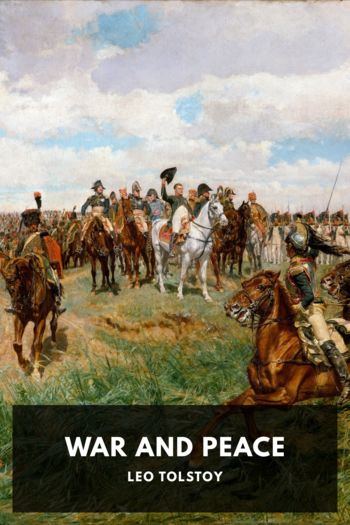
Description
Against the backdrop of the Napoleonic Wars, five aristocratic families in Russia are transformed by the vagaries of life, by war, and by the intersection of their lives with each other. Hundreds of characters populate War and Peace, many of them historical persons, including Napoleon and Tsar Alexander I, and all of them come to life under Tolstoy’s deft hand.
War and Peace is generally considered to be Tolstoy’s masterpiece, a pinnacle of Russian literature, and one of history’s great novels. Tolstoy himself refused to call it that, saying it was “not a novel, even less is it a poem, and still less a historical chronicle.” It contains elements of history, narrative, and philosophy, the latter increasing in quantity as the book moves towards its climax. Whatever it is called, it is a triumph whose breadth and depth is perhaps unmatched in literature.
This production restores the Russian given names that were anglicized by the Maudes in their translation, the use of Russian patronymics and diminutives that they eliminated, and Tolstoy’s original four-book structure.
Read free book «War and Peace by Leo Tolstoy (ebook reader for pc TXT) 📕» - read online or download for free at americanlibrarybooks.com
- Author: Leo Tolstoy
Read book online «War and Peace by Leo Tolstoy (ebook reader for pc TXT) 📕». Author - Leo Tolstoy
While the Emperor had still been at Vílna, the forces had been divided into three armies. First, the army under Barclay de Tolly, secondly, the army under Bagratión, and thirdly, the one commanded by Tormásov. The Emperor was with the first army, but not as commander in chief. In the orders issued it was stated, not that the Emperor would take command, but only that he would be with the army. The Emperor, moreover, had with him not a commander in chief’s staff but the imperial headquarters staff. In attendance on him was the head of the imperial staff, Quartermaster General Prince Volkónski, as well as generals, imperial aides-de-camp, diplomatic officials, and a large number of foreigners, but not the army staff. Besides these, there were in attendance on the Emperor without any definite appointments: Arakchéev, the ex-Minister of War; Count Bennigsen, the senior general in rank; the Grand Duke Tsarévich Konstantin Pávlovich; Count Rumyántsev, the Chancellor; Stein, a former Prussian minister; Armfeldt, a Swedish general; Pfuel, the chief author of the plan of campaign; Paulucci, an adjutant general and Sardinian émigré; Wolzogen—and many others. Though these men had no military appointment in the army, their position gave them influence, and often a corps commander, or even the commander in chief, did not know in what capacity he was questioned by Bennigsen, the Grand Duke, Arakchéev, or Prince Volkónski, or was given this or that advice and did not know whether a certain order received in the form of advice emanated from the man who gave it or from the Emperor and whether it had to be executed or not. But this was only the external condition; the essential significance of the presence of the Emperor and of all these people, from a courtier’s point of view (and in an Emperor’s vicinity all became courtiers), was clear to everyone. It was this: the Emperor did not assume the title of commander in chief, but disposed of all the armies; the men around him were his assistants. Arakchéev was a faithful custodian to enforce order and acted as the sovereign’s bodyguard. Bennigsen was a landlord in the Vílna province who appeared to be doing the honors of the district, but was in reality a good general, useful as an adviser and ready at hand to replace Barclay. The Grand Duke was there because it suited him to be. The ex-Minister Stein was there because his advice was useful and the Emperor Alexander held him in high esteem personally. Armfeldt virulently hated Napoleon and was a general full of self-confidence, a quality that always influenced Alexander. Paulucci was there because he was bold and decided in speech. The adjutants general were there because they always accompanied the Emperor, and lastly and chiefly Pfuel was there because he had drawn up the plan of campaign against Napoleon and, having induced Alexander to believe in the efficacy of that plan, was directing the whole business of the war. With Pfuel was Wolzogen, who expressed Pfuel’s thoughts in a more comprehensible way than Pfuel himself (who was a harsh, bookish theorist, self-confident to the point of despising everyone else) was able to do.
Besides these Russians and foreigners who propounded new and unexpected ideas every day—especially the foreigners, who did so with a boldness characteristic of people employed in a country not their own—there were many secondary personages accompanying the army because their principals were there.
Among the opinions and voices in this immense, restless, brilliant, and proud sphere, Prince Andréy noticed the following sharply defined subdivisions of tendencies and parties:
The first party consisted of Pfuel and his adherents—military theorists who believed in a science of war with immutable laws—laws of oblique movements, outflankings, and so forth. Pfuel and his adherents demanded a retirement into the depths of the country in accordance with precise laws defined by a pseudo-theory of war, and they saw only barbarism, ignorance, or evil intention in every deviation from that theory. To this party belonged the foreign nobles, Wolzogen, Wintzingerode, and others, chiefly Germans.
The second party was directly opposed to the first; one


Comments (0)