War and Peace by Leo Tolstoy (ebook reader for pc TXT) 📕
Description
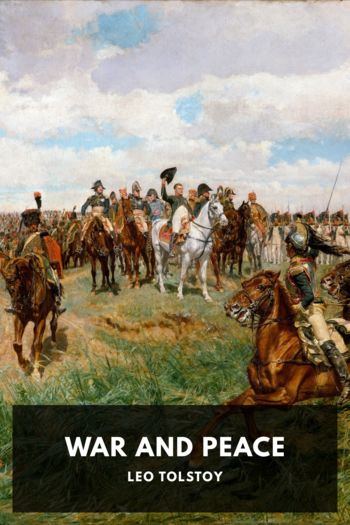
Against the backdrop of the Napoleonic Wars, five aristocratic families in Russia are transformed by the vagaries of life, by war, and by the intersection of their lives with each other. Hundreds of characters populate War and Peace, many of them historical persons, including Napoleon and Tsar Alexander I, and all of them come to life under Tolstoy’s deft hand.
War and Peace is generally considered to be Tolstoy’s masterpiece, a pinnacle of Russian literature, and one of history’s great novels. Tolstoy himself refused to call it that, saying it was “not a novel, even less is it a poem, and still less a historical chronicle.” It contains elements of history, narrative, and philosophy, the latter increasing in quantity as the book moves towards its climax. Whatever it is called, it is a triumph whose breadth and depth is perhaps unmatched in literature.
This production restores the Russian given names that were anglicized by the Maudes in their translation, the use of Russian patronymics and diminutives that they eliminated, and Tolstoy’s original four-book structure.
Read free book «War and Peace by Leo Tolstoy (ebook reader for pc TXT) 📕» - read online or download for free at americanlibrarybooks.com
- Author: Leo Tolstoy
Read book online «War and Peace by Leo Tolstoy (ebook reader for pc TXT) 📕». Author - Leo Tolstoy
To the third party—in which the Emperor had most confidence—belonged the courtiers who tried to arrange compromises between the other two. The members of this party, chiefly civilians and to whom Arakchéev belonged, thought and said what men who have no convictions but wish to seem to have some generally say. They said that undoubtedly war, particularly against such a genius as Bonaparte (they called him Bonaparte now), needs most deeply devised plans and profound scientific knowledge and in that respect Pfuel was a genius, but at the same time it had to be acknowledged that the theorists are often one-sided, and therefore one should not trust them absolutely, but should also listen to what Pfuel’s opponents and practical men of experience in warfare had to say, and then choose a middle course. They insisted on the retention of the camp at Drissa, according to Pfuel’s plan, but on changing the movements of the other armies. Though, by this course, neither one aim nor the other could be attained, yet it seemed best to the adherents of this third party.
Of a fourth opinion the most conspicuous representative was the Tsarévich, who could not forget his disillusionment at Austerlitz, where he had ridden out at the head of the Guards, in his casque and cavalry uniform as to a review, expecting to crush the French gallantly; but unexpectedly finding himself in the front line had narrowly escaped amid the general confusion. The men of this party had both the quality and the defect of frankness in their opinions. They feared Napoleon, recognized his strength and their own weakness, and frankly said so. They said: “Nothing but sorrow, shame, and ruin will come of all this! We have abandoned Vílna and Vítebsk and shall abandon Drissa. The only reasonable thing left to do is to conclude peace as soon as possible, before we are turned out of Petersburg.”
This view was very general in the upper army circles and found support also in Petersburg and from the chancellor, Rumyántsev, who, for other reasons of state, was in favor of peace.
The fifth party consisted of those who were adherents of Barclay de Tolly, not so much as a man but as minister of war and commander in chief. “Be he what he may” (they always began like that), “he is an honest, practical man and we have nobody better. Give him real power, for war cannot be conducted successfully without unity of command, and he will show what he can do, as he did in Finland. If our army is well organized and strong and has withdrawn to Drissa without suffering any defeats, we owe this entirely to Barclay. If Barclay is now to be superseded by Bennigsen all will be lost, for Bennigsen showed his incapacity already in 1807.”
The sixth party, the Bennigsenites, said, on the contrary, that at any rate there was no one more active and experienced than Bennigsen: “and twist about as you may, you will have to come to Bennigsen eventually. Let the others make mistakes now!” said they, arguing that our retirement to Drissa was a most shameful reverse and an unbroken series of blunders. “The more mistakes that are made the better. It will at any rate be understood all the sooner that things cannot go on like this. What is wanted is not some Barclay or other, but a man like Bennigsen, who made his mark in 1807, and to whom Napoleon himself did justice—a man whose authority would be willingly recognized, and Bennigsen is the only such man.”
The seventh party consisted of the sort of people who are always to be found, especially around young sovereigns, and of whom there were particularly many round Alexander—generals and imperial aides-de-camp passionately devoted to the Emperor, not merely as a monarch but as a man, adoring him sincerely and disinterestedly, as Rostóv had done in 1805, and who saw in him not only all the virtues but all human capabilities as well. These men, though enchanted with the sovereign for refusing the command of the army, yet blamed him for such excessive modesty, and only desired and insisted that their adored sovereign should abandon his diffidence and openly announce that he would place himself at the head of the army, gather round him a commander in chief’s staff, and, consulting experienced theoreticians and practical men where necessary, would himself lead the troops, whose spirits would thereby be raised to the highest pitch.
The eighth and largest group, which in its enormous numbers was to the others as ninety-nine to one, consisted of men who desired neither peace nor war, neither an advance nor a defensive camp at the Drissa or anywhere else, neither Barclay nor the Emperor, neither Pfuel nor Bennigsen, but only the one most essential thing—as much advantage and pleasure for themselves as possible. In the troubled waters of conflicting and intersecting intrigues that eddied about the Emperor’s headquarters, it was possible to succeed in many ways unthinkable at other times. A man who simply wished to retain his lucrative post would today agree with Pfuel, tomorrow with his opponent, and the day after, merely to avoid responsibility or to please the Emperor,


Comments (0)