Short Fiction by Anton Chekhov (libby ebook reader .txt) 📕
Description
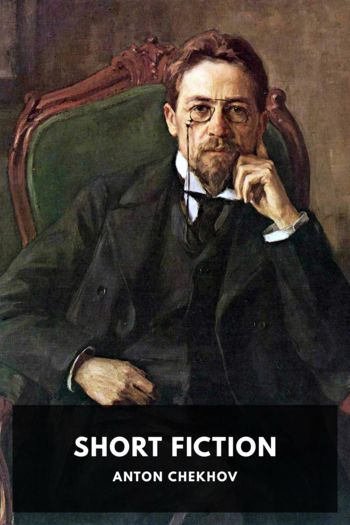
Anton Chekhov is widely considered to be one of the greatest short story writers in history. A physician by day, he’s famously quoted as saying, “Medicine is my lawful wife, and literature is my mistress.” Chekhov wrote nearly 300 short stories in his long writing career; while at first he wrote mainly to make a profit, as his interest in writing—and his skill—grew, he wrote stories that heavily influenced the modern development of the form.
His stories are famous for, among other things, their ambiguous morality and their often inconclusive nature. Chekhov was a firm believer that the role of the artist was to correctly pose a question, but not necessarily to answer it.
This collection contains all of his short stories and two novellas, all translated by Constance Garnett, and arranged by the date they were originally published.
Read free book «Short Fiction by Anton Chekhov (libby ebook reader .txt) 📕» - read online or download for free at americanlibrarybooks.com
- Author: Anton Chekhov
Read book online «Short Fiction by Anton Chekhov (libby ebook reader .txt) 📕». Author - Anton Chekhov
“I am expected downstairs,” said Natalya Gavrilovna.
She got up from the table and turned to Ivan Ivanitch.
“So you will look in upon me downstairs for a minute? I won’t say goodbye to you.”
And she went away.
Ivan Ivanitch was now drinking his seventh glass of tea, choking, smacking his lips, and sucking sometimes his moustache, sometimes the lemon. He was muttering something drowsily and listlessly, and I did not listen but waited for him to go. At last, with an expression that suggested that he had only come to me to take a cup of tea, he got up and began to take leave. As I saw him out I said:
“And so you have given me no advice.”
“Eh? I am a feeble, stupid old man,” he answered. “What use would my advice be? You shouldn’t worry yourself. … I really don’t know why you worry yourself. Don’t disturb yourself, my dear fellow! Upon my word, there’s no need,” he whispered genuinely and affectionately, soothing me as though I were a child. “Upon my word, there’s no need.”
“No need? Why, the peasants are pulling the thatch off their huts, and they say there is typhus somewhere already.”
“Well, what of it? If there are good crops next year, they’ll thatch them again, and if we die of typhus others will live after us. Anyway, we have to die—if not now, later. Don’t worry yourself, my dear.”
“I can’t help worrying myself,” I said irritably.
We were standing in the dimly lighted vestibule. Ivan Ivanitch suddenly took me by the elbow, and, preparing to say something evidently very important, looked at me in silence for a couple of minutes.
“Pavel Andreitch!” he said softly, and suddenly in his puffy, set face and dark eyes there was a gleam of the expression for which he had once been famous and which was truly charming. “Pavel Andreitch, I speak to you as a friend: try to be different! One is ill at ease with you, my dear fellow, one really is!”
He looked intently into my face; the charming expression faded away, his eyes grew dim again, and he sniffed and muttered feebly:
“Yes, yes. … Excuse an old man. … It’s all nonsense … yes.”
As he slowly descended the staircase, spreading out his hands to balance himself and showing me his huge, bulky back and red neck, he gave me the unpleasant impression of a sort of crab.
“You ought to go away, your Excellency,” he muttered. “To Petersburg or abroad. … Why should you live here and waste your golden days? You are young, wealthy, and healthy. … Yes. … Ah, if I were younger I would whisk away like a hare, and snap my fingers at everything.”
IIIMy wife’s outburst reminded me of our married life together. In old days after every such outburst we felt irresistibly drawn to each other; we would meet and let off all the dynamite that had accumulated in our souls. And now after Ivan Ivanitch had gone away I had a strong impulse to go to my wife. I wanted to go downstairs and tell her that her behaviour at tea had been an insult to me, that she was cruel, petty, and that her plebeian mind had never risen to a comprehension of what I was saying and of what I was doing. I walked about the rooms a long time thinking of what I would say to her and trying to guess what she would say to me.
That evening, after Ivan Ivanitch went away, I felt in a peculiarly irritating form the uneasiness which had worried me of late. I could not sit down or sit still, but kept walking about in the rooms that were lighted up and keeping near to the one in which Marya Gerasimovna was sitting. I had a feeling very much like that which I had on the North Sea during a storm when everyone thought that our ship, which had no freight nor ballast, would overturn. And that evening I understood that my uneasiness was not disappointment, as I had supposed, but a different feeling, though what exactly I could not say, and that irritated me more than ever.
“I will go to her,” I decided. “I can think of a pretext. I shall say that I want to see Ivan Ivanitch; that will be all.”
I went downstairs and walked without haste over the carpeted floor through the vestibule and the hall. Ivan Ivanitch was sitting on the sofa in the drawing room; he was drinking tea again and muttering something. My wife was standing opposite to him and holding on to the back of a chair. There was a gentle, sweet, and docile expression on her face, such as one sees on the faces of people listening to crazy saints or holy men when a peculiar hidden significance is imagined in their vague words and mutterings. There was something morbid, something of a nun’s exaltation, in my wife’s expression and attitude; and her low-pitched, half-dark rooms with their old-fashioned furniture, with her birds asleep in their cages, and with a smell of geranium, reminded me of the rooms of some abbess or pious old lady.
I went into the drawing room. My wife showed neither surprise nor confusion, and looked at me calmly and serenely, as though she had known I should come.
“I beg your pardon,” I said softly. “I am so glad you have not gone yet, Ivan Ivanitch. I forgot to ask you, do you know the Christian name of the president of our Zemstvo?”
“Andrey Stanislavovitch. Yes. …”
“Merci,” I said, took out my notebook, and wrote it down.
There followed a silence during which my wife and Ivan Ivanitch were probably waiting for me to go; my wife did not believe that I wanted to know the president’s name—I saw that from her eyes.
“Well, I must be going, my beauty,” muttered Ivan Ivanitch, after I had walked once or twice across the drawing room and sat down



Comments (0)