Short Fiction by Anton Chekhov (libby ebook reader .txt) 📕
Description
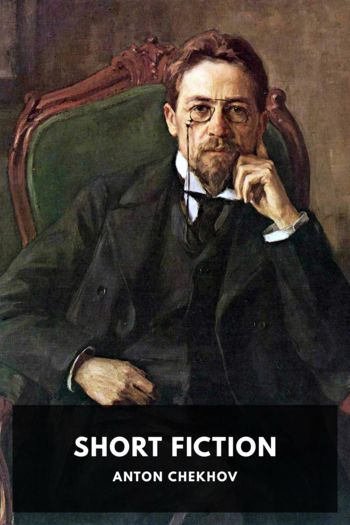
Anton Chekhov is widely considered to be one of the greatest short story writers in history. A physician by day, he’s famously quoted as saying, “Medicine is my lawful wife, and literature is my mistress.” Chekhov wrote nearly 300 short stories in his long writing career; while at first he wrote mainly to make a profit, as his interest in writing—and his skill—grew, he wrote stories that heavily influenced the modern development of the form.
His stories are famous for, among other things, their ambiguous morality and their often inconclusive nature. Chekhov was a firm believer that the role of the artist was to correctly pose a question, but not necessarily to answer it.
This collection contains all of his short stories and two novellas, all translated by Constance Garnett, and arranged by the date they were originally published.
Read free book «Short Fiction by Anton Chekhov (libby ebook reader .txt) 📕» - read online or download for free at americanlibrarybooks.com
- Author: Anton Chekhov
Read book online «Short Fiction by Anton Chekhov (libby ebook reader .txt) 📕». Author - Anton Chekhov
Whenever I passed by her, she would say, knowing the reason for my brooding:
“What can you expect, Pasha? I told you how it would be before. You can judge from our servants.”
My wife, Natalya Gavrilovna, lived on the lower storey, all the rooms of which she occupied. She slept, had her meals, and received her visitors downstairs in her own rooms, and took not the slightest interest in how I dined, or slept, or whom I saw. Our relations with one another were simple and not strained, but cold, empty, and dreary as relations are between people who have been so long estranged, that even living under the same roof gives no semblance of nearness. There was no trace now of the passionate and tormenting love—at one time sweet, at another bitter as wormwood—which I had once felt for Natalya Gavrilovna. There was nothing left, either, of the outbursts of the past—the loud altercations, upbraidings, complaints, and gusts of hatred which had usually ended in my wife’s going abroad or to her own people, and in my sending money in small but frequent instalments that I might sting her pride oftener. (My proud and sensitive wife and her family live at my expense, and much as she would have liked to do so, my wife could not refuse my money: that afforded me satisfaction and was one comfort in my sorrow.) Now when we chanced to meet in the corridor downstairs or in the yard, I bowed, she smiled graciously. We spoke of the weather, said that it seemed time to put in the double windows, and that someone with bells on their harness had driven over the dam. And at such times I read in her face: “I am faithful to you and am not disgracing your good name which you think so much about; you are sensible and do not worry me; we are quits.”
I assured myself that my love had died long ago, that I was too much absorbed in my work to think seriously of my relations with my wife. But, alas! that was only what I imagined. When my wife talked aloud downstairs I listened intently to her voice, though I could not distinguish one word. When she played the piano downstairs I stood up and listened. When her carriage or her saddle-horse was brought to the door, I went to the window and waited to see her out of the house; then I watched her get into her carriage or mount her horse and ride out of the yard. I felt that there was something wrong with me, and was afraid the expression of my eyes or my face might betray me. I looked after my wife and then watched for her to come back that I might see again from the window her face, her shoulders, her fur coat, her hat. I felt dreary, sad, infinitely regretful, and felt inclined in her absence to walk through her rooms, and longed that the problem that my wife and I had not been able to solve because our characters were incompatible, should solve itself in the natural way as soon as possible—that is, that this beautiful woman of twenty-seven might make haste and grow old, and that my head might be grey and bald.
One day at lunch my bailiff informed me that the Pestrovo peasants had begun to pull the thatch off the roofs to feed their cattle. Marya Gerasimovna looked at me in alarm and perplexity.
“What can I do?” I said to her. “One cannot fight single-handed, and I have never experienced such loneliness as I do now. I would give a great deal to find one man in the whole province on whom I could rely.”
“Invite Ivan Ivanitch,” said Marya Gerasimovna.
“To be sure!” I thought, delighted. “That is an idea! C’est raison,” I hummed, going to my study to write to Ivan Ivanitch. “C’est raison, c’est raison.”
IIOf all the mass of acquaintances who, in this house twenty-five to thirty-five years ago, had eaten, drunk, masqueraded, fallen in love, married bored us with accounts of their splendid packs of hounds and horses, the only one still living was Ivan Ivanitch Bragin. At one time he had been very active, talkative, noisy, and given to falling in love, and had been famous for his extreme views and for the peculiar charm of his face, which fascinated men as well as women; now he was an old man, had grown corpulent, and was living out his days with neither views nor charm. He came the day after getting my letter, in the evening just as the samovar was brought into the dining room and little Marya Gerasimovna had begun slicing the lemon.
“I am very glad to see you, my dear fellow,” I said gaily, meeting him. “Why, you are stouter than ever. …”
“It isn’t getting stout; it’s swelling,” he answered. “The bees must have stung me.”
With the familiarity of a man laughing at his own fatness, he put his arms round my waist and laid on my breast his big soft head, with the hair combed down on the forehead like a Little Russian’s, and went off into a thin, aged laugh.
“And you go on getting younger,” he said through his laugh. “I wonder what dye you use for your hair and beard; you might let me have some of it.” Sniffing and gasping, he embraced me and kissed me on the cheek. “You might give me some of it,” he repeated. “Why, you are not forty, are you?”
“Alas, I am forty-six!” I said, laughing.
Ivan Ivanitch smelt of tallow candles and cooking, and that suited him. His big, puffy, slow-moving body was swathed in a long frock-coat like a coachman’s full coat, with a high waist, and with



Comments (0)