Short Fiction by Anton Chekhov (libby ebook reader .txt) 📕
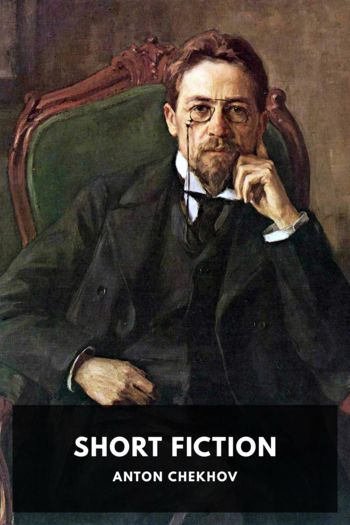
Description
Anton Chekhov is widely considered to be one of the greatest short story writers in history. A physician by day, he’s famously quoted as saying, “Medicine is my lawful wife, and literature is my mistress.” Chekhov wrote nearly 300 short stories in his long writing career; while at first he wrote mainly to make a profit, as his interest in writing—and his skill—grew, he wrote stories that heavily influenced the modern development of the form.
His stories are famous for, among other things, their ambiguous morality and their often inconclusive nature. Chekhov was a firm believer that the role of the artist was to correctly pose a question, but not necessarily to answer it.
This collection contains all of his short stories and two novellas, all translated by Constance Garnett, and arranged by the date they were originally published.
Read free book «Short Fiction by Anton Chekhov (libby ebook reader .txt) 📕» - read online or download for free at americanlibrarybooks.com
- Author: Anton Chekhov
Read book online «Short Fiction by Anton Chekhov (libby ebook reader .txt) 📕». Author - Anton Chekhov
Six months before, his colleagues had decided that he was going into consumption, and advised him to throw up everything and go to the Crimea. When she heard of this, Olga Dmitrievna affected to be very much alarmed; she began to be affectionate to her husband, and kept assuring him that it would be cold and dull in the Crimea, and that he had much better go to Nice, and that she would go with him, and there would nurse him, look after him, take care of him.
Now, he understood why his wife was so particularly anxious to go to Nice: her Michel lived at Monte Carlo.
He took an English dictionary, and translating the words, and guessing their meaning, by degrees he put together the following sentence: “I drink to the health of my beloved darling, and kiss her little foot a thousand times, and am impatiently expecting her arrival.” He pictured the pitiable, ludicrous part he would play if he had agreed to go to Nice with his wife. He felt so mortified that he almost shed tears and began pacing to and fro through all the rooms of the flat in great agitation. His pride, his plebeian fastidiousness, was revolted. Clenching his fists and scowling with disgust, he wondered how he, the son of a village priest, brought up in a clerical school, a plain, straightforward man, a surgeon by profession—how could he have let himself be enslaved, have sunk into such shameful bondage to this weak, worthless, mercenary, low creature.
“ ‘Little foot’!” he muttered to himself, crumpling up the telegram; “ ‘little foot’!”
Of the time when he fell in love and proposed to her, and the seven years that he had been living with her, all that remained in his memory was her long, fragrant hair, a mass of soft lace, and her little feet, which certainly were very small, beautiful feet; and even now it seemed as though he still had from those old embraces the feeling of lace and silk upon his hands and face—and nothing more. Nothing more—that is, not counting hysterics, shrieks, reproaches, threats, and lies—brazen, treacherous lies. He remembered how in his father’s house in the village a bird would sometimes chance to fly in from the open air into the house and would struggle desperately against the windowpanes and upset things; so this woman from a class utterly alien to him had flown into his life and made complete havoc of it. The best years of his life had been spent as though in hell, his hopes for happiness shattered and turned into a mockery, his health gone, his rooms as vulgar in their atmosphere as a cocotte’s, and of the ten thousand he earned every year he could never save ten roubles to send his old mother in the village, and his debts were already about fifteen thousand. It seemed that if a band of brigands had been living in his rooms his life would not have been so hopelessly, so irremediably ruined as by the presence of this woman.
He began coughing and gasping for breath. He ought to have gone to bed and got warm, but he could not. He kept walking about the rooms, or sat down to the table, nervously fidgeting with a pencil and scribbling mechanically on a paper.
“Trying a pen. … A little foot.”
By five o’clock he grew weaker and threw all the blame on himself. It seemed to him now that if Olga Dmitrievna had married someone else who might have had a good influence over her—who knows?—she might after all have become a good, straightforward woman. He was a poor psychologist, and knew nothing of the female heart; besides, he was churlish, uninteresting. …
“I haven’t long to live now,” he thought. “I am a dead man, and ought not to stand in the way of the living. It would be strange and stupid to insist upon one’s rights now. I’ll have it out with her; let her go to the man she loves. … I’ll give her a divorce. I’ll take the blame on myself.”
Olga Dmitrievna came in at last, and she walked into the study and sank into a chair just as she was in her white cloak, hat, and overboots.
“The nasty, fat boy,” she said with a sob, breathing hard. “It’s really dishonest; it’s disgusting.” She stamped. “I can’t put up with it; I can’t, I can’t!”
“What’s the matter?” asked Nikolay Yevgrafitch, going up to her.
“That student, Azarbekov, was seeing me home, and he lost my bag, and there was fifteen roubles in it. I borrowed it from mamma.”
She was crying in a most genuine way, like a little girl, and not only her handkerchief, but even her gloves, were wet with tears.
“It can’t be helped!” said the doctor. “If he’s lost it, he’s lost it, and it’s no good worrying over it. Calm yourself; I want to talk to you.”
“I am not a millionaire to lose money like that. He says he’ll pay it back, but I don’t believe him; he’s poor …”
Her husband begged her to calm herself and to listen to him, but she kept on talking of the student and of the fifteen roubles she had lost.
“Ach! I’ll give you twenty-five roubles tomorrow if you’ll only hold your tongue!”



Comments (0)