Short Fiction by Anton Chekhov (libby ebook reader .txt) 📕
Description
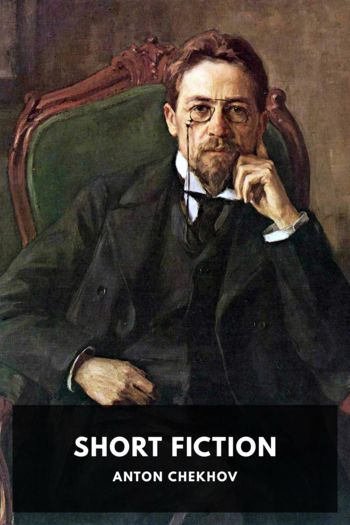
Anton Chekhov is widely considered to be one of the greatest short story writers in history. A physician by day, he’s famously quoted as saying, “Medicine is my lawful wife, and literature is my mistress.” Chekhov wrote nearly 300 short stories in his long writing career; while at first he wrote mainly to make a profit, as his interest in writing—and his skill—grew, he wrote stories that heavily influenced the modern development of the form.
His stories are famous for, among other things, their ambiguous morality and their often inconclusive nature. Chekhov was a firm believer that the role of the artist was to correctly pose a question, but not necessarily to answer it.
This collection contains all of his short stories and two novellas, all translated by Constance Garnett, and arranged by the date they were originally published.
Read free book «Short Fiction by Anton Chekhov (libby ebook reader .txt) 📕» - read online or download for free at americanlibrarybooks.com
- Author: Anton Chekhov
Read book online «Short Fiction by Anton Chekhov (libby ebook reader .txt) 📕». Author - Anton Chekhov
At night Yulia Sergeyevna read the evening prayers attentively, then knelt down, and pressing her hands to her bosom, gazing at the flame of the lamp before the icon, said with feeling:
“Give me understanding, Holy Mother, our Defender! Give me understanding, O Lord!”
She had in the course of her life come across elderly maiden ladies, poor and of no consequence in the world, who bitterly repented and openly confessed their regret that they had refused suitors in the past. Would not the same thing happen to her? Had not she better go into a convent or become a Sister of Mercy?
She undressed and got into bed, crossing herself and crossing the air around her. Suddenly the bell rang sharply and plaintively in the corridor.
“Oh, my God!” she said, feeling a nervous irritation all over her at the sound. She lay still and kept thinking how poor this provincial life was in events, monotonous and yet not peaceful. One was constantly having to tremble, to feel apprehensive, angry or guilty, and in the end one’s nerves were so strained, that one was afraid to peep out of the bedclothes.
A little while afterwards the bell rang just as sharply again. The servant must have been asleep and had not heard. Yulia Sergeyevna lighted a candle, and feeling vexed with the servant, began with a shiver to dress, and when she went out into the corridor, the maid was already closing the door downstairs.
“I thought it was the master, but it’s some one from a patient,” she said.
Yulia Sergeyevna went back to her room. She took a pack of cards out of the chest of drawers, and decided that if after shuffling the cards well and cutting, the bottom card turned out to be a red one, it would mean yes—that is, she would accept Laptev’s offer; and that if it was a black, it would mean no. The card turned out to be the ten of spades.
That relieved her mind—she fell asleep; but in the morning, she was wavering again between yes and no, and she was dwelling on the thought that she could, if she chose, change her life. The thought harassed her, she felt exhausted and unwell; but yet, soon after eleven, she dressed and went to see Nina Fyodorovna. She wanted to see Laptev: perhaps now he would seem more attractive to her; perhaps she had been wrong about him hitherto. …
She found it hard to walk against the wind. She struggled along, holding her hat on with both hands, and could see nothing for the dust.
IVGoing into his sister’s room, and seeing to his surprise Yulia Sergeyevna, Laptev had again the humiliating sensation of a man who feels himself an object of repulsion. He concluded that if after what had happened yesterday she could bring herself so easily to visit his sister and meet him, it must be because she was not concerned about him, and regarded him as a complete nonentity. But when he greeted her, and with a pale face and dust under her eyes she looked at him mournfully and remorsefully, he saw that she, too, was miserable.
She did not feel well. She only stayed ten minutes, and began saying goodbye. And as she went out she said to Laptev:
“Will you see me home, Alexey Fyodorovitch?”
They walked along the street in silence, holding their hats, and he, walking a little behind, tried to screen her from the wind. In the lane it was more sheltered, and they walked side by side.
“Forgive me if I was not nice yesterday;” and her voice quavered as though she were going to cry. “I was so wretched! I did not sleep all night.”
“I slept well all night,” said Laptev, without looking at her; “but that doesn’t mean that I was happy. My life is broken. I’m deeply unhappy, and after your refusal yesterday I go about like a man poisoned. The most difficult thing was said yesterday. Today I feel no embarrassment and can talk to you frankly. I love you more than my sister, more than my dead mother. … I can live without my sister, and without my mother, and I have lived without them, but life without you—is meaningless to me; I can’t face it. …”
And now too, as usual, he guessed her intention.
He realised that she wanted to go back to what had happened the day before, and with that object had asked him to accompany her, and now was taking him home with her. But what could she add to her refusal? What new idea had she in her head? From everything, from her glances, from her smile, and even from her tone, from the way she held her head and shoulders as she walked beside him, he saw that, as before, she did not love him, that he was a stranger to her. What more did she want to say?
Doctor Sergey Borisovitch was at home.
“You are very welcome. I’m always glad to see you, Fyodor Alexeyitch,” he




Comments (0)