Short Fiction by Anton Chekhov (libby ebook reader .txt) 📕
Description
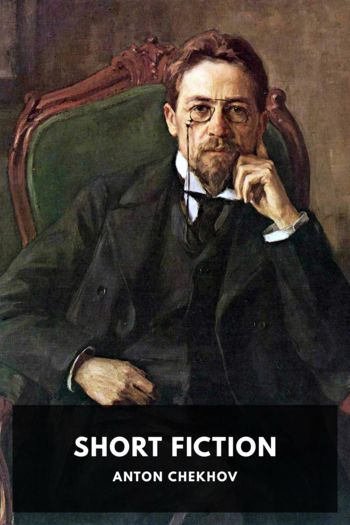
Anton Chekhov is widely considered to be one of the greatest short story writers in history. A physician by day, he’s famously quoted as saying, “Medicine is my lawful wife, and literature is my mistress.” Chekhov wrote nearly 300 short stories in his long writing career; while at first he wrote mainly to make a profit, as his interest in writing—and his skill—grew, he wrote stories that heavily influenced the modern development of the form.
His stories are famous for, among other things, their ambiguous morality and their often inconclusive nature. Chekhov was a firm believer that the role of the artist was to correctly pose a question, but not necessarily to answer it.
This collection contains all of his short stories and two novellas, all translated by Constance Garnett, and arranged by the date they were originally published.
Read free book «Short Fiction by Anton Chekhov (libby ebook reader .txt) 📕» - read online or download for free at americanlibrarybooks.com
- Author: Anton Chekhov
Read book online «Short Fiction by Anton Chekhov (libby ebook reader .txt) 📕». Author - Anton Chekhov
The doctor stopped close to his wife, thrust his hands in his trouser pockets, and slanting his head on one side fixed his eyes on his son. His face bore an expression of indifference, and only from the drops that glittered on his beard it could be seen that he had just been crying.
That repellent horror which is thought of when we speak of death was absent from the room. In the numbness of everything, in the mother’s attitude, in the indifference on the doctor’s face there was something that attracted and touched the heart, that subtle, almost elusive beauty of human sorrow which men will not for a long time learn to understand and describe, and which it seems only music can convey. There was a feeling of beauty, too, in the austere stillness. Kirilov and his wife were silent and not weeping, as though besides the bitterness of their loss they were conscious, too, of all the tragedy of their position; just as once their youth had passed away, so now together with this boy their right to have children had gone forever to all eternity! The doctor was forty-four, his hair was grey and he looked like an old man; his faded and invalid wife was thirty-five. Andrey was not merely the only child, but also the last child.
In contrast to his wife the doctor belonged to the class of people who at times of spiritual suffering feel a craving for movement. After standing for five minutes by his wife, he walked, raising his right foot high, from the bedroom into a little room which was half filled up by a big sofa; from there he went into the kitchen. After wandering by the stove and the cook’s bed he bent down and went by a little door into the passage.
There he saw again the white scarf and the white face.
“At last,” sighed Abogin, reaching towards the door-handle. “Let us go, please.”
The doctor started, glanced at him, and remembered. …
“Why, I have told you already that I can’t go!” he said, growing more animated. “How strange!”
“Doctor, I am not a stone, I fully understand your position … I feel for you,” Abogin said in an imploring voice, laying his hand on his scarf. “But I am not asking you for myself. My wife is dying. If you had heard that cry, if you had seen her face, you would understand my pertinacity. My God, I thought you had gone to get ready! Doctor, time is precious. Let us go, I entreat you.”
“I cannot go,” said Kirilov emphatically and he took a step into the drawing room.
Abogin followed him and caught hold of his sleeve.
“You are in sorrow, I understand. But I’m not asking you to a case of toothache, or to a consultation, but to save a human life!” he went on entreating like a beggar. “Life comes before any personal sorrow! Come, I ask for courage, for heroism! For the love of humanity!”
“Humanity—that cuts both ways,” Kirilov said irritably. “In the name of humanity I beg you not to take me. And how queer it is, really! I can hardly stand and you talk to me about humanity! I am fit for nothing just now. … Nothing will induce me to go, and I can’t leave my wife alone. No, no …”
Kirilov waved his hands and staggered back.
“And … and don’t ask me,” he went on in a tone of alarm. “Excuse me. By No. XIII of the regulations I am obliged to go and you have the right to drag me by my collar … drag me if you like, but … I am not fit … I can’t even speak … excuse me.”
“There is no need to take that tone to me, doctor!” said Abogin, again taking the doctor by his sleeve. “What do I care about No. XIII! To force you against your will I have no right whatever. If you will, come; if you will not—God forgive you; but I am not appealing to your will, but to your feelings. A young woman is dying. You were just speaking of the death of your son. Who should understand my horror if not you?”
Abogin’s voice quivered with emotion; that quiver and his tone were far more persuasive than his words. Abogin was sincere, but it was remarkable that whatever he said his words sounded stilted, soulless, and inappropriately flowery, and even seemed an outrage on the atmosphere of the doctor’s home and on the woman who was somewhere dying. He felt this himself, and so, afraid of not being understood, did his utmost to put softness and tenderness into his voice so that the sincerity of his tone might prevail if his words did not. As a rule, however fine and deep a phrase may be, it only affects the indifferent, and cannot fully satisfy those who are happy or unhappy; that is why dumbness is most often the highest expression of happiness or unhappiness; lovers understand each other better when they are silent, and a fervent, passionate speech delivered by the grave only touches outsiders, while to the widow and children of the dead man it seems cold and trivial.
Kirilov stood in silence. When Abogin uttered a few more phrases concerning the noble calling of a doctor, self-sacrifice, and so on, the doctor asked sullenly: “Is it far?”
“Something like eight or nine miles. I have capital horses, doctor! I give you my word of honour that I will get you there and back in an hour. Only one hour.”
These words had more effect on Kirilov than the appeals to humanity or the noble calling of the doctor. He thought a moment and



Comments (0)