Short Fiction by Anton Chekhov (libby ebook reader .txt) 📕
Description
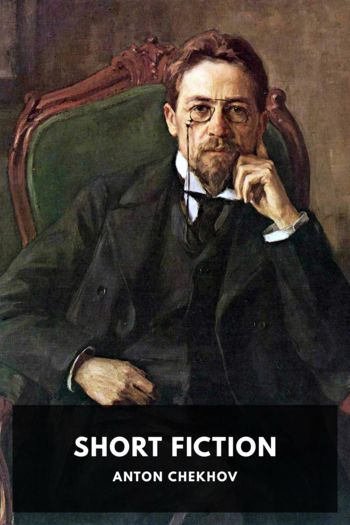
Anton Chekhov is widely considered to be one of the greatest short story writers in history. A physician by day, he’s famously quoted as saying, “Medicine is my lawful wife, and literature is my mistress.” Chekhov wrote nearly 300 short stories in his long writing career; while at first he wrote mainly to make a profit, as his interest in writing—and his skill—grew, he wrote stories that heavily influenced the modern development of the form.
His stories are famous for, among other things, their ambiguous morality and their often inconclusive nature. Chekhov was a firm believer that the role of the artist was to correctly pose a question, but not necessarily to answer it.
This collection contains all of his short stories and two novellas, all translated by Constance Garnett, and arranged by the date they were originally published.
Read free book «Short Fiction by Anton Chekhov (libby ebook reader .txt) 📕» - read online or download for free at americanlibrarybooks.com
- Author: Anton Chekhov
Read book online «Short Fiction by Anton Chekhov (libby ebook reader .txt) 📕». Author - Anton Chekhov
“To whom am I to go?” he muttered as he came out on to the road. “One says it is not his business, another says it is not his business. Whose business is it, then? No, till you grease their hands you will get nothing out of them. The doctor says that, but he keeps looking all the while at my fist to see whether I am going to give him a blue note. Well, brother, I’ll go, if it has to be to the governor.”
Shifting from one foot to the other and continually looking round him in an objectless way, he trudged lazily along the road and was apparently wondering where to go. … It was not cold and the snow faintly crunched under his feet. Not more than half a mile in front of him the wretched little district town in which his brother had just been tried lay outstretched on the hill. On the right was the dark prison with its red roof and sentry-boxes at the corners; on the left was the big town copse, now covered with hoarfrost. It was still; only an old man, wearing a woman’s short jacket and a huge cap, was walking ahead, coughing and shouting to a cow which he was driving to the town.
“Good day, grandfather,” said Kirila, overtaking him.
“Good day. …”
“Are you driving it to the market?”
“No,” the old man answered lazily.
“Are you a townsman?”
They got into conversation; Kirila told him what he had come to the hospital for, and what he had been talking about to the doctor.
“The doctor does not know anything about such matters, that is a sure thing,” the old man said to him as they were both entering the town; “though he is a gentleman, he is only taught to cure by every means, but to give you real advice, or, let us say, write out a petition for you—that he cannot do. There are special authorities to do that. You have been to the justice of the peace and to the police captain—they are no good for your business either.”
“Where am I to go?”
“The permanent member of the rural board is the chief person for peasants’ affairs. Go to him, Mr. Sineokov.”
“The one who is at Zolotovo?”
“Why, yes, at Zolotovo. He is your chief man. If it is anything that has to do with you peasants even the police captain has no authority against him.”
“It’s a long way to go, old man. … I dare say it’s twelve miles and may be more.”
“One who needs something will go seventy.”
“That is so. … Should I send in a petition to him, or what?”
“You will find out there. If you should have a petition the clerk will write you one quick enough. The permanent member has a clerk.”
After parting from the old man Kirila stood still in the middle of the square, thought a little, and walked back out of the town. He made up his mind to go to Zolotovo.
Five days later, as the doctor was on his way home after seeing his patients, he caught sight of Kirila again in his yard. This time the young peasant was not alone, but with a gaunt, very pale old man who nodded his head without ceasing, like a pendulum, and mumbled with his lips.
“Your honour, I have come again to ask your gracious mercy,” began Kirila. “Here I have come with my father. Be merciful, let Vaska go! The permanent member would not talk to me. He said: ‘Go away!’ ”
“Your honour,” the old man hissed in his throat, raising his twitching eyebrows, “be merciful! We are poor people, we cannot repay your honour, but if you graciously please, Kiryushka or Vaska can repay you in work. Let them work.”
“We will pay with work,” said Kirila, and he raised his hand above his head as though he would take an oath. “Let him go! They are starving, they are crying day and night, your honour!”
The young peasant bent a rapid glance on his father, pulled him by the sleeve, and both of them, as at the word of command, fell at the doctor’s feet. The latter waved his hand in despair, and, without looking round, walked quickly in at his door.
PolinkaIt is one o’clock in the afternoon. Shopping is at its height at the Nouveautés de Paris, a drapery establishment in one of the Arcades. There is a monotonous hum of shopmen’s voices, the hum one hears at school when the teacher sets the boys to learn something by heart. This regular sound is not interrupted by the laughter of lady customers nor the slam of the glass door, nor the scurrying of the boys.
Polinka, a thin fair little person whose mother is the head of a dressmaking establishment, is standing in the middle of the shop looking about for someone. A dark-browed boy runs up to her and asks, looking at her very gravely:
“What is your pleasure, madam?”
“Nikolay Timofeitch always takes my order,” answers Polinka.
Nikolay Timofeitch, a graceful dark young man, fashionably dressed, with frizzled hair and a big pin in his cravat, has already cleared a place on the counter and is craning forward, looking at Polinka with a smile.
“Morning, Pelagea Sergeevna!” he cries in a pleasant, hearty baritone voice. “What can I do for you?”
“Good morning!” says Polinka, going up to him. “You see, I’m back again. … Show me some gimp, please.”
“Gimp—for what purpose?”
“For a bodice trimming—to trim a whole dress, in fact.”
“Certainly.”
Nickolay Timofeitch lays several kinds of gimp before Polinka; she looks at the trimmings languidly and begins bargaining over them.
“Oh, come, a rouble’s not dear,” says the shopman persuasively, with a condescending smile. “It’s a French trimming, pure silk. … We have a commoner sort, if you like, heavier. That’s forty-five kopecks a yard; of course, it’s nothing like the same quality.”
“I want a bead corselet, too, with gimp buttons,” says Polinka, bending over the gimp and sighing for some reason. “And have you any bead motifs



Comments (0)