Short Fiction by Anton Chekhov (libby ebook reader .txt) 📕
Description
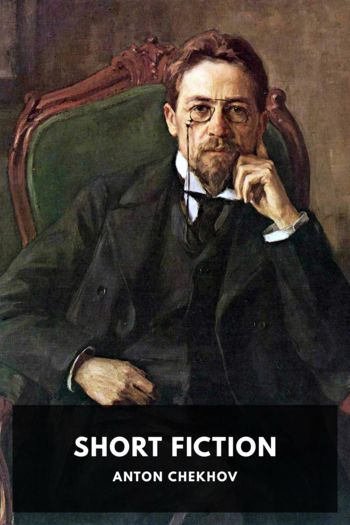
Anton Chekhov is widely considered to be one of the greatest short story writers in history. A physician by day, he’s famously quoted as saying, “Medicine is my lawful wife, and literature is my mistress.” Chekhov wrote nearly 300 short stories in his long writing career; while at first he wrote mainly to make a profit, as his interest in writing—and his skill—grew, he wrote stories that heavily influenced the modern development of the form.
His stories are famous for, among other things, their ambiguous morality and their often inconclusive nature. Chekhov was a firm believer that the role of the artist was to correctly pose a question, but not necessarily to answer it.
This collection contains all of his short stories and two novellas, all translated by Constance Garnett, and arranged by the date they were originally published.
Read free book «Short Fiction by Anton Chekhov (libby ebook reader .txt) 📕» - read online or download for free at americanlibrarybooks.com
- Author: Anton Chekhov
Read book online «Short Fiction by Anton Chekhov (libby ebook reader .txt) 📕». Author - Anton Chekhov
“What are you laughing at the child for?” Pelageya Ivanovna calls from the next room. “You had better show him instead of laughing at him. He’ll get a one again tomorrow, and make me miserable.”
“What is it you don’t understand?” Pavel Vassilitch asks Styopa.
“Why this … division of fractions,” the boy answers crossly. “The division of fractions by fractions. …”
“H’m … queer boy! What is there in it? There’s nothing to understand in it. Learn the rules, and that’s all. … To divide a fraction by a fraction you must multiply the numerator of the first fraction by the denominator of the second, and that will be the numerator of the quotient. … In this case, the numerator of the first fraction. …”
“I know that without your telling me,” Styopa interrupts him, flicking a walnut shell off the table. “Show me the proof.”
“The proof? Very well, give me a pencil. Listen. … Suppose we want to divide seven eighths by two fifths. Well, the point of it is, my boy, that it’s required to divide these fractions by each other. … Have they set the samovar?”
“I don’t know.”
“It’s time for tea. … It’s past seven. Well, now listen. We will look at it like this. … Suppose we want to divide seven eighths not by two fifths but by two, that is, by the numerator only. We divide it, what do we get?”
“Seven sixteenths.”
“Right. Bravo! Well, the trick of it is, my boy, that if we … so if we have divided it by two then. … Wait a bit, I am getting muddled. I remember when I was at school, the teacher of arithmetic was called Sigismund Urbanitch, a Pole. He used to get into a muddle over every lesson. He would begin explaining some theory, get in a tangle, and turn crimson all over and race up and down the classroom as though someone were sticking an awl in his back, then he would blow his nose half a dozen times and begin to cry. But you know we were magnanimous to him, we pretended not to see it. ‘What is it, Sigismund Urbanitch?’ we used to ask him. ‘Have you got toothache?’ And what a set of young ruffians, regular cutthroats, we were, but yet we were magnanimous, you know! There weren’t any boys like you in my day, they were all great hulking fellows, great strapping louts, one taller than another. For instance, in our third class, there was Mamahin. My goodness, he was a solid chap! You know, a regular maypole, seven feet high. When he moved, the floor shook; when he brought his great fist down on your back, he would knock the breath out of your body! Not only we boys, but even the teachers were afraid of him. So this Mamahin used to …”
Pelageya Ivanovna’s footsteps are heard through the door. Pavel Vassilitch winks towards the door and says:
“There’s mother coming. Let’s get to work. Well, so you see, my boy,” he says, raising his voice. “This fraction has to be multiplied by that one. Well, and to do that you have to take the numerator of the first fraction …”
“Come to tea!” cries Pelageya Ivanovna. Pavel Vassilitch and his son abandon arithmetic and go in to tea. Pelageya Ivanovna is already sitting at the table with an aunt who never speaks, another aunt who is deaf and dumb, and Granny Markovna, a midwife who had helped Styopa into the world. The samovar is hissing and puffing out steam which throws flickering shadows on the ceiling. The cats come in from the entry sleepy and melancholy with their tails in the air. …
“Have some jam with your tea, Markovna,” says Pelageya Ivanovna, addressing the midwife. “Tomorrow the great fast begins. Eat well today.”
Markovna takes a heaped spoonful of jam hesitatingly as though it were a powder, raises it to her lips, and with a sidelong look at Pavel Vassilitch, eats it; at once her face is overspread with a sweet smile, as sweet as the jam itself.
“The jam is particularly good,” she says. “Did you make it yourself, Pelageya Ivanovna, ma’am?”
“Yes. Who else is there to do it? I do everything myself. Styopotchka, have I given you your tea too weak? Ah, you have drunk it already. Pass your cup, my angel; let me give you some more.”
“So this Mamahin, my boy, could not bear the French master,” Pavel Vassilitch goes on, addressing his son. “ ‘I am a nobleman,’ he used to shout, ‘and I won’t allow a Frenchman to lord it over me! We beat the French in 1812!’ Well, of course they used to thrash him for it … thrash him dre-ead-fully, and sometimes when he saw they were meaning to thrash him, he would jump out of window, and off he would go! Then for five or six days afterwards he would not show himself at the school. His mother would come to the headmaster and beg him for God’s sake: ‘Be so kind, sir, as to find my Mishka, and flog him, the rascal!’ And the headmaster would say to her: ‘Upon my word, madam, our five porters aren’t a match for him!’ ”
“Good heavens, to think of such ruffians being born,” whispers Pelageya Ivanovna, looking at her husband in horror. “What a trial for the poor mother!”
A silence follows. Styopa yawns loudly, and scrutinises the Chinaman on the tea-caddy whom he has seen a thousand times already. Markovna and the two aunts sip tea carefully out of their saucers. The air is still and stifling from the stove. … Faces and gestures betray the sloth and repletion that comes when the stomach is full, and yet one must go on eating. The samovar, the cups, and the tablecloth are cleared away, but still the family sits on at the table. …



Comments (0)