Short Fiction by Anton Chekhov (libby ebook reader .txt) 📕
Description
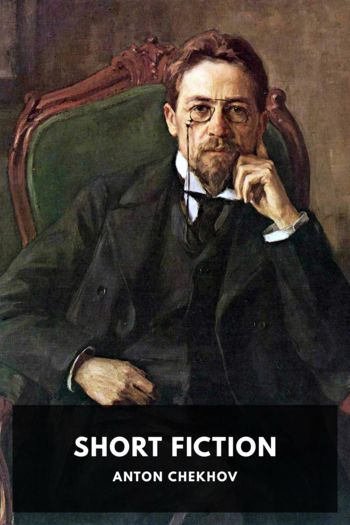
Anton Chekhov is widely considered to be one of the greatest short story writers in history. A physician by day, he’s famously quoted as saying, “Medicine is my lawful wife, and literature is my mistress.” Chekhov wrote nearly 300 short stories in his long writing career; while at first he wrote mainly to make a profit, as his interest in writing—and his skill—grew, he wrote stories that heavily influenced the modern development of the form.
His stories are famous for, among other things, their ambiguous morality and their often inconclusive nature. Chekhov was a firm believer that the role of the artist was to correctly pose a question, but not necessarily to answer it.
This collection contains all of his short stories and two novellas, all translated by Constance Garnett, and arranged by the date they were originally published.
Read free book «Short Fiction by Anton Chekhov (libby ebook reader .txt) 📕» - read online or download for free at americanlibrarybooks.com
- Author: Anton Chekhov
Read book online «Short Fiction by Anton Chekhov (libby ebook reader .txt) 📕». Author - Anton Chekhov
The watchman stands for a minute before the broken window and looks with horror towards the altar. … A little wax candle which the thieves had forgotten to put out flickers in the wind that bursts in at the window and throws dim red patches of light on the vestments flung about and a cupboard overturned on the floor, on numerous footprints near the high altar and the altar of offerings.
A little time passes and the howling wind sends floating over the churchyard the hurried uneven clangs of the alarm-bell. …
Home“Someone came from the Grigoryevs’ to fetch a book, but I said you were not at home. The postman brought the newspaper and two letters. By the way, Yevgeny Petrovitch, I should like to ask you to speak to Seryozha. Today, and the day before yesterday, I have noticed that he is smoking. When I began to expostulate with him, he put his fingers in his ears as usual, and sang loudly to drown my voice.”
Yevgeny Petrovitch Bykovsky, the prosecutor of the circuit court, who had just come back from a session and was taking off his gloves in his study, looked at the governess as she made her report, and laughed.
“Seryozha smoking …” he said, shrugging his shoulders. “I can picture the little cherub with a cigarette in his mouth! Why, how old is he?”
“Seven. You think it is not important, but at his age smoking is a bad and pernicious habit, and bad habits ought to be eradicated in the beginning.”
“Perfectly true. And where does he get the tobacco?”
“He takes it from the drawer in your table.”
“Yes? In that case, send him to me.”
When the governess had gone out, Bykovsky sat down in an armchair before his writing-table, shut his eyes, and fell to thinking. He pictured his Seryozha with a huge cigar, a yard long, in the midst of clouds of tobacco smoke, and this caricature made him smile; at the same time, the grave, troubled face of the governess called up memories of the long past, half-forgotten time when smoking aroused in his teachers and parents a strange, not quite intelligible horror. It really was horror. Children were mercilessly flogged and expelled from school, and their lives were made a misery on account of smoking, though not a single teacher or father knew exactly what was the harm or sinfulness of smoking. Even very intelligent people did not scruple to wage war on a vice which they did not understand. Yevgeny Petrovitch remembered the headmaster of the high school, a very cultured and good-natured old man, who was so appalled when he found a high school boy with a cigarette in his mouth that he turned pale, immediately summoned an emergency committee of the teachers, and sentenced the sinner to expulsion. This was probably a law of social life: the less an evil was understood, the more fiercely and coarsely it was attacked.
The prosecutor remembered two or three boys who had been expelled and their subsequent life, and could not help thinking that very often the punishment did a great deal more harm than the crime itself. The living organism has the power of rapidly adapting itself, growing accustomed and inured to any atmosphere whatever, otherwise man would be bound to feel at every moment what an irrational basis there often is underlying his rational activity, and how little of established truth and certainty there is even in work so responsible and so terrible in its effects as that of the teacher, of the lawyer, of the writer. …
And such light and discursive thoughts as visit the brain only when it is weary and resting began straying through Yevgeny Petrovitch’s head; there is no telling whence and why they come, they do not remain long in the mind, but seem to glide over its surface without sinking deeply into it. For people who are forced for whole hours, and even days, to think by routine in one direction, such free private thinking affords a kind of comfort, an agreeable solace.
It was between eight and nine o’clock in the evening. Overhead, on the second storey, someone was walking up and down, and on the floor above that four hands were playing scales. The pacing of the man overhead who, to judge from his nervous step, was thinking of something harassing, or was suffering from toothache, and the monotonous scales gave the stillness of the evening a drowsiness that disposed to lazy reveries. In the nursery, two rooms away, the governess and Seryozha were talking.
“Pa-pa has come!” carolled the child. “Papa has co-ome. Pa! Pa! Pa!”
“Votre père vous appelle, allez vite!” cried the governess, shrill as a frightened bird. “I am speaking to you!”
“What am I to say to him, though?” Yevgeny Petrovitch wondered.
But before he had time to think of anything whatever his son Seryozha, a boy of seven, walked into the study.
He was a child whose sex could only have been guessed from his dress: weakly, white-faced, and fragile. He was limp like a hothouse plant, and everything about him seemed extraordinarily soft and tender: his movements, his curly hair, the look in his eyes, his velvet jacket.
“Good evening, papa!” he said, in a soft voice, clambering on to his father’s knee and giving him a rapid kiss on his neck. “Did you send for me?”
“Excuse me, Sergey Yevgenitch,” answered the prosecutor, removing him from his knee. “Before kissing we must have a talk, and a serious talk … I am angry with you, and don’t love you any more. I tell you, my boy, I don’t love you, and you are no son of mine. …”
Seryozha looked intently at his father, then shifted his eyes to the table, and shrugged his shoulders.
“What have I done to you?” he asked in perplexity, blinking. “I haven’t been in your study all day, and I haven’t touched anything.”
“Natalya Semyonovna has just been complaining to




Comments (0)