Short Fiction by Anton Chekhov (libby ebook reader .txt) 📕
Description
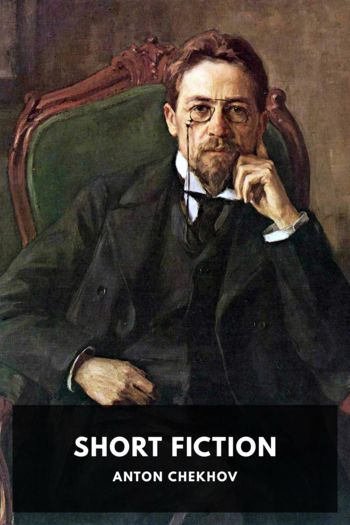
Anton Chekhov is widely considered to be one of the greatest short story writers in history. A physician by day, he’s famously quoted as saying, “Medicine is my lawful wife, and literature is my mistress.” Chekhov wrote nearly 300 short stories in his long writing career; while at first he wrote mainly to make a profit, as his interest in writing—and his skill—grew, he wrote stories that heavily influenced the modern development of the form.
His stories are famous for, among other things, their ambiguous morality and their often inconclusive nature. Chekhov was a firm believer that the role of the artist was to correctly pose a question, but not necessarily to answer it.
This collection contains all of his short stories and two novellas, all translated by Constance Garnett, and arranged by the date they were originally published.
Read free book «Short Fiction by Anton Chekhov (libby ebook reader .txt) 📕» - read online or download for free at americanlibrarybooks.com
- Author: Anton Chekhov
Read book online «Short Fiction by Anton Chekhov (libby ebook reader .txt) 📕». Author - Anton Chekhov
“What a pretty boy!” said the lady. “Whose boy is it? Kazimir Mihalovitch, look what a charming fellow! Good heavens, he is asleep!”
And the lady kissed Yegorushka warmly on both cheeks, and he smiled and, thinking he was asleep, shut his eyes. The swing-door squeaked, and there was the sound of hurried footsteps, coming in and going out.
“Yegorushka, Yegorushka!” he heard two bass voices whisper. “Get up; it is time to start.”
Somebody, it seemed to be Deniska, set him on his feet and led him by the arm. On the way he half-opened his eyes and once more saw the beautiful lady in the black dress who had kissed him. She was standing in the middle of the room and watched him go out, smiling at him and nodding her head in a friendly way. As he got near the door he saw a handsome, stoutly built, dark man in a bowler hat and in leather gaiters. This must have been the lady’s escort.
“Woa!” he heard from the yard.
At the front door Yegorushka saw a splendid new carriage and a pair of black horses. On the box sat a groom in livery, with a long whip in his hands. No one but Solomon came to see the travellers off. His face was tense with a desire to laugh; he looked as though he were waiting impatiently for the visitors to be gone, so that he might laugh at them without restraint.
“The Countess Dranitsky,” whispered Father Christopher, clambering into the chaise.
“Yes, Countess Dranitsky,” repeated Kuzmitchov, also in a whisper.
The impression made by the arrival of the countess was probably very great, for even Deniska spoke in a whisper, and only ventured to lash his bays and shout when the chaise had driven a quarter of a mile away and nothing could be seen of the inn but a dim light.
IVWho was this elusive, mysterious Varlamov of whom people talked so much, whom Solomon despised, and whom even the beautiful countess needed? Sitting on the box beside Deniska, Yegorushka, half asleep, thought about this person. He had never seen him. But he had often heard of him and pictured him in his imagination. He knew that Varlamov possessed several tens of thousands of acres of land, about a hundred thousand sheep, and a great deal of money. Of his manner of life and occupation Yegorushka knew nothing, except that he was always “going his rounds in these parts,” and he was always being looked for.
At home Yegorushka had heard a great deal of the Countess Dranitsky, too. She, too, had some tens of thousands of acres, a great many sheep, a stud farm and a great deal of money, but she did not “go rounds,” but lived at home in a splendid house and grounds, about which Ivan Ivanitch, who had been more than once at the countess’s on business, and other acquaintances told many marvellous tales; thus, for instance, they said that in the countess’s drawing room, where the portraits of all the kings of Poland hung on the walls, there was a big table-clock in the form of a rock, on the rock a gold horse with diamond eyes, rearing, and on the horse the figure of a rider also of gold, who brandished his sword to right and to left whenever the clock struck. They said, too, that twice a year the countess used to give a ball, to which the gentry and officials of the whole province were invited, and to which even Varlamov used to come; all the visitors drank tea from silver samovars, ate all sorts of extraordinary things (they had strawberries and raspberries, for instance, in winter at Christmas), and danced to a band which played day and night. …
“And how beautiful she is,” thought Yegorushka, remembering her face and smile.
Kuzmitchov, too, was probably thinking about the countess. For when the chaise had driven a mile and a half he said:
“But doesn’t that Kazimir Mihalovitch plunder her right and left! The year before last when, do you remember, I bought some wool from her, he made over three thousand from my purchase alone.”
“That is just what you would expect from a Pole,” said Father Christopher.
“And little does it trouble her. Young and foolish, as they say, her head is full of nonsense.”
Yegorushka, for some reason, longed to think of nothing but Varlamov and the countess, particularly the latter. His drowsy brain utterly refused ordinary thoughts, was in a cloud and retained only fantastic fairytale images, which have the advantage of springing into the brain of themselves without any effort on the part of the thinker, and completely vanishing of themselves at a mere shake of the head; and, indeed, nothing that was around him disposed to ordinary thoughts. On the right there were the dark hills which seemed to be screening something unseen and terrible; on the left the whole sky about the horizon was covered with a crimson glow, and it was hard to tell whether there was a fire somewhere, or whether it was the moon about to rise. As by day the distance could be seen, but its tender lilac tint had gone, quenched by the evening darkness, in which the whole steppe was hidden like Moisey Moisevitch’s children under the quilt.
Corncrakes and quails do not call in the July nights, the nightingale does not sing in the woodland marsh, and there is no scent of flowers, but still the steppe is lovely and full of life. As soon as the sun goes down and the darkness enfolds the earth, the day’s weariness is forgotten, everything is forgiven, and the steppe breathes a light sigh from its broad bosom. As though because the grass cannot see in the dark that it has grown old, a gay youthful twitter rises up from it, such as is not heard by day; chirruping, twittering, whistling, scratching, the basses, tenors



Comments (0)