Short Fiction by Anton Chekhov (libby ebook reader .txt) 📕
Description
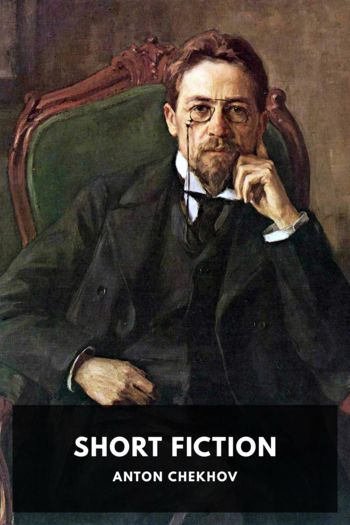
Anton Chekhov is widely considered to be one of the greatest short story writers in history. A physician by day, he’s famously quoted as saying, “Medicine is my lawful wife, and literature is my mistress.” Chekhov wrote nearly 300 short stories in his long writing career; while at first he wrote mainly to make a profit, as his interest in writing—and his skill—grew, he wrote stories that heavily influenced the modern development of the form.
His stories are famous for, among other things, their ambiguous morality and their often inconclusive nature. Chekhov was a firm believer that the role of the artist was to correctly pose a question, but not necessarily to answer it.
This collection contains all of his short stories and two novellas, all translated by Constance Garnett, and arranged by the date they were originally published.
Read free book «Short Fiction by Anton Chekhov (libby ebook reader .txt) 📕» - read online or download for free at americanlibrarybooks.com
- Author: Anton Chekhov
Read book online «Short Fiction by Anton Chekhov (libby ebook reader .txt) 📕». Author - Anton Chekhov
“In the name of the Father, the Son, and the Holy Ghost. … Study,” he said. “Work hard, my lad. If I die, remember me in your prayers. Here is a ten-kopeck piece from me, too. …”
Yegorushka kissed his hand, and shed tears; something whispered in his heart that he would never see the old man again.
“I have applied at the high school already,” said Ivan Ivanitch in a voice as though there were a corpse in the room. “You will take him for the entrance examination on the seventh of August. … Well, goodbye; God bless you, goodbye, Yegor!”
“You might at least have had a cup of tea,” wailed Nastasya Petrovna.
Through the tears that filled his eyes Yegorushka could not see his uncle and Father Christopher go out. He rushed to the window, but they were not in the yard, and the red dog, who had just been barking, was running back from the gate with the air of having done his duty. When Yegorushka ran out of the gate Ivan Ivanitch and Father Christopher, the former waving his stick with the crook, the latter his staff, were just turning the corner. Yegorushka felt that with these people all that he had known till then had vanished from him forever. He sank helplessly on to the little bench, and with bitter tears greeted the new unknown life that was beginning for him now. …
What would that life be like?
LightsThe dog was barking excitedly outside. And Ananyev the engineer, his assistant called Von Schtenberg, and I went out of the hut to see at whom it was barking. I was the visitor, and might have remained indoors, but I must confess my head was a little dizzy from the wine I had drunk, and I was glad to get a breath of fresh air.
“There is nobody here,” said Ananyev when we went out. “Why are you telling stories, Azorka? You fool!”
There was not a soul in sight.
“The fool,” Azorka, a black house-dog, probably conscious of his guilt in barking for nothing and anxious to propitiate us, approached us, diffidently wagging his tail. The engineer bent down and touched him between his ears.
“Why are you barking for nothing, creature?” he said in the tone in which good-natured people talk to children and dogs. “Have you had a bad dream or what? Here, doctor, let me commend to your attention,” he said, turning to me, “a wonderfully nervous subject! Would you believe it, he can’t endure solitude—he is always having terrible dreams and suffering from nightmares; and when you shout at him he has something like an attack of hysterics.”
“Yes, a dog of refined feelings,” the student chimed in.
Azorka must have understood that the conversation was concerning him. He turned his head upwards and grinned plaintively, as though to say, “Yes, at times I suffer unbearably, but please excuse it!”
It was an August night, there were stars, but it was dark. Owing to the fact that I had never in my life been in such exceptional surroundings, as I had chanced to come into now, the starry night seemed to me gloomy, inhospitable, and darker than it was in reality. I was on a railway line which was still in process of construction. The high, half-finished embankment, the mounds of sand, clay, and rubble, the holes, the wheelbarrows standing here and there, the flat tops of the mud huts in which the workmen lived—all this muddle, coloured to one tint by the darkness, gave the earth a strange, wild aspect that suggested the times of chaos. There was so little order in all that lay before me that it was somehow strange in the midst of the hideously excavated, grotesque-looking earth to see the silhouettes of human beings and the slender telegraph posts. Both spoiled the ensemble of the picture, and seemed to belong to a different world. It was still, and the only sound came from the telegraph wire droning its wearisome refrain somewhere very high above our heads.
We climbed up on the embankment and from its height looked down upon the earth. A hundred yards away where the pits, holes, and mounds melted into the darkness of the night, a dim light was twinkling. Beyond it gleamed another light, beyond that a third, then a hundred paces away two red eyes glowed side by side—probably the windows of some hut—and a long series of such lights, growing continually closer and dimmer, stretched along the line to the very horizon, then turned in a semicircle to the left and disappeared in the darkness of the distance. The lights were motionless. There seemed to be something in common between them and the stillness of the night and the disconsolate song of the telegraph wire. It seemed as though some weighty secret were buried under the embankment and only the lights, the night, and the wires knew of it.
“How glorious, O Lord!” sighed Ananyev; “such space and beauty that one can’t tear oneself away! And what an embankment! It’s not an embankment, my dear fellow, but a regular Mont Blanc. It’s costing millions. …”
Going into ecstasies over the lights and the embankment that was costing millions, intoxicated by the wine and his sentimental mood, the engineer slapped Von Schtenberg on the shoulder and went on in a jocose tone:
“Well, Mihail Mihailitch, lost in reveries? No doubt it is pleasant to look at the work of one’s own hands, eh? Last year this very spot was bare steppe, not a sight of human life, and now look: life … civilisation … And how splendid it all is, upon my soul! You and I are building a railway, and after we are gone, in another century or two, good men will build a factory, a school, a hospital, and things will begin to move! Eh!”
The student stood motionless with his hands thrust in his pockets, and did not take his eyes off the lights. He was not listening to the engineer, but was thinking, and was



Comments (0)