Short Fiction by Anton Chekhov (libby ebook reader .txt) 📕
Description
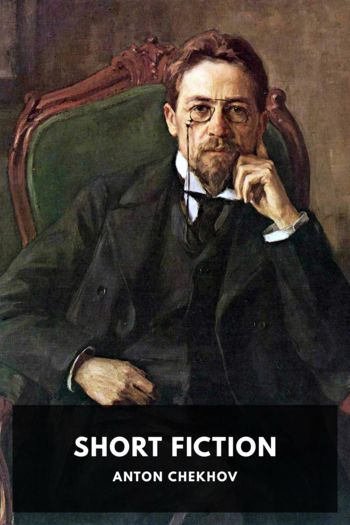
Anton Chekhov is widely considered to be one of the greatest short story writers in history. A physician by day, he’s famously quoted as saying, “Medicine is my lawful wife, and literature is my mistress.” Chekhov wrote nearly 300 short stories in his long writing career; while at first he wrote mainly to make a profit, as his interest in writing—and his skill—grew, he wrote stories that heavily influenced the modern development of the form.
His stories are famous for, among other things, their ambiguous morality and their often inconclusive nature. Chekhov was a firm believer that the role of the artist was to correctly pose a question, but not necessarily to answer it.
This collection contains all of his short stories and two novellas, all translated by Constance Garnett, and arranged by the date they were originally published.
Read free book «Short Fiction by Anton Chekhov (libby ebook reader .txt) 📕» - read online or download for free at americanlibrarybooks.com
- Author: Anton Chekhov
Read book online «Short Fiction by Anton Chekhov (libby ebook reader .txt) 📕». Author - Anton Chekhov
“Our thoughts make no one hot or cold,” the student said reluctantly.
“Ah! there you are again!—do stop it! You have not yet had a good sniff at life. But when you have lived as long as I have you will know a thing or two! Our theory of life is not so innocent as you suppose. In practical life, in contact with human beings, it leads to nothing but horrors and follies. It has been my lot to pass through experiences which I would not wish a wicked Tatar to endure.”
“For instance?” I asked.
“For instance?” repeated the engineer.
He thought a minute, smiled and said:
“For instance, take this example. More correctly, it is not an example, but a regular drama, with a plot and a denouement. An excellent lesson! Ah, what a lesson!”
He poured out wine for himself and us, emptied his glass, stroked his broad chest with his open hands, and went on, addressing himself more to me than to the student.
“It was in the year 187-, soon after the war, and when I had just left the University. I was going to the Caucasus, and on the way stopped for five days in the seaside town of N⸺. I must tell you that I was born and grew up in that town, and so there is nothing odd in my thinking N⸺ extraordinarily snug, cosy, and beautiful, though for a man from Petersburg or Moscow, life in it would be as dreary and comfortless as in any Tchuhloma or Kashira. With melancholy I passed by the high school where I had been a pupil; with melancholy I walked about the very familiar park, I made a melancholy attempt to get a nearer look at people I had not seen for a long time—all with the same melancholy.
“Among other things, I drove out one evening to the so-called Quarantine. It was a small mangy copse in which, at some forgotten time of plague, there really had been a quarantine station, and which was now the resort of summer visitors. It was a drive of three miles from the town along a good soft road. As one drove along one saw on the left the blue sea, on the right the unending gloomy steppe; there was plenty of air to breathe, and wide views for the eyes to rest on. The copse itself lay on the seashore. Dismissing my cabman, I went in at the familiar gates and first turned along an avenue leading to a little stone summerhouse which I had been fond of in my childhood. In my opinion that round, heavy summerhouse on its clumsy columns, which combined the romantic charm of an old tomb with the ungainliness of a Sobakevitch,3 was the most poetical nook in the whole town. It stood at the edge above the cliff, and from it there was a splendid view of the sea.
“I sat down on the seat, and, bending over the parapet, looked down. A path ran from the summerhouse along the steep, almost overhanging cliff, between the lumps of clay and tussocks of burdock. Where it ended, far below on the sandy shore, low waves were languidly foaming and softly purring. The sea was as majestic, as infinite, and as forbidding as seven years before when I left the high school and went from my native town to the capital; in the distance there was a dark streak of smoke—a steamer was passing—and except for this hardly visible and motionless streak and the sea-swallows that flitted over the water, there was nothing to give life to the monotonous view of sea and sky. To right and left of the summerhouse stretched uneven clay cliffs.
“You know that when a man in a melancholy mood is left tête-à-tête with the sea, or any landscape which seems to him grandiose, there is always, for some reason, mixed with melancholy, a conviction that he will live and die in obscurity, and he reflectively snatches up a pencil and hastens to write his name on the first thing that comes handy. And that, I suppose, is why all convenient solitary nooks like my summerhouse are always scrawled over in pencil or carved with penknives. I remember as though it were today; looking at the parapet I read: ‘Ivan Korolkov, May 16, 1876.’ Beside Korolkov some local dreamer had scribbled freely, adding:
“ ‘He stood on the desolate ocean’s strand,
While his soul was filled with imaginings grand.’
“And his handwriting was dreamy, limp like





Comments (0)