Short Fiction by Anton Chekhov (libby ebook reader .txt) 📕
Description
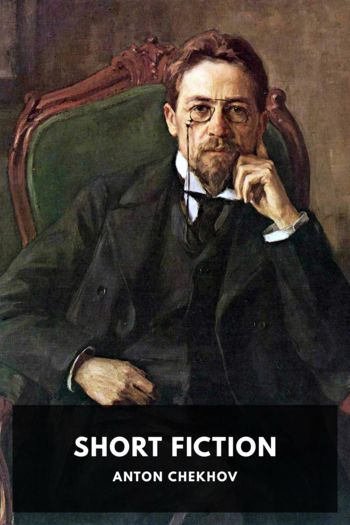
Anton Chekhov is widely considered to be one of the greatest short story writers in history. A physician by day, he’s famously quoted as saying, “Medicine is my lawful wife, and literature is my mistress.” Chekhov wrote nearly 300 short stories in his long writing career; while at first he wrote mainly to make a profit, as his interest in writing—and his skill—grew, he wrote stories that heavily influenced the modern development of the form.
His stories are famous for, among other things, their ambiguous morality and their often inconclusive nature. Chekhov was a firm believer that the role of the artist was to correctly pose a question, but not necessarily to answer it.
This collection contains all of his short stories and two novellas, all translated by Constance Garnett, and arranged by the date they were originally published.
Read free book «Short Fiction by Anton Chekhov (libby ebook reader .txt) 📕» - read online or download for free at americanlibrarybooks.com
- Author: Anton Chekhov
Read book online «Short Fiction by Anton Chekhov (libby ebook reader .txt) 📕». Author - Anton Chekhov
“ ‘Merciful God!’ she said, crying, ‘it’s unbearable. It’s beyond all endurance! I suffer in silence, but I want to live too. … Oh, my God! My God!’
“And so on in the same style.
“I wanted to look at the child and speak to her. So as not to frighten her I first gave a loud sigh and coughed, then cautiously struck a match. … There was a flash of bright light in the darkness, which lighted up the weeping figure. It was Kisotchka!”
“Marvels upon marvels!” said Von Schtenberg with a sigh. “Black night, the murmur of the sea; she in grief, he with a sensation of world—solitude. … It’s too much of a good thing. … You only want Circassians with daggers to complete it.”
“I am not telling you a tale, but fact.”
“Well, even if it is a fact … it all proves nothing, and there is nothing new in it. …”
“Wait a little before you find fault! Let me finish,” said Ananyev, waving his hand with vexation; “don’t interfere, please! I am not telling you, but the doctor. … Well,” he went on, addressing me and glancing askance at the student who bent over his books and seemed very well satisfied at having gibed at the engineer—“well, Kisotchka was not surprised or frightened at seeing me. It seemed as though she had known beforehand that she would find me in the summerhouse. She was breathing in gasps and trembling all over as though in a fever, while her tear-stained face, so far as I could distinguish it as I struck match after match, was not the intelligent, submissive weary face I had seen before, but something different, which I cannot understand to this day. It did not express pain, nor anxiety, nor misery—nothing of what was expressed by her words and her tears. … I must own that, probably because I did not understand it, it looked to me senseless and as though she were drunk.
“ ‘I can’t bear it,’ muttered Kisotchka in the voice of a crying child. ‘It’s too much for me, Nikolay Anastasyitch. Forgive me, Nikolav Anastasyitch. I can’t go on living like this. … I am going to the town to my mother’s. … Take me there. … Take me there, for God’s sake!’
“In the presence of tears I can neither speak nor be silent. I was flustered and muttered some nonsense trying to comfort her.
“ ‘No, no; I will go to my mother’s,’ said Kisotchka resolutely, getting up and clutching my arm convulsively (her hands and her sleeves were wet with tears). ‘Forgive me, Nikolay Anastasyitch, I am going. … I can bear no more. …’
“ ‘Kisotchka, but there isn’t a single cab,’ I said. ‘How can you go?’
“ ‘No matter, I’ll walk. … It’s not far. I can’t bear it. …’
“I was embarrassed, but not touched. Kisotchka’s tears, her trembling, and the blank expression of her face suggested to me a trivial, French or Little Russian melodrama, in which every ounce of cheap shallow feeling is washed down with pints of tears.
“I didn’t understand her, and knew I did not understand her; I ought to have been silent, but for some reason, most likely for fear my silence might be taken for stupidity, I thought fit to try to persuade her not to go to her mother’s, but to stay at home. When people cry, they don’t like their tears to be seen. And I lighted match after match and went on striking till the box was empty. What I wanted with this ungenerous illumination, I can’t conceive to this day. Cold-hearted people are apt to be awkward, and even stupid.
“In the end Kisotchka took my arm and we set off. Going out of the gate, we turned to the right and sauntered slowly along the soft dusty road. It was dark. As my eyes grew gradually accustomed to the darkness, I began to distinguish the silhouettes of the old gaunt oaks and lime trees which bordered the road. The jagged, precipitous cliffs, intersected here and there by deep, narrow ravines and creeks, soon showed indistinctly, a black streak on the right. Low bushes nestled by the hollows, looking like sitting figures. It was uncanny. I looked sideways suspiciously at the cliffs, and the murmur of the sea and the stillness of the country alarmed my imagination. Kisotchka did not speak. She was still trembling, and before she had gone half a mile she was exhausted with walking and was out of breath. I too was silent.
“Three-quarters of a mile from the Quarantine Station there was a deserted building of four storeys, with a very high chimney in which there had once been a steam flour mill. It stood solitary on the cliff, and by day it could be seen for a long distance, both by sea and by land. Because it was deserted and no one lived in it, and because there was an echo in it which distinctly repeated the steps and voices of passersby, it seemed mysterious. Picture me in the dark night arm-in-arm with a woman who was running away from her husband near this tall long monster which repeated the sound of every step I took and stared at me fixedly with its hundred black windows. A normal young man would have been moved to romantic feelings in such surroundings, but I looked at the dark windows and thought: ‘All this is very impressive, but time will come when of that building and of Kisotchka and her troubles and of me with my thoughts, not one grain of dust will remain. … All is nonsense and vanity. …’
“When we reached the flour mill Kisotchka suddenly stopped, took her arm out of mine, and said, no longer in a childish voice, but in her own:
“ ‘Nikolay Anastasvitch, I know all this seems strange to you. But I am terribly unhappy! And you cannot even imagine how unhappy! It’s impossible to imagine it! I don’t



Comments (0)