Short Fiction by Anton Chekhov (libby ebook reader .txt) 📕
Description
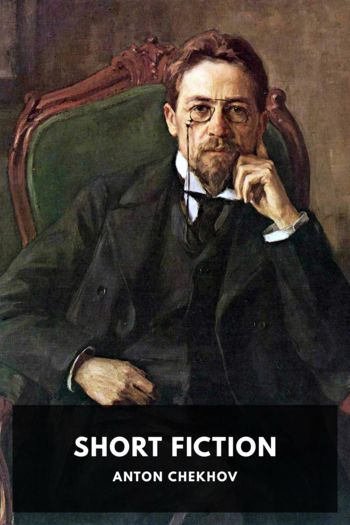
Anton Chekhov is widely considered to be one of the greatest short story writers in history. A physician by day, he’s famously quoted as saying, “Medicine is my lawful wife, and literature is my mistress.” Chekhov wrote nearly 300 short stories in his long writing career; while at first he wrote mainly to make a profit, as his interest in writing—and his skill—grew, he wrote stories that heavily influenced the modern development of the form.
His stories are famous for, among other things, their ambiguous morality and their often inconclusive nature. Chekhov was a firm believer that the role of the artist was to correctly pose a question, but not necessarily to answer it.
This collection contains all of his short stories and two novellas, all translated by Constance Garnett, and arranged by the date they were originally published.
Read free book «Short Fiction by Anton Chekhov (libby ebook reader .txt) 📕» - read online or download for free at americanlibrarybooks.com
- Author: Anton Chekhov
Read book online «Short Fiction by Anton Chekhov (libby ebook reader .txt) 📕». Author - Anton Chekhov
“And I put down my uneasiness to the dread that Kisotchka might turn up any minute and prevent my going away, and that I should have to tell lies and act a part before her. I hurriedly dressed, packed my things, and left the hotel, giving instructions to the porter to take my luggage to the station for the seven o’clock train in the evening. I spent the whole day with a doctor friend and left the town that evening. As you see, my philosophy did not prevent me from taking to my heels in a mean and treacherous flight. …
“All the while that I was at my friend’s, and afterwards driving to the station, I was tormented by anxiety. I fancied that I was afraid of meeting with Kisotchka and a scene. In the station I purposely remained in the toilet room till the second bell rang, and while I was making my way to my compartment, I was oppressed by a feeling as though I were covered all over with stolen things. With what impatience and terror I waited for the third bell!
“At last the third bell that brought my deliverance rang at last, the train moved; we passed the prison, the barracks, came out into the open country, and yet, to my surprise, the feeling of uneasiness still persisted, and still I felt like a thief passionately longing to escape. It was queer. To distract my mind and calm myself I looked out of the window. The train ran along the coast. The sea was smooth, and the turquoise sky, almost half covered with the tender, golden crimson light of sunset, was gaily and serenely mirrored in it. Here and there fishing boats and rafts made black patches on its surface. The town, as clean and beautiful as a toy, stood on the high cliff, and was already shrouded in the mist of evening. The golden domes of its churches, the windows and the greenery reflected the setting sun, glowing and melting like shimmering gold. … The scent of the fields mingled with the soft damp air from the sea.
“The train flew rapidly along. I heard the laughter of passengers and guards. Everyone was good-humoured and lighthearted, yet my unaccountable uneasiness grew greater and greater. … I looked at the white mist that covered the town and I imagined how a woman with a senseless blank face was hurrying up and down in that mist by the churches and the houses, looking for me and moaning, ‘Oh, my God! Oh, my God!’ in the voice of a little girl or the cadences of a Little Russian actress. I recalled her grave face and big anxious eyes as she made the sign of the Cross over me, as though I belonged to her, and mechanically I looked at the hand which she had kissed the day before.
“ ‘Surely I am not in love?’ I asked myself, scratching my hand.
“Only as night came on when the passengers were asleep and I was left tête-à-tête with my conscience, I began to understand what I had not been able to grasp before. In the twilight of the railway carriage the image of Kisotchka rose before me, haunted me and I recognised clearly that I had committed a crime as bad as murder. My conscience tormented me. To stifle this unbearable feeling, I assured myself that everything was nonsense and vanity, that Kisotchka and I would die and decay, that her grief was nothing in comparison with death, and so on and so on … and that if you come to that, there is no such thing as free will, and that therefore I was not to blame. But all these arguments only irritated me and were extraordinarily quickly crowded out by other thoughts. There was a miserable feeling in the hand that Kisotchka had kissed. … I kept lying down and getting up again, drank vodka at the stations, forced myself to eat bread and butter, fell to assuring myself again that life had no meaning, but nothing was of any use. A strange and if you like absurd ferment was going on in my brain. The most incongruous ideas crowded one after another in disorder, getting more and more tangled, thwarting each other, and I, the thinker, ‘with my brow bent on the earth,’ could make out nothing and could not find my bearings in this mass of essential and nonessential ideas. It appeared that I, the thinker, had not mastered the technique of thinking, and that I was no more capable of managing my own brain than mending a watch. For the first time in my life I was really thinking eagerly and intensely, and that seemed to me so monstrous that I said to myself: ‘I am going off my head.’ A man whose brain does not work at all times, but only at painful moments, is often haunted by the thought of madness.
“I spent a day and a night in this misery, then a second night, and learning from experience how little my philosophy was to me, I came to my senses and realised at last what sort of a creature I was. I saw that my ideas were not worth a brass farthing, and that before meeting Kisotchka I had not begun to think and had not even a conception of what thinking in earnest meant; now through suffering I realised that I had neither convictions nor a definite moral standard, nor heart, nor reason; my whole intellectual and moral wealth consisted of specialist knowledge, fragments, useless memories, other people’s ideas—and nothing else; and my mental processes were as lacking in complexity, as useless and as rudimentary as a Yakut’s. … If I had disliked lying, had not stolen, had not murdered, and, in fact, made obviously gross mistakes, that was not owing to my convictions—I had none, but because I was in bondage, hand and foot, to my nurse’s fairy tales and to



Comments (0)