Short Fiction by Anton Chekhov (libby ebook reader .txt) 📕
Description
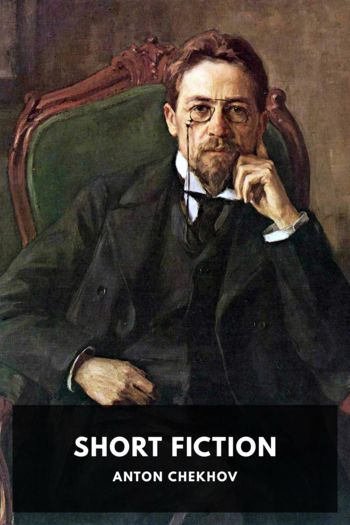
Anton Chekhov is widely considered to be one of the greatest short story writers in history. A physician by day, he’s famously quoted as saying, “Medicine is my lawful wife, and literature is my mistress.” Chekhov wrote nearly 300 short stories in his long writing career; while at first he wrote mainly to make a profit, as his interest in writing—and his skill—grew, he wrote stories that heavily influenced the modern development of the form.
His stories are famous for, among other things, their ambiguous morality and their often inconclusive nature. Chekhov was a firm believer that the role of the artist was to correctly pose a question, but not necessarily to answer it.
This collection contains all of his short stories and two novellas, all translated by Constance Garnett, and arranged by the date they were originally published.
Read free book «Short Fiction by Anton Chekhov (libby ebook reader .txt) 📕» - read online or download for free at americanlibrarybooks.com
- Author: Anton Chekhov
Read book online «Short Fiction by Anton Chekhov (libby ebook reader .txt) 📕». Author - Anton Chekhov
“I realised that I was not a thinker, not a philosopher, but simply a dilettante. God had given me a strong healthy Russian brain with promise of talent. And, only fancy, here was that brain at twenty-six, undisciplined, completely free from principles, not weighed down by any stores of knowledge, but only lightly sprinkled with information of a sort in the engineering line; it was young and had a physiological craving for exercise, it was on the lookout for it, when all at once quite casually the fine juicy idea of the aimlessness of life and the darkness beyond the tomb descends upon it. It greedily sucks it in, puts its whole outlook at its disposal and begins playing with it, like a cat with a mouse. There is neither learning nor system in the brain, but that does not matter. It deals with the great ideas with its own innate powers, like a self-educated man, and before a month has passed the owner of the brain can turn a potato into a hundred dainty dishes, and fancies himself a philosopher. …
“Our generation has carried this dilettantism, this playing with serious ideas into science, into literature, into politics, and into everything which it is not too lazy to go into, and with its dilettantism has introduced, too, its coldness, its boredom, and its one-sidedness and, as it seems to me, it has already succeeded in developing in the masses a new hitherto nonexistent attitude to serious ideas.
“I realised and appreciated my abnormality and utter ignorance, thanks to a misfortune. My normal thinking, so it seems to me now, dates from the day when I began again from the A, B, C, when my conscience sent me flying back to N⸺, when with no philosophical subleties I repented, besought Kisotchka’s forgiveness like a naughty boy and wept with her. …”
Ananyev briefly described his last interview with Kisotchka.
“H’m. …” the student filtered through his teeth when the engineer had finished. “That’s the sort of thing that happens.”
His face still expressed mental inertia, and apparently Ananyev’s story had not touched him in the least. Only when the engineer after a moment’s pause, began expounding his view again and repeating what he had said at first, the student frowned irritably, got up from the table and walked away to his bed. He made his bed and began undressing.
“You look as though you have really convinced someone this time,” he said irritably.
“Me convince anybody!” said the engineer. “My dear soul, do you suppose I claim to do that? God bless you! To convince you is impossible. You can reach conviction only by way of personal experience and suffering!”
“And then—it’s queer logic!” grumbled the student as he put on his nightshirt. “The ideas which you so dislike, which are so ruinous for the young are, according to you, the normal thing for the old; it’s as though it were a question of grey hairs. … Where do the old get this privilege? What is it based upon? If these ideas are poison, they are equally poisonous for all?”
“Oh, no, my dear soul, don’t say so!” said the engineer with a sly wink. “Don’t say so. In the first place, old men are not dilettanti. Their pessimism comes to them not casually from outside, but from the depths of their own brains, and only after they have exhaustively studied the Hegels and Kants of all sorts, have suffered, have made no end of mistakes, in fact—when they have climbed the whole ladder from bottom to top. Their pessimism has both personal experience and sound philosophic training behind it. Secondly, the pessimism of old thinkers does not take the form of idle talk, as it does with you and me, but of weltschmertz, of suffering; it rests in them on a Christian foundation because it is derived from love for humanity and from thoughts about humanity, and is entirely free from the egoism which is noticeable in dilettanti. You despise life because its meaning and its object are hidden just from you, and you are only afraid of your own death, while the real thinker is unhappy because the truth is hidden from all and he is afraid for all men. For instance, there is living not far from here the Crown forester, Ivan Alexandritch. He is a nice old man. At one time he was a teacher somewhere, and used to write something; the devil only knows what he was, but anyway he is a remarkably clever fellow and in philosophy he is A1. He has read a great deal and he is continually reading now. Well, we came across him lately in the Gruzovsky district. … They were laying the sleepers and rails just at the time. It’s not a difficult job, but Ivan Alexandritch, not being a specialist, looked at it as though it were a conjuring trick. It takes an experienced workman less than a minute to lay a sleeper and fix a rail on it. The workmen were in good form and really were working smartly and rapidly; one rascal in particular brought his hammer down with exceptional smartness on the head of the nail and drove it in at one blow, though the handle of the hammer was two yards or more in length and each nail was a foot long. Ivan Alexandritch watched the workmen a long time, was moved, and said to me with tears in his eyes:
“ ‘What a pity that these splendid men will die!’ Such pessimism I understand.”
“All that proves nothing and explains nothing,” said the student, covering himself up with a sheet; “all that is simply pounding liquid in a mortar. No one knows anything and nothing can be proved by words.”
He peeped out from under the sheet, lifted up his head and, frowning irritably, said quickly:
“One must be very naive to believe in human



Comments (0)