Short Fiction by Anton Chekhov (libby ebook reader .txt) 📕
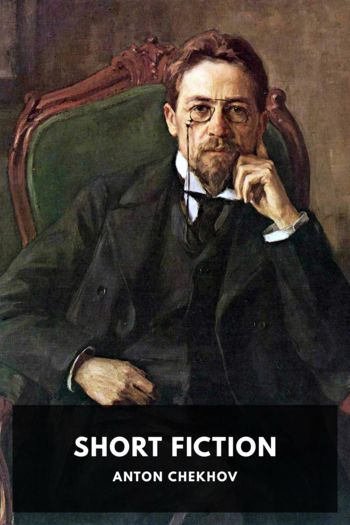
Description
Anton Chekhov is widely considered to be one of the greatest short story writers in history. A physician by day, he’s famously quoted as saying, “Medicine is my lawful wife, and literature is my mistress.” Chekhov wrote nearly 300 short stories in his long writing career; while at first he wrote mainly to make a profit, as his interest in writing—and his skill—grew, he wrote stories that heavily influenced the modern development of the form.
His stories are famous for, among other things, their ambiguous morality and their often inconclusive nature. Chekhov was a firm believer that the role of the artist was to correctly pose a question, but not necessarily to answer it.
This collection contains all of his short stories and two novellas, all translated by Constance Garnett, and arranged by the date they were originally published.
Read free book «Short Fiction by Anton Chekhov (libby ebook reader .txt) 📕» - read online or download for free at americanlibrarybooks.com
- Author: Anton Chekhov
Read book online «Short Fiction by Anton Chekhov (libby ebook reader .txt) 📕». Author - Anton Chekhov
“Plague take you, unclean devils!”
And all the while I was unceasingly hearing her bare feet, and seeing how she walked across the yard with a grave, preoccupied face. She ran now down the steps, swishing the air about me, now into the kitchen, now to the threshing-floor, now through the gate, and I could hardly turn my head quickly enough to watch her.
And the oftener she fluttered by me with her beauty, the more acute became my sadness. I felt sorry both for her and for myself and for the Little Russian, who mournfully watched her every time she ran through the cloud of chaff to the carts. Whether it was envy of her beauty, or that I was regretting that the girl was not mine, and never would be, or that I was a stranger to her; or whether I vaguely felt that her rare beauty was accidental, unnecessary, and, like everything on earth, of short duration; or whether, perhaps, my sadness was that peculiar feeling which is excited in man by the contemplation of real beauty, God only knows.
The three hours of waiting passed unnoticed. It seemed to me that I had not had time to look properly at Masha when Karpo drove up to the river, bathed the horse, and began to put it in the shafts. The wet horse snorted with pleasure and kicked his hoofs against the shafts. Karpo shouted to it: “Ba—ack!” My grandfather woke up. Masha opened the creaking gates for us, we got into the chaise and drove out of the yard. We drove in silence as though we were angry with one another.
When, two or three hours later, Rostov and Nahitchevan appeared in the distance, Karpo, who had been silent the whole time, looked round quickly, and said:
“A fine wench, that at the Armenian’s.”
And he lashed his horses.
IIAnother time, after I had become a student, I was traveling by rail to the south. It was May. At one of the stations, I believe it was between Byelgorod and Harkov, I got out of the tram to walk about the platform.
The shades of evening were already lying on the station garden, on the platform, and on the fields; the station screened off the sunset, but on the topmost clouds of smoke from the engine, which were tinged with rosy light, one could see the sun had not yet quite vanished.
As I walked up and down the platform I noticed that the greater number of the passengers were standing or walking near a second-class compartment, and that they looked as though some celebrated person were in that compartment. Among the curious whom I met near this compartment I saw, however, an artillery officer who had been my fellow-traveler, an intelligent, cordial, and sympathetic fellow—as people mostly are whom we meet on our travels by chance and with whom we are not long acquainted.
“What are you looking at there?” I asked.
He made no answer, but only indicated with his eyes a feminine figure. It was a young girl of seventeen or eighteen, wearing a Russian dress, with her head bare and a little shawl flung carelessly on one shoulder; not a passenger, but I suppose a sister or daughter of the stationmaster. She was standing near the carriage window, talking to an elderly woman who was in the train. Before I had time to realize what I was seeing, I was suddenly overwhelmed by the feeling I had once experienced in the Armenian village.
The girl was remarkably beautiful, and that was unmistakable to me and to those who were looking at her as I was.
If one is to describe her appearance feature by feature, as the practice is, the only really lovely thing was her thick wavy fair hair, which hung loose with a black ribbon tied round her head; all the other features were either irregular or very ordinary. Either from a peculiar form of coquettishness, or from shortsightedness, her eyes were screwed up, her nose had an undecided tilt, her mouth was small, her profile was feebly and insipidly drawn, her shoulders were narrow and undeveloped for her age—and yet the girl made the impression of being really beautiful, and looking at her, I was able to feel convinced that the Russian face does not need strict regularity in order to be lovely; what is more, that if instead of her turn-up nose the girl had been given a different one, correct and plastically irreproachable like the Armenian girl’s, I fancy her face would have lost all its charm from the change.
Standing at the window talking, the girl, shrugging at the evening damp, continually looking round at us, at one moment put her arms akimbo, at the next raised her hands to her head to straighten her hair, talked, laughed, while her face at one moment wore an expression of wonder, the next of horror, and I don’t remember a moment when her face and body were at rest. The whole secret and magic of her beauty lay just in these tiny, infinitely elegant movements, in her smile, in the play of her face, in her rapid glances at us, in the combination of the subtle grace of her movements with her youth, her freshness, the purity of her soul that sounded in her laugh and voice, and with the weakness we love so much in children, in birds, in fawns, and in young trees.
It was that butterfly’s beauty so in keeping with waltzing, darting about the garden, laughter and gaiety, and incongruous with serious thought, grief, and repose; and it seemed as though a gust





Comments (0)