Short Fiction by Anton Chekhov (libby ebook reader .txt) 📕
Description
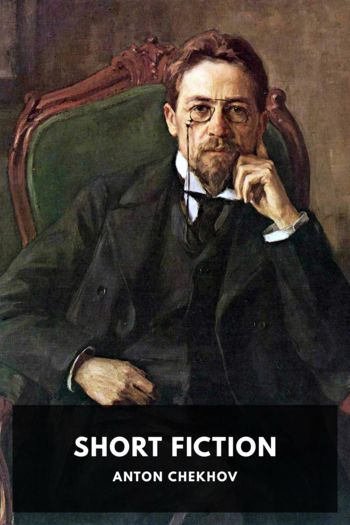
Anton Chekhov is widely considered to be one of the greatest short story writers in history. A physician by day, he’s famously quoted as saying, “Medicine is my lawful wife, and literature is my mistress.” Chekhov wrote nearly 300 short stories in his long writing career; while at first he wrote mainly to make a profit, as his interest in writing—and his skill—grew, he wrote stories that heavily influenced the modern development of the form.
His stories are famous for, among other things, their ambiguous morality and their often inconclusive nature. Chekhov was a firm believer that the role of the artist was to correctly pose a question, but not necessarily to answer it.
This collection contains all of his short stories and two novellas, all translated by Constance Garnett, and arranged by the date they were originally published.
Read free book «Short Fiction by Anton Chekhov (libby ebook reader .txt) 📕» - read online or download for free at americanlibrarybooks.com
- Author: Anton Chekhov
Read book online «Short Fiction by Anton Chekhov (libby ebook reader .txt) 📕». Author - Anton Chekhov
I was not the only one to think the Armenian girl beautiful. My grandfather, an old man of seventy, gruff and indifferent to women and the beauties of nature, looked caressingly at Masha for a full minute, and asked:
“Is that your daughter, Avert Nazaritch?”
“Yes, she is my daughter,” answered the Armenian.
“A fine young lady,” said my grandfather approvingly.
An artist would have called the Armenian girl’s beauty classical and severe, it was just that beauty, the contemplation of which—God knows why!—inspires in one the conviction that one is seeing correct features; that hair, eyes, nose, mouth, neck, bosom, and every movement of the young body all go together in one complete harmonious accord in which nature has not blundered over the smallest line. You fancy for some reason that the ideally beautiful woman must have such a nose as Masha’s, straight and slightly aquiline, just such great dark eyes, such long lashes, such a languid glance; you fancy that her black curly hair and eyebrows go with the soft white tint of her brow and cheeks as the green reeds go with the quiet stream. Masha’s white neck and her youthful bosom were not fully developed, but you fancy the sculptor would need a great creative genius to mold them. You gaze, and little by little the desire comes over you to say to Masha something extraordinarily pleasant, sincere, beautiful, as beautiful as she herself was.
At first I felt hurt and abashed that Masha took no notice of me, but was all the time looking down; it seemed to me as though a peculiar atmosphere, proud and happy, separated her from me and jealously screened her from my eyes.
“That’s because I am covered with dust,” I thought, “am sunburnt, and am still a boy.”
But little by little I forgot myself, and gave myself up entirely to the consciousness of beauty. I thought no more now of the dreary steppe, of the dust, no longer heard the buzzing of the flies, no longer tasted the tea, and felt nothing except that a beautiful girl was standing only the other side of the table.
I felt this beauty rather strangely. It was not desire, nor ecstacy, nor enjoyment that Masha excited in me, but a painful though pleasant sadness. It was a sadness vague and undefined as a dream. For some reason I felt sorry for myself, for my grandfather and for the Armenian, even for the girl herself, and I had a feeling as though we all four had lost something important and essential to life which we should never find again. My grandfather, too, grew melancholy; he talked no more about manure or about oats, but sat silent, looking pensively at Masha.
After tea my grandfather lay down for a nap while I went out of the house into the porch. The house, like all the houses in the Armenian village stood in the full sun; there was not a tree, not an awning, no shade. The Armenian’s great courtyard, overgrown with goosefoot and wild mallows, was lively and full of gaiety in spite of the great heat. Threshing was going on behind one of the low hurdles which intersected the big yard here and there. Round a post stuck into the middle of the threshing-floor ran a dozen horses harnessed side by side, so that they formed one long radius. A Little Russian in a long waistcoat and full trousers was walking beside them, cracking a whip and shouting in a tone that sounded as though he were jeering at the horses and showing off his power over them.
“A—a—a, you damned brutes! … A—a—a, plague take you! Are you frightened?”
The horses, sorrel, white, and piebald, not understanding why they were made to run round in one place and to crush the wheat straw, ran unwillingly as though with effort, swinging their tails with an offended air. The wind raised up perfect clouds of golden chaff from under their hoofs and carried it away far beyond the hurdle. Near the tall fresh stacks peasant women were swarming with rakes, and carts were moving, and beyond the stacks in another yard another dozen similar horses were running round a post, and a similar Little Russian was cracking his whip and jeering at the horses.
The steps on which I was sitting were hot; on the thin rails and here and there on the window-frames sap was oozing out of the wood from the heat; red ladybirds were huddling together in the streaks of shadow under the steps and under the shutters. The sun was baking me on my head, on my chest, and on my back, but I did not notice it, and was conscious only of the thud of bare feet on the uneven floor in the passage and in the rooms behind me. After clearing away the tea-things, Masha ran down the steps, fluttering the air as she passed, and like a bird flew into a little grimy outhouse—I suppose the kitchen—from which came the smell of roast mutton and the sound of angry talk in Armenian. She vanished into the dark doorway, and in her place there appeared on the threshold an old bent, red-faced Armenian woman wearing green trousers. The old woman was angry and was scolding someone. Soon afterwards Masha appeared in the doorway, flushed with the heat of the kitchen and carrying a big black loaf on her shoulder; swaying gracefully under the weight of the bread, she ran across the yard to the threshing-floor, darted over the hurdle, and, wrapt in a cloud of golden chaff, vanished




Comments (0)